Climate Change of the Arctic and Antarctica.
The melting of sea ice will significantly increase Arctic precipitation, creating a climate feedback comparable to doubling global carbon dioxide
http://www.sciencedaily.com/releases/2015/12/151221193418.htm
Another Major Glacier comes undone in Greenland
http://www.jpl.nasa.gov/news/news.php?feature=4771&utm_source=iContact&utm_medium=email&utm_campaign=NASAJPL&utm_content=Daily20151112-4
Antarctic snow accumulation that began 10,000 years ago is currently adding enough ice to the continent to outweigh the increased losses from its thinning glaciers http://www.sciencedaily.com/releases/2015/10/151030220523.htm
Two degree Celsius warming locks in sea level rise for thousands of years
Posted: 18 Oct 2015 06:38 PM PDT
A jump in global average temperatures of 1.5°C to 2°C will see the collapse of Antarctic ice shelves and lead to hundreds and even thousands of years of sea level rise, according to new research.
Melting of Antarctic ice shelves set to intensify
Posted: 12 Oct 2015 08:57 AM PDT
New research projects a doubling of surface melting of Antarctic ice shelves by 2050 and that by 2100 melting may surpass intensities associated with ice shelf collapse, if greenhouse gas emissions from fossil fuel consumption continue at the present rate.
Greenlands plumbing system is revealed:
http://www.sciencedaily.com/releases/2015/10/151009083035.htm
NASA researchers have found that ice covering Greenland is melting faster than previously thought.
FULL STORY: http://science.nasa.gov/science-news/science-at-nasa/2015/28aug_greenland/
Burning remaining fossil fuel could cause 60-meter sea level rise
http://www.sciencedaily.com/releases/2015/09/150911164146.htm
CBS report on Alaskan glacial ice melting at a rapid rate.
Ocean rise from the melting of Greenland’s and Antarctica’s Ice:
Greenland’s acceleration since 1994 is a constant 8.2% per year.


 At
this rate, Greenland’s Ice is completely gone by 2100 which results in a 20
At
this rate, Greenland’s Ice is completely gone by 2100 which results in a 20
foot ocean rise. http://egpreston.com/GreenlandIcemelt3.xls
Most comprehensive projections for West Antarctica's future revealed http://www.sciencedaily.com/releases/2015/08/150818085745.htm
Cyclone over Greenland in 2011 - rainfall caused extensive ice melt
http://www.sciencedaily.com/releases/2015/07/150713113447.htm
20 foot geological ocean rise only required 1 to 2 degrees temperature rise http://www.sciencedaily.com/releases/2015/07/150709145159.htm
Greenland interior ice melt water is accumulating and not draining:
http://www.sciencedaily.com/releases/2015/06/150603182008.htm
Eventually this weakened ice and water will collapse catastrophically all the way to the coast of Greenland if it does not drain away from the interior, which seems to be the case, thus the buildup is likely to result in a catastrophic outcome later.
The mechanisms for how the ice cracks draining lakes in Greenland is finally understood. The meltwater plunges to the base of Greenland’s ice sheet. Eventually the ice sheet above will float to the ocean in a catastrophic event. When will this happen?
http://www.sciencedaily.com/releases/2015/06/150603132250.htm
Antarctic ice is melting from above and below:
http://www.sciencedaily.com/releases/2015/05/150513083739.htm
http://www.jpl.nasa.gov/news/news.php?feature=4589
Antartica ice melting increasingly faster.
http://www.sciencedaily.com/releases/2015/04/150430191140.htm
|
Antarctic ice shelves rapidly thinning Posted: 26 Mar 2015 12:14 PM PDT A new study
has revealed that the thickness of Antarctica's floating ice shelves has
recently decreased by as much as 18 percent in certain areas over nearly two
decades, providing new insights on how the Antarctic ice sheet is responding
to climate change. |
Climate change: Scientist investigates changing sea levels
Posted: 17 Mar 2015 06:28 AM PDT
The sea level
has been rising by an average of 3.1 millimeters a year since 1993. Long-term
measurements recorded since the start of the 20th century indicate an acceleration
in the averaged sea level change. Coastal flooding and land loss are just some
of the potential consequences.
Greenland’s ice melt 8000-5000 years ago gives us a clue to what to expect today which is a warming much more rapidly than it did 8000 years ago although the temperature rise is expected to be about the same. The 16 cm isn’t much rise. But today Greenland’s rate of ice melting is much greater than 8000-5000 years ago.
http://www.sciencedaily.com/releases/2015/02/150220094805.htm
Posted: 12 Feb 2015 12:45 PM PST
During the
second half of the 21st century, the US Southwest and Great Plains will face
persistent drought worse than anything seen in times ancient or modern, with
the drying conditions 'driven primarily' by human-induced global warming, a new
study predicts.
http://www.sciencedaily.com/releases/2015/02/150203094326.htm
Antarctica ice is protected by floating sea ice surrounding the continent. This keeps ice on the land from melting. In the past the earth's orbit changed and melted some of the sea ice resulting in some of Antarctica's ice melting. They can see that melting history in the ice and sediment and we know the Earth's orbit history. The study says the CO2 effect is greater than the Earth's orbit effect in the past. Basically what the scientists are saying is that Antarctica is now going to be subject to much more land mass ice melting as the sea ice shield is disappearing which causes inland ice melting. This has the potential for eventually raising the oceans "dozens of meters."
Univ. of Texas produces radar history of the Greenland ice sheet:
http://www.sciencedaily.com/releases/2015/01/150123140943.htm
and others made this neat video:
Arctic ice cap slides into the ocean
Posted: 23 Jan 2015 05:17 AM PST
Satellite images
have revealed that a remote Arctic ice cap has thinned by more than 50 metres
since 2012 -- about one sixth of its original thickness -- and that it is now
flowing 25 times faster. The findings show that over the last two decades, ice
loss from the south-east region of Austfonna, located in the Svalbard
archipelago, has increased significantly. In this time, ice flow has
accelerated to speeds of several kilometres per year, and ice thinning has
spread more than 50km inland -- to within 10km of the summit.
Two lakes beneath Greenland disappear within weeks.
http://www.sciencedaily.com/releases/2015/01/150121135156.htm
Climate Mission Impossible: Scientists Say Fossil Fuels Must Go Untapped
How did Greenland acquire its ice sheets? Here is how:
http://www.sciencedaily.com/releases/2015/01/150105112506.htm
Average temperature in Finland has risen by more than two degrees in the past 166 years (I assume the temp is in C although the article doesn’t say.)
http://www.sciencedaily.com/releases/2014/12/141222084307.htm
Massive study provides first detailed look at how Greenland's ice is vanishing
http://www.pnas.org/content/early/2014/12/12/1411680112
http://www.pnas.org/content/suppl/2014/12/13/1411680112.DCSupplemental
http://www.sciencedaily.com/releases/2014/12/141215154522.htm
Migrating 'supraglacial' lakes could trigger future Greenland ice loss
http://www.sciencedaily.com/releases/2014/12/141215114059.htm
West Antarctica Ice melting rate tripled in the past decade. This is an acceleration rate of 11.6% per year.
http://www.sciencedaily.com/releases/2014/12/141202183313.htm
Greenland Ice Sheet more vulnerable to climate change than previously thought
http://www.sciencedaily.com/releases/2014/09/140929090553.htm
Discrepancy in Greenland
temperatures during end of last ice age resolved A new
study of three ice cores from Greenland documents the warming of the large ice
sheet at the end of the last ice age -- resolving a long-standing paradox over
when that warming occurred. http://www.sciencedaily.com/releases/2014/09/140904141953.htm
Cause of global warming hiatus found deep in the Atlantic Ocean
Posted: 21 Aug 2014 11:14 AM PDT
Observations
show that the heat absent from the Earth's surface for more than a decade is
plunging deep in the north and south Atlantic Ocean, and is part of a naturally
occurring cycle. Subsurface warming in the ocean explains why global average
air temperatures have flatlined since 1999, despite greenhouse gases trapping
more solar heat at Earth's surface.
Sunlight, not microbes, key to carbon dioxide in Arctic
Posted: 21 Aug 2014 11:15 AM PDT
The vast
reservoir of carbon stored in Arctic permafrost is gradually being converted to
carbon dioxide after entering the freshwater system in a process thought to be
controlled largely by microbial activity. However, researchers say that
sunlight and not bacteria is the key to triggering the production of CO2 from
material released by Arctic soils.
Record decline of ice sheets: Scientists map elevation changes of Greenlandic and Antarctic glaciers
Posted: 20 Aug 2014 08:05 AM PDT
Researchers have
for the first time extensively mapped Greenland's and Antarctica's ice sheets
with the help of the ESA satellite CryoSat-2 and have thus been able to prove
that the ice crusts of both regions momentarily decline at an unprecedented
rate. In total the ice sheets are losing around 500 cubic kilometers of ice per
year.
Ocean warming could drive heavy rain bands toward poles
http://www.sciencedaily.com/releases/2014/08/140818113219.htm
Finally scientists are waking up to the fact that the ice is melting faster than earlier models predicted.
http://www.sciencedaily.com/releases/2014/08/140813182259.htm
The blow holes in the Siberian tundra may also be methane gas releases.
Scientists discover vast methane plumes escaping from the arctic seafloor
http://earthsky.org/earth/scientists-discover-vast-methane-plumes-escaping-from-arctic-seafloor
Changing Antarctic winds create new sea level threat
New research
shows projected changes in the winds circling the Antarctic may accelerate
global sea level rise significantly more than previously estimated. Changes to
Antarctic winds have already been linked to southern Australia's drying climate
but now it appears they may also have a profound impact on warming ocean
temperatures under the ice shelves along the coastline of West and East
Antarctic.
Understanding the ocean's role in Greenland glacier melt
Posted: 23 Jun 2014 12:51 PM PDT
The Greenland
Ice Sheet is a 1.7 million-square-kilometer, 2-mile thick layer of ice that
covers Greenland. Its fate is inextricably linked to our global climate system.
Melting and refreezing of deep Greenland ice speeds flow to
sea: Findings may shift understanding of ice sheet behavior Posted: 15 Jun
2014 11:38 AM PDT
http://www.sciencedaily.com/releases/2014/06/140615143832.htm?utm_source=feedburner&utm_medium=email&utm_campaign=Feed%3A+sciencedaily%2Fearth_climate+%28Earth+%26+Climate+News+--+ScienceDaily%29
Researchers have found evidence of widespread refreezing of ice at the bottom
of the Greenland Ice Sheet; some of these features coincide with faster flows.
The newly revealed forms may help scientists understand more about how ice
sheets behave and how they will respond to a warming climate.
Major West Antarctic glacier melting from geothermal sources (June 9, 2014) -- New research on the Thwaits Glacier will help ice sheet modeling efforts needed to determine when the collapse of the glacier will begin in earnest and at what rate the sea level will increase as it proceeds. ... > full story
KPBS interview on Antarctica ice melting. http://www.kpbs.org/news/2014/jun/02/studies-show-west-antartic-ice-sheet-collapsing/
Solving the puzzle of ice age climates: Southern Ocean and explanation for 'Last Glacial Maximum' (June 2, 2014) -- The paleoclimate record for the last ice age -- a time 21,000 years ago called the "Last Glacial Maximum" (LGM) -- tells of a cold Earth whose northern continents were covered by vast ice sheets. Chemical traces from plankton fossils in deep-sea sediments reveal rearranged ocean water masses, as well as extended sea ice coverage off Antarctica. Air bubbles in ice cores show that carbon dioxide in the atmosphere was far below levels seen before the Industrial Revolution. ... > full story
Antarctic Ice Sheet unstable at end of last ice age (May 28, 2014) -- A new study has found that the Antarctic Ice Sheet began melting about 5,000 years earlier than previously thought coming out of the last ice age -- and that shrinkage of the vast ice sheet accelerated during eight distinct episodes, causing rapid sea level rise. ... > full story
Greenland will be far greater contributor to sea rise than expected: Work reveals long, deep valleys connecting ice cap to ocean (May 18, 2014) -- Greenland's icy reaches are far more vulnerable to warm ocean waters from climate change than had been thought, according to new research by glaciologists. The work shows previously uncharted deep valleys stretching for dozens of miles under the Greenland Ice Sheet. ... > full story also see http://www.jpl.nasa.gov/news/news.php?release=2014-155&2&utm_source=iContact&utm_medium=email&utm_campaign=NASAJPL&utm_content=daily20140519
Climate change, forest fires drove widespread surface melting of Greenland ice sheet (May 19, 2014) -- Rising temperatures and ash from Northern Hemisphere forest fires combined to cause large-scale surface melting of the Greenland ice sheet in 1889 and 2012, contradicting conventional thinking that the melt events were driven by warming alone, a new study finds. ... > full story
Antarctica's ice losses on the rise (May 19, 2014) -- Three years of observations show that the Antarctic ice sheet is now losing 159 billion tons of ice each year -- twice as much as when it was last surveyed. Scientists have now produced the first complete assessment of Antarctic ice sheet elevation change. ... > full story
West Antarctic glacier loss appears unstoppable (May 12, 2014) -- A new study finds a rapidly melting section of the West Antarctic Ice Sheet appears to be in an irreversible state of decline, with nothing to stop the glaciers in this area from melting into the sea. The study presents multiple lines of evidence, incorporating 40 years of observations that indicate the glaciers in the Amundsen Sea sector of West Antarctica "have passed the point of no return," according to the lead author. ... > full story
Ocean winds keep Antarctica cold, Australia dry (May 11, 2014) -- New research has explained why Antarctica is not warming as much as other continents, and why southern Australia is recording more droughts. Researchers have found rising levels of carbon dioxide in the atmosphere are strengthening the stormy Southern Ocean winds which deliver rain to southern Australia, but pushing them further south towards Antarctica. ... > full story
U.S. Climate Has Already Changed, Study Finds, Citing Heat and Floods John Holdren, declaring that the issue of human-induced climate change had “moved firmly into the present,” a major study found that water shortages, torrential rains, heat waves and wildfires are worsening.
Uncontrollable ice-melt? Uncorking East Antarctica could yield unstoppable sea-level rise, simulations show (May 5, 2014) -- The melting of a rather small ice volume on East Antarctica's shore could trigger a persistent ice discharge into the ocean, resulting in unstoppable sea-level rise for thousands of years to come. These findings are based on computer simulations of the Antarctic ice flow using improved data of the ground profile underneath the ice sheet. ... > full story
Why Arctic ice is disappearing more rapidly than expected: River ice reveals new twist on Arctic melt (April 2, 2014) -- A new study has discovered unexpected climate-driven changes in the mighty Mackenzie River's ice breakup. This discovery may help resolve the complex puzzle underlying why Arctic ice is disappearing more rapidly than expected. ... > full story
Northeast Greenland ice loss accelerating, researchers say (March 16, 2014) -- The last remaining stable portion of the Greenland ice sheet is stable no more, an international team of scientists has discovered. The finding will likely boost estimates of expected global sea level rise in the future. The new result focuses on ice loss due to a major retreat of an outlet glacier connected to a long "river" of ice -- known as an ice stream -- that drains ice from the interior of the ice sheet. The Zachariae ice stream retreated about 20 kilometers (12.4 miles) over the last decade, the researchers concluded. For comparison, one of the fastest moving glaciers, the Jakobshavn ice stream in southwest Greenland, has retreated 35 kilometers (21.7 miles) over the last 150 years. ... > full story
Big thaw projected for Antarctic sea ice: Ross Sea will reverse current trend, be largely ice free in summer by 2100 (February 27, 2014) -- A new modeling study suggests that a recent observed increase in summer sea-ice cover in Antarctica's Ross Sea is likely short-lived, with the area projected to lose more than half its summer sea ice by 2050 and more than three quarters by 2100. These changes will significantly impact marine life in what is one of the world's most productive and unspoiled marine ecosystems. ... > full story
Climate change: No warming hiatus for extreme hot temperatures (February 26, 2014) -- While there are claims that there has been a hiatus in global average temperatures, no such hiatus has occurred at the extreme end of the temperature spectrum. New research shows extremely hot temperatures over land have dramatically and unequivocally increased in number and area despite claims that the rise in global average temperatures has slowed over the past 10 to 20 years. ... > full story
Climate engineering: Minor potential, major risk of side-effects? (February 25, 2014) -- Researchers have studied with computer simulations the long-term global consequences of several 'climate engineering' methods. They show that all the proposed methods would either be unable to significantly reduce global warming if CO2 emissions remain high, or they could not be stopped without causing dangerous climate disruption. ... > full story
Volcanoes contribute to recent global warming 'hiatus' (February 24, 2014) -- Volcanic eruptions in the early part of the 21st century have cooled the planet, according to a new study. This cooling partly offset the warming produced by greenhouse gases. ... > full story
Los Angeles' vulnerability to future sea level rise projected (February 18, 2014) -- Los Angeles, a metropolis perched on the edge of a coast, can expect to experience sea level rise of as much as two feet due by 2050 due to climate change, according to current projections. http://www.sciencedaily.com/releases/2014/02/140218184824.htm
If You See Something, Say Something
Climate scientists can no longer stay on the sidelines of the global warming debate.
The Flood Next Time By JUSTIN GILLIS
The numbers are unmistakable, scientists say. Global sea levels are rising, while land along the East Coast is sinking. Just ask Norfolk, Va.
Antarctica's Pine Island Glacier sensitive to climatic variability (January 2, 2014) -- The thinning of Pine Island Glacier in West Antarctica is much more susceptible to climatic and ocean variability than at first thought, according to new research. ... > full story
Greenland ice stores liquid water year-round (December 22, 2013) -- Researchers have found an extensive reservoir in the Greenland Ice Sheet that holds water year round. A surprising discovery, the existence of the 27,000 square mile aquifer adds important information to sea level rise calculations. ... > full story
Rapid climate changes at end of last glaciation, but with 120 year time lag (December 4, 2013) -- Regional climate changes can be very rapid. Geoscientists now report that such a rapid climate change occurred in different regions with a time difference of 120 years. Investigation in the west German Eifel region and in southern Norway demonstrated that at the end of the last glaciation about 12,240 years before present climate became warmer, first recognized in the Eifel region and 120 years later in southern Norway. Nonetheless, the warming was equally rapid in both regions. ... > full story
Sea-level rise to drive coastal flooding, regardless of change in cyclone activity (December 4, 2013) -- Though recent studies focus on climate change impacts on intensity and frequency of tropical cyclones, a new review shows that sea level rise and shoreline retreat are the two more certain factors expected to drive an increase in future flood risk. ... > full story
Airborne radar looking through thick ice during NASA polar campaigns (December 2, 2013) -- The bedrock hidden beneath the thick ice sheets covering Greenland and Antarctica has intrigued researchers for years. Scientists are interested in how the shape of this hidden terrain affects how ice moves -- a key factor in making predictions about the future of these massive ice reservoirs and their contribution to sea level rise in a changing climate. ... > full story
Lakes discovered beneath Greenland ice sheet (November 27, 2013) -- Scientists have discovered two subglacial lakes 800 meters below the Greenland Ice Sheet. Subglacial lakes are likely to influence the flow of the ice sheet, impacting global sea level change. The discovery of the lakes in Greenland will also help researchers to understand how the ice will respond to changing environmental conditions. ... > full story
Even if emissions stop, carbon dioxide could warm Earth for centuries (November 24, 2013) -- Research suggests that even if carbon-dioxide emissions came to a sudden halt, the carbon dioxide already in Earth's atmosphere could continue to warm our planet for hundreds of years. Thus, it might take a lot less carbon than previously thought to reach the global temperature scientists deem unsafe. ... > full story
Greenland's shrunken ice sheet: We've been here before (November 22, 2013) -- Think Greenland’s ice sheet is small today? It was smaller — as small as it's been in recent history — from 3-5,000 years ago, according to scientists who studied the ice sheet’s history using a new technique they developed for interpreting the Arctic fossil record. ... > full story
Sea level rise forecasts helped by insights into glacier melting (November 22, 2013) -- Predictions of sea level rise could become more accurate, thanks to new insight into how glacier movement is affected by melting ice in summer. ... > full story
Expert assessment: Sea-level rise could exceed one meter in this century (November 22, 2013) -- Sea-level rise in this century is likely to be 70-120 centimeters by 2100 if greenhouse-gas emissions are not mitigated, a broad assessment of the most active scientific publishers on that topic has revealed. The 90 experts participating in the survey anticipate a median sea-level rise of 200-300 centimeters by the year 2300 for a scenario with unmitigated emissions. ... > full story
Solar activity playing a minimal role in global warming, research suggests (November 7, 2013) -- Changes in solar activity have contributed no more than 10 per cent to global warming in the twentieth century, a new study has found. ... > full story
The deep Greenland Sea is warming faster than the world ocean (September 25, 2013) -- Recent warming of the Greenland Sea Deep Water is about ten times higher than warming rates estimated for the global ocean. Scientists analyzed temperature data from 1950 to 2010 in the abyssal Greenland Sea, which is an ocean area located just to the south of the Arctic Ocean. ... > full story
Underlying ocean melts ice shelf, speeds up glacier movement (September 12, 2013) -- Warm ocean water, not warm air, is melting the Pine Island Glacier's floating ice shelf in Antarctica and may be the culprit for increased melting of other ice shelves, according to an international team of researchers. ... > full story
http://www.sciencedaily.com/releases/2013/09/130912143946.htm
West Antartica ice sheet is discussed here: http://www.sciencedaily.com/releases/2013/09/130904141054.htm
East Antarctic Ice Sheet could be more vulnerable to climate change than previously thought (August 28, 2013) -- The world's largest ice sheet could be more vulnerable to the effects of climate change than previously thought, according to new research. ... > full story
Climate Panel Cites Near Certainty on Warming
As Sea Levels Rise, Timing Could Make All The Difference
http://www.bendbulletin.com/article/20130813/NEWS0107/308130317/
Greenland ice is melting -- even from below: Heat flow from the mantle contributes to the ice melt (August 11, 2013) -- The Greenland ice sheet is melting from below, caused by a high heat flow from the mantle into the lithosphere. This influence is very variable spatially and has its origin in an exceptionally thin lithosphere. Consequently, there is an increased heat flow from the mantle and a complex interplay between this geothermal heating and the Greenland ice sheet. New research finds that this effect cannot be neglected when modeling the ice sheet as part of a climate study. ... > full story
Three-decade decline in reflectivity of Arctic sea ice (August 8, 2013) -- The reflectivity of Arctic sea ice, or albedo, regulates the solar radiation balance. A diminishing albedo affects the melt rate of Arctic sea ice. ... > full story
Arctic Ocean more vulnerable to human-induced changes than Antarctic Ocean (August 6, 2013) -- Scientists have found evidence suggesting that the Arctic Ocean is more vulnerable to human-induced changes than the Antarctic Ocean. ... > full story
Carbon emissions to impact climate beyond the day after tomorrow (August 5, 2013) -- Future warming from fossil fuel burning could be more intense and longer-lasting than previously thought. This prediction emerges from a new study that includes insights from episodes of climate change in the geologic past to inform projections of human-made future climate change. ... > full story
Planetary 'runaway greenhouse' more easily triggered, research shows (July 30, 2013) -- It might be easier than previously thought for a planet to overheat into the scorchingly uninhabitable "runaway greenhouse" stage, according to new research. ... > full story
Ice-free Arctic winters could explain amplified warming during Pliocene (July 29, 2013) -- Year-round ice-free conditions across the surface of the Arctic Ocean could explain why the Earth was substantially warmer during the Pliocene Epoch than it is today, despite similar concentrations of carbon dioxide in the atmosphere, according to new research. ... > full story
Sea level rise: New iceberg theory points to areas at risk of rapid disintegration (July 22, 2013) -- In events that could exacerbate sea level rise over the coming decades, stretches of ice on the coasts of Antarctica and Greenland are at risk of rapidly cracking apart and falling into the ocean, according to new iceberg calving simulations. ... > full story
The Aussies finally figure out the mechanisms that are causing rapid climate change at the present time. This is a must see film. http://www.abc.net.au/catalyst/stories/3796205.htm
Greenland's 2013 Summer Melt Underway
http://earthobservatory.nasa.gov/IOTD/view.php?id=81569&src=eoa-iotd
El Nino unusually active in the late 20th century: Is it because of global warming? (June 30, 2013) -- Reliable prediction of El Nino response to global warming is difficult, as El Nino varies naturally over decades and centuries. Instrumental records are too short to determine whether recent changes are natural or attributable to increased greenhouse gases. An international team of scientists now show that recent El Nino activity is the highest for the past 700 years, possibly a response to global warming. ... > full story
Humans play role in Australia's 'angry' hot summer (June 27, 2013) -- Human influences through global warming are likely to have played a role in Australia's recent "angry" hot summer, the hottest in Australia's observational record, new research has found. ... > full story
Climate tug of war disrupting Australian atmospheric circulation patterns (June 26, 2013) -- Further evidence of climate change shifting atmospheric circulation in the southern Australian-New Zealand region has been identified in a new study. ... > full story
NASA Science News for June 24, 2013
Arctic permafrost soils contain more accumulated carbon than all the human fossil-fuel emissions since 1850 combined. Warming permafrost, poised to release its own gases into the atmosphere, could be the "sleeping giant" of climate change. VIDEO: http://www.youtube.com/watch?v=hZSM8GcmJKg FULL STORY: http://science.nasa.gov/science-news/science-at-nasa/2013/24jun_permafrost/
Jet stream changes cause climatically exceptional Greenland Ice Sheet melt (June 17, 2013) -- Scientists have shown that unusual changes in atmospheric jet stream circulation caused the exceptional surface melt of the Greenland Ice Sheet in summer 2012. ... > full story
Warm ocean drives most Antarctic ice shelf loss (June 13, 2013) -- Ocean waters melting the undersides of Antarctic ice shelves, not icebergs calving into the sea, are responsible for most of the continent's ice loss, a new study has found. ... > full story
Carbon dioxide at NOAA's Mauna Loa Observatory reaches new milestone: Tops 400 parts per million (May 10, 2013) -- On May 9, the daily mean concentration of carbon dioxide in the atmosphere of Mauna Loa, Hawaii, surpassed 400 parts per million (ppm) for the first time since measurements began in 1958. Independent measurements made by both NOAA and the Scripps Institution of Oceanography have been approaching this level during the past week. It marks an important milestone because Mauna Loa, as the oldest continuous carbon dioxide measurement station in the world, is the primary global benchmark site for monitoring the increase of this potent heat-trapping gas.
Ice-free Arctic may be in our future, international researchers say (May 9, 2013) -- Analyses of the longest continental sediment core ever collected in the Arctic provide "absolutely new knowledge" of Arctic climate from 2.2 to 3.6 million years ago. The research has major implications for understanding how the Arctic transitioned from a forested landscape without ice sheets to the ice- and snow-covered land we know today.
New insight into accelerating summer ice melt on the Antarctic Peninsula (April 14, 2013) -- A new 1,000-year Antarctic Peninsula climate reconstruction shows that summer ice melting has intensified almost 10-fold, and mostly since the mid-20th century. Summer ice melt affects the stability of Antarctic ice shelves and glaciers.
Recent Antarctic climate, glacier changes at the 'upper bound' of normal (April 14, 2013) -- In the last few decades, glaciers at the edge of the icy continent of Antarctica have been thinning, and research has shown the rate of thinning has accelerated and contributed significantly to sea level rise. New ice core research suggests that, while the changes are dramatic, they cannot be attributed with confidence to human-caused global warming
Arctic nearly free of summer sea ice during first half of 21st century, experts predict (April 12, 2013) -- For scientists studying summer sea ice in the Arctic, it's not a question of "if" there will be nearly ice-free summers, but "when." And two scientists say that "when" is sooner than many thought -- before 2050 and possibly within the next decade or two.
Warmest summers in last two decades in northern latitudes were unprecedented in six centuries (April 11, 2013) -- Through developing a statistical model of Arctic temperature and how it relates to instrumental and proxy records derived from trees, ice cores, and lake sediments, scientists have shown that the warmest summers in the last two decades are unprecedented in the previous six centuries.
2013 wintertime Arctic sea ice maximum fifth lowest on record (April 3, 2013) -- During the cold and dark of Arctic winter, sea ice refreezes and achieves its maximum extent, usually in late Feb. or early Mar. According to a NASA analysis, this year the annual maximum extent was reached on Feb. 28 and it was the fifth lowest sea ice winter extent in the past 35 years.
Thin clouds drove Greenland's record-breaking 2012 ice melt (April 3, 2013) -- If the sheet of ice covering Greenland were to melt in its entirety tomorrow, global sea levels would rise by 24 feet. Three million cubic kilometers of ice won't wash into the ocean overnight, but researchers have been tracking increasing melt rates since at least 1979. Last summer, however, the melt was so large that similar events show up in ice core records only once every 150 years or so over the last four millennia.
The Dutch decide they can no longer push the ocean back and are letting the ocean back in.
IEEE Spectrum reports large Arctic ice loss in 2012.
http://m.spectrum.ieee.org/energy/environment/laser-eyes-spy-a-big-melt-in-the-arctic
Biggest ice calving event ever captured in real time.
http://www.youtube.com/embed/hC3VTgIPoGU?rel=0
Fossil beaches offer clues about sea level rise:
Loss of Arctic sea ice speeds domino effect of warming temperatures at high latitudes (January 23, 2013) -- Melting Arctic sea ice is no longer just evidence of a rapidly warming planet —- it’s also part of the problem. ... > full story
Melt ponds cause Artic sea ice to melt more rapidly (January 18, 2013) -- The Arctic sea ice has not only declined over the past decade but has also become distinctly thinner and younger. Researchers are now observing mainly thin, first-year ice floes which are extensively covered with melt ponds in the summer months where once meter-thick, multi-year ice used to float.
NASA reports the global warming trend contines.
http://earthobservatory.nasa.gov/IOTD/view.php?id=80167&src=eoa-iotd
Studying the suns effect on climate change:
http://science.nasa.gov/science-news/science-at-nasa/2013/08jan_sunclimate/
Natural relationship between carbon dioxide concentrations and sea level documented (January 2, 2013) -- By comparing reconstructions of atmospheric carbon dioxide concentrations and sea level over the past 40 million years, researchers have found that greenhouse gas concentrations similar to the present (almost 400 parts per million) were systematically associated with sea levels at least nine meters above current levels.
Jim Hansen’s latest data shows Greenland Ice continues to melt with an exponential doubling rate every ten years http://www.columbia.edu/~jeh1/mailings/2012/20121226_GreenlandIceSheetUpdate.pdf
Warming temperatures will change Greenland's face, experts predict (November 13, 2012) -- Global climate models abound. What is harder to pin down, is how a warmer global temperature might affect any specific region on Earth. Researchers have now made the global local. Using a combination of climate models, they predict how different greenhouse gas scenarios would change the face of Greenland and impact sea level rise.
Scientists team with U.S. Coast Guard to explore ice-free Arctic Ocean (October 2, 2012) -- With the melting ice in the Arctic, U.S. Coast Guard crews based in Alaska have taken on a new challenge: carefully deploying scientific equipment through cracks in the ice from an airplane hundreds of feet in the air. It's all part of a new partnership that has evolved since disappearing Arctic ice has opened vast new frontiers -- for the Coast Guard and for University of Washington scientists. This year, the lowest ebb of Arctic sea ice covered less area than at any time since scientists began recording it. From 1979 to 2000, the average low point for the year was 7 million square kilometers, or 2.7 million square! miles. This year, it's less than half as much -- 3.4 million square kilometers.
Arctic sea ice shatters previous low records; Antarctic sea ice edges to record high (October 3, 2012) -- This September, sea ice covering the Arctic Ocean fell to the lowest extent in the satellite record, which began in 1979. Satellite data showed that the sea ice cover reached its lowest extent on September 16. Sea ice extent averaged for the month of September was also the lowest in the satellite record. As the Arctic was experiencing a record low minimum extent, the Antarctic sea ice was reaching record high levels, culminating in a Southern Hemisphere winter maximum extent of 19.44 million square kilometers (7.51 million square miles) on September 26.
Irreversible warming will cause sea levels to rise for thousands of years to come, new research shows (October 1, 2012) -- Greenhouse gas emissions up to now have triggered an irreversible warming of Earth that will cause sea levels to rise for thousands of years to come, new research has shown.
Ending Its Summer Melt, Arctic Sea Ice Sets a New Low That Leads to Warnings in 2012
http://www.statesman.com/news/nation/arctic-sea-ice-shrinks-to-all-time-low-2462444.html
Climate Change Skeptic changes his mind:
Summer storm spins over Arctic (August 10, 2012) -- An unusually strong storm formed off the coast of Alaska on August 5 and tracked into the center of the Arctic Ocean, where it slowly dissipated over the next several days. Arctic storms such as this one can have a large impact on the sea ice, causing it to melt rapidly through many mechanisms, such as tearing off large swaths of ice and pushing them to warmer sites, churning the ice and making it slushier, or lifting warmer waters from the depths of the Arctic Ocean.
Earth's oceans and other ecosystems still absorbing about half the greenhouse gases emitted by people (August 1, 2012) -- Earth's oceans, forests and other ecosystems continue to soak up about half the carbon dioxide emitted into the atmosphere by human activities, even as those emissions have increased, according to a new study. The scientists analyzed 50 years of global carbon dioxide measurements and found that the processes by which the planet's oceans and ecosystems absorb the greenhouse gas are not yet at capacity.
New discovery of how carbon is stored in the Southern Ocean (July 29, 2012) -- Scientists have discovered an important method of how carbon is drawn down from the surface of the Southern Ocean to the deep waters beneath. The Southern Ocean is an important carbon sink in the world – around 40 percent of the annual global CO2 emissions absorbed by the world's oceans enter through this region.
Ice melt in Greenland is high enough to cause flooding in the summer of 2012:
http://earthobservatory.nasa.gov/IOTD/view.php?id=78685&src=eoa-iotd
250 years of global warming: Berkeley Earth releases new analysis (July 30, 2012) -- According to a new Berkeley Earth study released July 29, the average temperature of Earth's land has risen by 1.5 °C over the past 250 years. The good match between the new temperature record and historical carbon dioxide records suggests that the most straightforward explanation for this warming is human greenhouse gas emissions.
Evidence for climate extremes, costs, gets more local
Satellites see Unprecedented Greenland Ice Sheet Melt
http://www.jpl.nasa.gov/news/news.cfm?release=2012-217&cid=release_2012-217
Seeping Arctic methane has serious implications for Florida coastline (June 18, 2012) -- All of the methane escaping into the atmosphere causes more melting ice, oceanographers say, which causes sea levels to rise and could affect coastal real estate values -- sooner rather than later.
Ancient warming greened Antarctica, study finds (June 17, 2012) -- A new study finds ancient Antarctica was much warmer and wetter than previously suspected. The climate was suitable to support substantial vegetation -- including stunted trees -- along the edges of the frozen continent.
June 17, 2012 PASADENA, Calif. A new university-led study with NASA participation finds ancient Antarctica was much warmer and wetter than previously suspected. By examining plant leaf wax remnants in sediment core samples taken from beneath the Ross Ice Shelf, the research team found summer temperatures along the Antarctic coast 15 to 20 million years ago were 20 degrees Fahrenheit (11 degrees Celsius) warmer than today.
http://www.jpl.nasa.gov/news/news.cfm?release=2012-179&cid=release_2012-179
U.S. experienced second warmest May, warmest spring on record, NOAA reports (June 7, 2012) -- According to NOAA scientists, the average temperature for the contiguous U.S. during May was 64.3°F, 3.3°F above the long-term average, making it the second warmest May on record. The month's high temperatures also contributed to the warmest spring, warmest year-to-date, and warmest 12-month period the nation has experienced since recordkeeping began in 1895.
Today's climate more sensitive to carbon dioxide than in past 12 million years (June 6, 2012) -- Until now, studies of Earth's climate have documented a strong correlation between global climate and atmospheric carbon dioxide; that is, during warm periods, high concentrations of CO2 persist, while colder times correspond to relatively low levels.
NASA finds that Methane Leaking through the Cracks in the Arctic Ocean
http://earthobservatory.nasa.gov/IOTD/view.php?id=77868&src=eoa-iotd
Greenland may be slip-sliding away due to surface lake melting (April 16, 2012) -- Like snow sliding off a roof on a sunny day, the Greenland Ice Sheet may be sliding faster into the ocean due to massive releases of meltwater from surface lakes, according to a new study by the University of Colorado Boulder-based Cooperative Institute for Research in Environmental Sciences. ... > full story
Warming Antarctic brings changes to penguin breeding cycles (March 21, 2012) -- Three penguin species that share the Western Antarctic Peninsula for breeding grounds have been affected in different ways by the higher temperatures brought on by global warming, according to new research. ... > full story
New study lowers estimate of ancient sea-level rise (March 14, 2012) -- The seas are creeping higher as the planet warms. But how high will they go? In Bermuda and the Bahamas, researchers have gone looking for answers; By pinpointing where shorelines stood during a warm period 400,000 years ago, they hope to narrow the range of projections. After correcting for apparent sinking of the islands, the authors of a new study estimate the seas rose 20 to 43 feet higher than today -- far less than previous estimates, but still drastic. ... > full story
Ancient Arctic Sea Ice is Melting http://earthobservatory.nasa.gov/IOTD/view.php?id=77270&src=eoa-iotd
Global sea level rise: NASA mission takes stock of Earth's melting land ice (February 9, 2012) -- In the first comprehensive satellite study of its kind, researchers have used NASA data to calculate how much Earth's melting land ice is adding to global sea level rise. Using satellite measurements from the NASA/German Aerospace Center Gravity Recovery and Climate Experiment (GRACE), the researchers measured ice loss in all of Earth's land ice between 2003 and 2010, with particular emphasis on glaciers and ice caps outside of Greenland and Antarctica. The total global ice mass lost from Greenland, Antarctica and Earth's glaciers and ice caps during the study period was about 4.3 trillion tons (1,000 cubic miles), adding about 0.5 inches (12 millimeters) to global sea level. That's enough ice to cover the United States 1.5 feet (0.5 meters) deep. ... http://www.sciencedaily.com/releases/2012/02/120209100544.htm
NASA talks about GRACE satellite results in glacial ice melting on Feb 2012.
http://www.jpl.nasa.gov/news/news.cfm?release=2012-036&cid=release_2012-036
Comments from 2011 and earlier:
Items that do not change daily: http://egpreston.com/climate_knowledge.htm
Track latest NASA climate change data: http://climate.nasa.gov/
CO2 Latest Trend: http://www.esrl.noaa.gov/gmd/ccgg/trends/
Answers to climate skeptics http://www.skepticalscience.com/argument.php
IPCC: “We cannot explain the observed warming without including human influences.”
Sea level rise links:
http://earthobservatory.nasa.gov/blogs/earthmatters/?src=features-recent
http://www.ccrc.unsw.edu.au/Copenhagen/Copenhagen_Diagnosis_FIGURES.pdf
http://sealevel.colorado.edu/ and http://www.wunderground.com/blog/JeffMasters/comment.html?entrynum=1255
http://www.sciencedaily.com/releases/2011/12/111208173647.htm
http://bravenewclimate.com/2011/11/06/depressing-climate-trends/
Ice age findings forecast problems: Data from end of last Ice Age confirm effects of climate change on oceans (January 18, 2012) -- The first comprehensive study of changes in the oxygenation of oceans at the end of the last Ice Age has implications for the future of our oceans under global warming. The study looked at marine sediment and found that that the dissolved oxygen concentrations in large parts of the oceans changed dramatically during the relatively slow natural climate changes at the end of the last Ice Age. ... > full story
Paleoclimate record points toward potential rapid climate changes (December 9, 2011) -- New research into the Earth's paleoclimate history suggests the potential for rapid climate changes this century, including multiple meters of sea level rise, if global warming is not abated. ... > full story
Drop in carbon dioxide levels led to polar ice sheet, study finds (December 2, 2011) -- A drop in carbon dioxide appears to be the driving force that led to the Antarctic ice sheet's formation, according to a recent study of molecules from ancient algae found in deep-sea core samples. ... > full story
Abrupt permafrost thaw increases climate threat, experts say (December 1, 2011) -- As the Arctic warms, greenhouse gases will be released from thawing permafrost faster and at significantly higher levels than previous estimates, according to a survey of international experts. Permafrost thaw will release approximately the same amount of carbon as deforestation. However, the effect of thawing permafrost on climate will be 2.5 times greater because emissions include methane, a more powerful greenhouse gas than carbon dioxide. ... > full story
Hot house earth happened about 50 million years ago. National Geographic has a nice article on this event and what it means to us today: http://ngm.nationalgeographic.com/2011/10/hothouse-earth/kunzig-text
Erratic, extreme day-to-day weather puts climate change in new light (November 16, 2011) -- Researchers report the first climate study to focus on variations in daily weather conditions, which found that day-to-day weather has grown increasingly erratic and extreme, with significant fluctuations in sunshine and rainfall affecting more than a third of the planet. These swings could have consequences for ecosystem stability and the control of pests and diseases; industries such as agriculture and solar-energy production; and could affect what scientists can expect to see as the Earth's climate changes. ... > full story
Methane may be answer to 56-million-year question: Ocean could have contained enough methane to cause drastic climate change (November 9, 2011) -- The release of massive amounts of carbon from methane hydrate frozen under the seafloor 56 million years ago has been linked to the greatest change in global climate since a dinosaur-killing asteroid presumably hit Earth nine million years earlier. New calculations by researchers show that this long-controversial scenario is quite possible. ... > full story
Depressing climate change trend. Scientists are beginning to realize that the Arctic Ice melting is accelerating, shortening the time we have before ocean rises are very significant.
http://bravenewclimate.com/2011/11/06/depressing-climate-trends/
Scientists predict faster retreat for Antarctica's Thwaites Glacier; Underwater ridge critical to future flow (November 1, 2011) -- The retreat of Antarctica's fast-flowing Thwaites Glacier is expected to speed up within 20 years, once the glacier detaches from an underwater ridge that is currently holding it back, according to a new study. The study is the latest to confirm the importance of seafloor topography in predicting how these glaciers will behave in the near future. ... > full story
Prehistoric greenhouse data from ocean floor could predict Earth's future, study finds (October 30, 2011) -- New research indicates that Atlantic Ocean temperatures during the greenhouse climate of the Late Cretaceous Epoch were influenced by circulation in the deep ocean. These changes in circulation patterns 70 million years ago could help scientists understand the consequences of modern increases in greenhouse gases. ... > full story
Glaciers in southwest China feel the brunt of climate change (October 28, 2011) -- Significant increases in annual temperatures are having a devastating effect on glaciers in the mountainous regions of southwestern China, potentially affecting natural habitats, tourism and wider economic development. ... > full story
Extreme melting on greenland ice sheet, team reports; Glacial melt cycle could become self-amplifying (October 26, 2011) -- The Greenland ice sheet can experience extreme melting even when temperatures don't hit record highs, according to a new analysis by Dr. Marco Tedesco, assistant professor in the Department of Earth and Atmospheric Sciences at the City College of New York. His findings suggest that glaciers could undergo a self-amplifying cycle of melting and warming that would be difficult to halt. ... > full story
Also see http://greenland2011.cryocity.org/
And http://climate.rutgers.edu/measures/snowice/
And http://climate.rutgers.edu/snowcover/
And http://climate.rutgers.edu/snowcover/files/snowdata2010.doc
Cooling the warming debate: Major new analysis confirms that global warming is real (October 21, 2011) -- Global warming is real, according to a major new study. Despite issues raised by climate change skeptics, the Berkeley Earth Surface Temperature study finds reliable evidence of a rise in the average world land temperature of approximately 1 degree Celsius since the mid-1950s. ... > full story
New study shows no simultaneous warming of northern and southern hemispheres as a result of climate change for 20,000 years (October 24, 2011) -- A common argument against global warming is that the climate has always varied. Temperatures rise sometimes and this is perfectly natural is the usual line. However, a climate researcher has now shown that global warming, i.e. simultaneous warming events in the northern and southern hemispheres, have not occurred in the past 20 000 years, which is as far back as it is possible to analyze with sufficient precision to compare with modern developments. ... > full story
Why climate models underestimated Arctic sea ice retreat: No Arctic sea ice in summer by end of century? (October 12, 2011) -- In recent decades, Arctic sea ice has suffered a dramatic decline that exceeds climate model predictions. The unexpected rate of ice shrinkage has now been explained. Researchers argue that climate models underestimate the rate of ice thinning, which is actually about four times faster than calculations. This model bias is due to the poor representation of the sea ice southward drift out of the Arctic basin through the Fram Strait. When this mechanism was taken into account to correct the discrepancy between simulations and observations, results from the new model suggested that there will be no Arctic sea ice in summer by the end of the century. ... > full story
Arctic sea ice continues decline, hits second-lowest level (October 6, 2011) -- Last month the extent of sea ice covering the Arctic Ocean declined to the second-lowest extent on record. Satellite data from NASA and the the National Snow and Ice Data Center showed that the summertime sea ice cover narrowly avoided a new record low. The near-record ice-melt followed higher-than-average summer temperatures, but without the unusual weather conditions that contributed to the extreme melt of 2007. ... > full story
NASA Leads Study of Unprecedented Arctic Ozone Loss
http://www.jpl.nasa.gov/news/news.cfm?release=2011-308
Steep increase in global CO<sub>2</sub> emissions despite reductions by industrialized countries with binding Kyoto targets (September 22, 2011) -- Global emissions of carbon dioxide -- the main cause of global warming -- increased by 45% between 1990 and 2010, and reached an all-time high of 33 billion tonnes in 2010. Increased energy efficiency, nuclear energy and the growing contribution of renewable energy are not compensating for the globally increasing demand for power and transport, which is strongest in developing countries, according to a new report. ... > full story
Deep oceans can mask global warming for decade-long periods (September 19, 2011) -- The planet's deep oceans at times may absorb enough heat to flatten the rate of global warming for periods of as long as a decade even in the midst of longer-term warming, according to a new analysis. ... > full story
Arctic sea ice reaches minimum 2011 extent, making it second lowest in satellite record (September 15, 2011) -- The blanket of sea ice that floats on the Arctic Ocean appears to have reached its lowest extent for 2011, the second lowest recorded since satellites began measuring it in 1979, according to the University of Colorado Boulder's National Snow and Ice Data Center. ... > full story
Sea levels much less stable than earlier believed, new coral dating method suggests (September 11, 2011) -- New evidence of sea-level oscillations during a warm period that started about 125,000 years ago raises the possibility of a similar scenario if the planet continues its more recent warming trend, says a research team. ... > full story
800,000 years of abrupt climate variability: Earth's climate is capable of very rapid transitions (September 8, 2011) -- An international team of scientists has produced a prediction of what climate records from Greenland might look like over the last 800,000 years. The team's reconstruction is based on the much longer ice core temperature record retrieved from Antarctica and uses a mathematical formulation to extend the Greenland record beyond its current limit. ... > full story
Permafrost could release vast amounts of carbon and accelerate climate change by end of century (August 24, 2011) -- Billions of tons of carbon trapped in permafrost may be released into the atmosphere by the end of this century as the Earth's climate changes, further accelerating global warming, a new computer modeling study. The study also found that soil in high-latitude regions could shift from being a sink to a source of carbon dioxide by the end of the 21st century as the soil warms in response to climate change. ... > full story
NASA Research Yields Full Map of Antarctic Ice Flow
http://www.jpl.nasa.gov/news/news.cfm?release=2011-256&cid=release_2011-256
NASA researchers have created the first complete map of the speed and direction of ice flow in Antarctica. The map, which shows glaciers flowing thousands of miles from the continent's deep interior to its coast, will be critical for tracking future sea-level increases from climate change.
Large variations in Arctic sea ice: Polar ice much less stable than previously thought, study finds (August 4, 2011) -- For the last 10,000 years, summer sea ice in the Arctic Ocean has been far from constant. For several thousand years, there was much less sea ice in The Arctic Ocean -- probably less than half of current amounts, according to a new study. ... > full story
Ancient glacial melting shows that small amount of subsurface warming can trigger rapid collapse of ice shelves (August 2, 2011) -- An analysis of prehistoric "Heinrich events" that happened many thousands of years ago, creating mass discharges of icebergs into the North Atlantic Ocean, make it clear that very small amounts of subsurface warming of water can trigger a rapid collapse of ice shelves. The results are important due to concerns that warmer water could cause a comparatively fast collapse of ice shelves in Antarctica or Greenland. ... > full story
The oceans are becoming more acidic and are warming irreversibly
http://www.nytimes.com/2011/07/16/opinion/16sat3.html?_r=1&nl=todaysheadlines&emc=tha211
Fast-shrinking Greenland glacier experienced rapid growth during cooler times (July 15, 2011) -- Large, marine-calving glaciers have the ability not only to shrink rapidly in response to global warming, but to grow at a remarkable pace during periods of global cooling, according to geologists working in Greenland. ... > full story
Ocean currents speed melting of Antarctic ice: A major glacier is undermined from below (June 27, 2011) -- Stronger ocean currents beneath West Antarctica's Pine Island Glacier Ice Shelf are eroding the ice from below, speeding the melting of the glacier as a whole, according to a new study. ... > full story
One warming event in the past was not related to the sun
http://www.sciencedaily.com/releases/2011/06/110615120246.htm
NASA says Arctic Melt Raises Sea Levels and Reinforces Global Warming
http://earthobservatory.nasa.gov/blogs/earthmatters/?src=features-recent
In a Changing Antarctica, Some Penguins Thrive as Others Suffer, Relentless warming is taking a toll on penguins. http://www.nytimes.com/2011/05/10/science/10penguins.html?nl=todaysheadlines&emc=tha210
King crabs invade Antarctica (April 26, 2011) -- It's like a scene out of a sci-fi movie -- thousands, possibly millions, of king crabs are marching through icy, deep-sea waters and up the Antarctic slope. Shell-crushing crabs haven't been in Antarctica, Earth's southernmost continent, for hundreds or thousands, if not millions, of years. But something has changed, and these crustaceans are poised to move by the droves up the slope and onto the shelf that surrounds Antarctica. ... > full story
Ozone hole linked to climate change all the way to the equator (April 25, 2011) -- The ozone hole, which is located over the South Pole, has affected the entire circulation of the Southern Hemisphere all the way to the equator, according to new research. This is the first time that ozone depletion, an upper atmospheric phenomenon confined to the polar regions, has been linked to climate change from the Pole to the equator. ... > full story
Democrats and Republicans increasingly divided over global warming, study finds (April 23, 2011) -- Despite the growing scientific consensus that global warming is real, Americans have become increasingly polarized on the environmental problem, according to a first-of-its-kind study. ... > full story
Melting ice on Arctic islands a major player in sea level rise (April 21, 2011) -- Melting glaciers and ice caps on Canadian Arctic islands play a much greater role in sea level rise than scientists previously thought, according to a new study, ... > full story
Americans believe climate change is occurring, but disagree on why (April 19, 2011) -- Most Americans now agree that climate change is occurring, but still disagree on why, with opinions about the cause of climate change defined by political party, not scientific understanding, according to new research. http://www.carseyinstitute.unh.edu/publications/IB-Hamilton-Climate-Change-2011.pdf ... > full story
West Antarctic warming triggered by warmer sea surface in tropical Pacific (April 11, 2011) -- New research shows that rising sea surface temperatures in the central Pacific Ocean drive atmospheric circulation that has caused some of the largest shifts in Antarctic climate in recent decades. ... > full story
Scientists concerned massive pool of fresh water in Arctic Ocean could alter Atlantic currents
http://www.chicagotribune.com/news/nationworld/sns-ap-eu-climate-oceans,0,4896148.story
A warm Atlantic causes cold air to be drawn down from the Arctic making winters colder in the northern US: http://www.sciencedaily.com/releases/2011/03/110330131306.htm
Measurements of winter Arctic sea ice shows continuing ice loss, study finds (March 30, 2011) -- The 2011 Arctic sea ice extent maximum that marks the beginning of the melt season appears to be tied for the lowest ever measured by satellites, say scientists. ... > full story
Freshwater content of upper Arctic Ocean increased 20 percent since 1990s, large-scale assessment finds (March 27, 2011) -- The freshwater content of the upper Arctic Ocean has increased by about 20 percent since the 1990s, according to a new large-scale assessment. This corresponds to a rise of approximately 8,400 cubic kilometres and has the same magnitude as the volume of freshwater annually exported on average from this marine region in liquid or frozen form. ... > full story
Antarctic icebergs play a previously unknown role in global carbon cycle, climate (March 26, 2011) -- In a finding that has global implications for climate research, scientists have discovered that when icebergs cool and dilute the seas through which they pass for days, they also raise chlorophyll levels in the water that may in turn increase carbon dioxide absorption in the Southern Ocean. ... > full story
If you were thinking that massive amounts of algae could absorb CO2 you may want to consider what the article below is saying:
Algae, bacteria hogged oxygen after ancient mass extinction, slowed marine life recovery (March 26, 2011) -- After the biggest mass extinction in Earth's history -- 250 million years ago -- algae and bacteria in the ocean rebounded so fast that they consumed virtually all the oxygen in the sea, slowing the recovery of the rest of marine animals for several million years. ... > full story
NASA says that ice loss is accelerating:
http://www.jpl.nasa.gov/news/news.cfm?release=2011-070&cid=release_2011-070
Record ice melting in Greenland in 2010
http://earthobservatory.nasa.gov/IOTD/view.php?id=49338
http://www.skepticalscience.com/Latest-GRACE-data-on-Greenland-ice-mass.html
http://geology.com/press-release/greenland-ice-sheet/
Satellite to examine how sun's brightness impacts climate change (February 22, 2011) -- A new instrument developed to study changes in the sun's brightness and its impact on Earth's climate is one of two primary payloads on NASA's Glory mission set to launch on Feb. 23. ... > full story
Frequent, severe fires turn Alaskan forests into a carbon production line (February 20, 2011) -- Alaskan forests used to be important players in Mother Nature's game plan for regulating carbon dioxide levels in the air. It's elementary earth science: Trees take up carbon dioxide and give off oxygen. But now, American and Canadian researchers report that climate change is causing wildfires to burn larger swaths of Alaskan trees and to char the groundcover more severely, turning the black spruce forests of Alaska from repositories of carbon to generators of it. And the more carbon dioxide they release, the greater impact that may have in turn on future climate change. ... > full story
Earth temperature would continue rising even if CO2 emissions were stopped - Feb 2011
http://www.sciencedaily.com/releases/2011/02/110215150845.htm
Rising sea levels will affect US coastal cities by 2100 – Feb 2011
http://www.sciencedaily.com/releases/2011/02/110215081742.htm
Record Low Arctic Sea Ice Extent for January 2011
http://earthobservatory.nasa.gov/IOTD/view.php?id=49132&src=eoa-iotd
Warming North Atlantic water tied to heating Arctic (January 28, 2011) -- The temperatures of North Atlantic Ocean water flowing north into the Arctic Ocean adjacent to Greenland -- the warmest water in at least 2,000 years -- are likely related to the amplification of global warming in the Arctic, says a new study. ... > full story
The latest from NASA's Earth Observatory (25 January 2011)
Arctic Oscillation Chills United States, Warms Arctic
http://earthobservatory.nasa.gov/IOTD/view.php?id=48882&src=eoa-iotd
Cold Jumps Arctic 'Fence,' Stoking Winter's Fury
Europe and the United States have had two consecutive severe
winters, but it is freakishly warm 2,000 miles to the north.
http://www.nytimes.com/2011/01/25/science/earth/25cold.html?nl=todaysheadlines&emc=tha22
Humans has been provoking climate change for thousands of years, carbon history shows (January 24, 2011) -- The Roman Conquest, the Black Death and the discovery of America -- by modifying the nature of the forests -- have had a significant impact on the environment. These are the findings of scientists in Switzerland who have researched our long history of emitting carbon into the environment. ... > full story
New melt record for Greenland ice sheet; 'Exceptional' season stretched up to 50 days longer than average (January 21, 2011) -- New research shows that 2010 set new records for the melting of the Greenland Ice Sheet, expected to be a major contributor to projected sea level rises in coming decades. ... > full story
Dramatic ocean circulation changes caused a colder Europe in the past (January 15, 2011) -- The unusually cold weather in Europe this winter has been caused by a change in the winds. Instead of the typical westerly winds warmed by Atlantic surface ocean currents, cold northerly Arctic winds are influencing much of Europe. However, scientists have long suspected that far more severe and longer-lasting cold intervals have been caused by changes to the circulation of the warm Atlantic ocean currents themselves. ... > full story
Earth's Hot Past - http://www.sciencedaily.com/releases/2011/01/110113141607.htm
PBS Nova “Secrets Beneath the Ice”
Mountain glacier melt to contribute 12 centimeters to world sea-level increases by 2100 (January 11, 2011) -- Melt off from small mountain glaciers and ice caps will contribute about 12 centimeters to world sea-level increases by 2100, according to new research. ... > full story
Time running out to save climate record held in unique eastern European Alps glacier (January 6, 2011) -- A preliminary look at an ice field atop the highest mountain in the eastern European Alps suggests that the glacier may hold records of ancient climate extending back as much as a thousand years. Researchers warn, however, that the record may soon be lost as global warming takes its toll on these high-altitude sites. ... > full story
Earthshaking possibilities may limit underground storage of carbon dioxide (December 15, 2010) -- Combating global warming by pumping carbon dioxide into the ground for long-term storage -- known as carbon sequestration -- could trigger small earthquakes that might breach the storage system, allowing the gas back into the atmosphere, according to a geophysicist. That hazard, combined with a need for thousands of injection sites around the globe, may keep sequestration from being feasible on a large scale. ... > full story
Greenland ice sheet flow not directly related to warming. Note that they are talking about ice flow and not the rate of loss of ice – melting rate which is steadily rising.
http://www.sciencedaily.com/releases/2010/12/101208172318.htm
Wildfires create a possible runaway CO2 condition
http://www.sciencedaily.com/releases/2010/12/101205202514.htm
Turning atm CO2 into a petro fuel: Julia R. Khusnutdinova, Nigam P. Rath, Liviu M. Mirica. Stable Mononuclear Organometallic Pd(III) Complexes and Their C−C Bond Formation Reactivity. Journal of the American Chemical Society, 2010; 132 (21): 7303 DOI: 10.1021/ja103001g http://www.wustl.edu/ Maybe we will see a new jet fuel soon created from energy and CO2, i.e. a manufacture the jet fuel.
Ocean rise paper J.D. Stanford, R. Hemingway, E.J. Rohling, P.G. Challenor, M. Medina-Elizalde, A.J. Lester. Sea-level probability for the last deglaciation: A statistical analysis of far-field records. Global and Planetary Change, 2010; DOI: 10.1016/j.gloplacha.2010.11.002
Here’s what happens when the ocean level slowly rises: http://www.nytimes.com/2010/11/26/science/earth/26norfolk.html?_r=1&nl=todaysheadlines&emc=a3
Study confirms ancient volcanic event and release of CO2 led to global temperature rise. http://www.clickgreen.org.uk/research/data/121676-study-confirms-co2-link-to-ancient-global-warming-event.html
_________________________________________________________________
As Arctic temperatures rise, tundra fires increase (November 18, 2010) -- The Anaktuvuk River Fire in 2007 burned over 1,000 square kilometers of tundra on Alaska's North Slope, doubling the area burned in that region since record keeping began in 1950. A new analysis reveals that this was the most destructive tundra fire at that site for at least 5,000 years. Models built on 60 years of climate and fire data found that even moderate increases in warm-season temperatures in the region dramatically increase the likelihood of such fires. ... > full story
New ocean acidification study shows added danger to already struggling coral reefs (November 13, 2010) -- Over the next century recruitment of new corals could drop by 73 percent, as rising carbon dioxide levels turn the oceans more acidic. New research findings reveal a new danger to the already threatened Caribbean and Florida reef Elkhorn corals. ... > full story
Extreme global warming in the ancient past (November 11, 2010) -- Variations in atmosphere carbon dioxide around 40 million years ago were tightly coupled to changes in global temperature, according to new findings. ... > full story
Arctic Ice is melting and moving in these NASA satellite photos (Nov 10, 2010):
http://earthobservatory.nasa.gov/IOTD/view.php?id=46883&src=eoa-iotd
http://www.jpl.nasa.gov/news/news.cfm?release=2010-379&cid=release_2010-379
Current global warming may reverse circulation in Atlantic Ocean, as it did 20,000 years ago (November 4, 2010) -- Earth's climate change 20,000 years ago reversed the circulation of the Atlantic Ocean. Global warming today could have similar effects on ocean currents and could accelerate climate change, suggests a new study by researchers in Spain and colleagues. ... > full story
Water flowing through ice sheets accelerates warming, could speed up ice flow (November 3, 2010) -- Melt water flowing through ice sheets via crevasses, fractures and large drains called moulins can carry warmth into ice sheet interiors, greatly accelerating the thermal response of an ice sheet to climate change, according to a new study. ... > full story
Every person emits two tons of carbon dioxide a year through eating, Spanish study finds (November 2, 2010) -- Every person emits the equivalent of approximately two tons of carbon dioxide a year from the time food is produced to when the human body excretes it, representing more than 20 percent of total yearly emissions. That is what a study by researchers in Spain says, confirming for the first time that human excrement contributes to water pollution, primarily with nitrogen and phosphorus. ... > full story
Is South Pole ice melting? Gravity field satellites observe Antarctic ice mass fluctuations due to El Niño (October 29, 2010) -- The change in the ice mass covering Antarctica is a critical factor in global climate events. Scientists in Germany have now found that the year by year mass variations in the western Antarctic are mainly attributable to fluctuations in precipitation, which are controlled significantly by the climate phenomenon El Niño. ... > full story
Tracking evidence of 'The Great Dying' (October 29, 2010) -- More than 251 million years ago, at the end of the Permian period, Earth almost became a lifeless planet. Around 90 percent of all living species disappeared then, in what scientists have called "The Great Dying." A geologist who has spent much of the past decade investigating the chemical evidence buried in rocks formed during this major extinction is presenting his latest findings concerning the ancient catastrophe. ... > full story
As Arctic warms, increased shipping likely to accelerate climate change (October 26, 2010) -- As the ice-capped Arctic Ocean warms, ship traffic will increase at the top of the world. And if the sea ice continues to decline, a new route connecting international trading partners may emerge -- but not without significant repercussions to climate, according to a US and Canadian research team. ... > full story
Arctic Report Card: Region continues to warm at unprecedented rate (October 22, 2010) -- The Arctic region, also called the "planet's refrigerator," continues to heat up, affecting local populations and ecosystems as well as weather patterns in the most populated parts of the Northern Hemisphere, according to a team of 69 international scientists. The findings were released in the Arctic Report Card, a yearly assessment of Arctic conditions. ... > full story
Geoengineering won’t curb sea-level rise
http://www.nature.com/news/2010/100823/full/news.2010.426.html
Studies of radiative forcing components: Reducing uncertainty about climate change (October 16, 2010) -- Much is known about factors that have a warming effect on Earth's climate -- but only a limited amount is understood about factors that have a cooling effect. Researchers in Norway are working to fill the knowledge gap by studying as many radiative forcing components as possible simultaneously. ... > full story
Carbon dioxide controls Earth's temperature, new modeling study shows (October 15, 2010) -- Water vapor and clouds are the major contributors to Earth's greenhouse effect, but a new atmosphere-ocean climate modeling study shows that the planet's temperature ultimately depends on the atmospheric level of carbon dioxide. ... > full story
Climate change target 'not safe', researchers say (October 3, 2010) -- An analysis of geological records that preserve details of the last known period of global warming has revealed "startling" results which suggest current targets for limiting climate change are unsafe. ... > full story
How warm was this summer? (October 1, 2010) -- An unparalleled heat wave in eastern Europe, coupled with intense droughts and fires around Moscow, put Earth's temperatures in the headlines this summer. Likewise, a string of exceptionally warm days in July in the eastern United States strained power grids, forced nursing home evacuations, and slowed transit systems. Both high-profile events reinvigorated questions about humanity's role in climate change. ... > full story
2010 tied with 1998 as warmest global temperature on record (September 20, 2010) -- The first eight months of 2010 tied the same period in 1998 for the warmest combined land and ocean surface temperature on record worldwide. Meanwhile, the June-August summer was the second warmest on record globally after 1998, and last month was the third warmest August on record. Separately, last month's global average land surface temperature was the second warmest on record for August, while the global ocean surface temperature tied with 1997 as the sixth warmest for August. ... > full story
2010 was fourth warmest U.S. summer on record (September 14, 2010) -- The contiguous United States had its fourth-warmest summer (June-August) on record, according to the latest NOAA State of the Climate report. The report also showed the August average temperature was 75.0 degrees F, which is 2.2 degrees F above the long-term (1901-2000) average. Last month's average precipitation was 2.41 inches, 0.19 inch below the 1901-2000 average. ... > full story
Main climate threat from carbon dioxide sources yet to be built (September 10, 2010) -- New energy-efficient or carbon-free technologies can help cut carbon dioxide emissions, but what about the power plants, cars, trucks, and other fossil-fuel-burning devices already in operation? Unless forced into early retirement, they will emit carbon dioxide into the atmosphere for decades to come. Scientists have calculated the amount of carbon dioxide expected to be released from existing energy infrastructure worldwide, and then used a global climate model to project its effect on the Earth's atmosphere and climate. ... > full story
Melting rate of icecaps in Greenland and Western Antarctica lower than expected (September 7, 2010) -- The Greenland and West Antarctic ice caps are melting at half the speed previously predicted, according to analysis of recent satellite data. ... > full story
Sea level to rise even with aggressive geo-engineering and greenhouse gas control, study finds (August 24, 2010) -- Sea level will likely be 30-70 centimeters higher by 2100 than at the start of the century, even if all but the most aggressive geo-engineering schemes are undertaken to mitigate the effects of global warming and greenhouse gas emissions are stringently controlled, according to new findings by international research group of scientists from England, China and Denmark. ... > full story
Warmest year-to-date global temperature on record (August 17, 2010) -- The combined global land and ocean surface temperature made this July the second warmest on record, behind 1998, and the warmest averaged January-July on record. The global average land surface temperature for July and January-July was warmest on record. The global ocean surface temperature for July was the fifth warmest, and for January-July 2010 was the second warmest on record, behind 1998. ... > full story
Signs of reversal of Arctic cooling: Rapid temperature rise in the coldest region of mainland Europe (July 29, 2010) -- Parts of the Arctic have cooled over the past century, but temperatures have been rising steeply since 1990, according to a summer temperature reconstruction for the past 400 years produced on the base of tree rings from regions beyond the Arctic Circle. ... > full story
Researchers witness overnight breakup, retreat of Greenland glacier (July 13, 2010) -- NASA-funded researchers monitoring Greenland's Jakobshavn Isbrae glacier report that a 7 square kilometer (2.7 square mile) section of the glacier broke up on July 6 and 7, as shown in a new image. ... > full story
Warmer ecosystems could absorb less atmospheric carbon dioxide (July 1, 2010) -- A predicted rise in global temperature of 4 C by 2100 could lead to a 13 percent reduction in ecosystems' ability to absorb carbon dioxide from the atmosphere, new research suggests. ... > full story
Arctic climate may be more sensitive to warming than thought, says new study (June 30, 2010) -- A new study shows the Arctic climate system may be more sensitive to greenhouse warming than previously thought, and that current levels of Earth's atmospheric carbon dioxide may be high enough to bring about significant, irreversible shifts in Arctic ecosystems. 400 ppm is all that is needed to reach this level with the current level at 390 it is predicted to reach 400 ppm by 2015... > full story
Climate change scientists turn up the heat in Alaska (June 30, 2010) -- Scientists are planning a large-scale, long-term ecosystem experiment to test the effects of global warming on the icy layers of arctic permafrost. ... > full story
http://www.jpl.nasa.gov/news/news.cfm?release=2010-212&cid=release_2010-212
“Recent studies have shown carbon dioxide emissions from fossil fuel combustion have been increasing faster than predicted”
Sea ice in the Arctic not recovering: Another critical minimum forecast (June 28, 2010) -- A critical minimum for Arctic sea ice can again be expected for late summer 2010, according to new projections by researchers in Germany. ... > full story
Carbon dioxide is the missing link to past global climate changes (June 17, 2010) -- Carbon dioxide is the missing ingredient in explaining the advent of Ice Ages in the Northern Hemisphere and why those cold epochs have caused changes in the tropics for the past 2.7 million years. Scientists analyzed ocean sediment cores and found a definitive link between the Ice Ages and ocean surface temperatures in the tropics. They believe carbon dioxide explains the link. ... > full story
NASA Earth Observatory (08 June 2010) Global warming is happening now, and scientists are confident that greenhouse gases are responsible. To understand what this means for humanity, it is necessary to understand what global warming is, how scientists know it's happening, and how they predict future climate.
http://earthobservatory.nasa.gov/Features/GlobalWarming/?src=eoa-features
Ocean Acidification in the Arctic: What are the consequences of carbon dioxide increase on marine ecosystems? (June 4, 2010) -- Carbon dioxide emissions not only lead to global warming, but also cause another, less well-known but equally disconcerting environmental change: ocean acidification. Scientists have just started the first major CO2 perturbation experiment in the Arctic Ocean. Their goal is to determine the response of Arctic marine life to the rapid change in ocean chemistry. ... > full story
Arctic ice at low point compared to recent geologic history (June 3, 2010) -- Less ice covers the Arctic today than at any time in recent geologic history. That's the conclusion of an international group of researchers, who have compiled the first comprehensive history of Arctic ice. ... > full story
Ocean stored significant warming over last 16 years, study finds (May 22, 2010) -- The upper layer of the world's ocean has warmed since 1993, indicating a strong climate change signal, according to a new study. The energy stored is enough to power nearly 500 100-watt light bulbs per each of the roughly 6.7 billion people on the planet. ... > full story
Leading scientists call for more effort in tackling rising ocean acidity (May 19, 2010) -- Ten years ago, ocean acidification was a phenomenon only known to small group of ocean scientists. It's now recognized as the hidden partner of climate change, prompting calls for an urgent, substantial reduction in carbon emissions to reduce future impacts. Scientists from the European Science Foundation at European Maritime Day 2010 give a comprehensive view of current research and highlight the need for a integrated effort internationally to research and monitor ocean acidification effects. ... > full story
Greenland rapidly rising as ice melt continues (May 18, 2010) -- Scientists say Greenland's ice is melting so quickly that the land underneath is rising at an accelerated pace. The idea behind the study is that if Greenland is losing its ice cover, the resulting loss of weight causes the rocky surface beneath to rise. ... > full story
Climate change played major role in mass extinction of mammals 50,000 years ago, study finds (May 18, 2010) -- Scientists have discovered that climate change played a major role in causing mass extinction of mammals in the late quaternary era, 50,000 years ago. Their study takes a new approach to this hotly debated topic by using global data modeling to build continental 'climate footprints.' ... > full story
Warmest April Global Temperature on Record, NOAA says (May 18, 2010) -- The combined global land and ocean surface temperature was the warmest on record for both April and for the period from January-April, according to NOAA. Additionally, last month's average ocean surface temperature was the warmest on record for any April, and the global land surface temperature was the third warmest on record. ... > full story
Geologists show unprecedented warming in Africa's Lake Tanganyika; Valuable fish stocks at risk (May 17, 2010) -- Geologists have documented that Lake Tanganyika in east Africa has experienced unprecedented warming in the last century. Using core samples obtained from the lake bed, the team determined the lake is currently the warmest it has been in the last 1,500 years. The warming likely is affecting the valuable fish stocks upon which millions of people depend. ... > full story
255 members of the National Academy of Sciences defend climate science integrity (May 6, 2010) -- Two-hundred and fifty-five members of the National Academy of Sciences, including 11 Nobel laureates, joined together to defend the rigor and objectivity of climate science. Their statement, "Climate Change and the Integrity of Science," will be published in the journal Science on May 7, asserting "the compelling, comprehensive, and consistent objective evidence that humans are changing the climate in ways that threaten our societies and the ecosystems on which we depend." ... > full story
New NASA post in Climate Q&A
If Earth has warmed and cooled throughout history, what makes scientists think that humans are causing global warming now?
Through the looking glass: Scientists peer into Antarctica's past to see our future climate (May 1, 2010) -- In response to growing concerns about our planet's changing climate, rising global temperatures and sea levels, and increasing concentrations of atmospheric carbon dioxide, scientists are looking to the planet's past to help predict its future. New results from a research expedition in Antarctic waters may provide critical clues to understanding one of the most dramatic periods of climatic change in Earth's history -- and a glimpse into what might lie far ahead in our climate's future. ... > full story
Melting icebergs in polar oceans causing sea level rise globally, new assessment finds (April 29, 2010) -- Scientists have discovered that changes in the amount of ice floating in the polar oceans are causing sea levels to rise -- by a mere hair's breadth today, but possibly much more if melting trends continue. ... > full story
Melting sea ice major cause of warming in Arctic, new study reveals (April 28, 2010) -- Melting sea ice has been shown to be a major cause of warming in the Arctic, according to an Australian study. ... > full story
http://physicsworld.com/cws/article/news/42499
new ocean conveyor belt discovered http://physicsworld.com/cws/article/news/42487
Winds from Siberia reduce Arctic sea ice cover, Norwegian researchers find (April 28, 2010) -- The ice cover in the Arctic has decreased dramatically in recent years. Norwegian researchers have discovered that changes in air circulation patterns create winds that push away the ice. The changed wind direction pushes large ice masses away from the Arctic and down along the eastern coast of Greenland. At the same time, less ice forms when the winds over the Arctic are determined by the pressure systems in northern Russia rather than those over the North Atlantic and the Pacific Ocean, as is normally ! the case. ... > full story
Carbon dioxide emissions causing ocean acidification to progress at unprecedented rate (April 23, 2010) -- The changing chemistry of the world's oceans is a growing global problem, says the summary of a congressionally requested study. ... > full story
Study Says Carbon Dioxide Making Oceans More Acidic.
http://www.sciencedaily.com/releases/2010/04/100420152841.htm
The AP (4/23) reports, "The chemistry of the oceans is changing faster than it has in hundreds of thousands of years because of the carbon dioxide being absorbed from the atmosphere," according to a study (pdf) from the National Research Council. "The chemicals make the water more acidic, which can affect sea life. Since the beginning of the Industrial Revolution in the 18th century, the pH of ocean water has declined from 8.2 to 8.1 and a further decline of 0.2 to 0.3 units is expected by the end of this century," the study predicts.
The Los Angeles Times (4/22, Mohan) "Greenspace" blog reported, "Oceans worldwide are turning increasingly acidic as they absorb more carbon from the atmosphere, which could have negative effects on many forms of marine life at the base of the oceanic food chain, including plankton, coral and large mollusks such as oysters." Greenspace noted, "Little is known about the long-term effects of a more acidic ocean, but studies have shown acidification affects many biological processes, including photosynthesis, nutrient uptake, growth and reproduction."
NASA photos of a changing world
http://earthobservatory.nasa.gov/Features/WorldOfChange/?src=eoa-ann
Massive Arctic ice cap is shrinking, study shows; Rate accelerating since 1985 (April 13, 2010) -- Warmer summers are accelerating the rate at which the Devon Island ice cap is losing mass, according to new research. The study's authors say that although the extent and depth of the cap have been declining since measurements began in 1961, the trend has increased since 1985. ... > full story
Ocean acidification: 'Evil twin' threatens world's oceans, scientists warn (April 1, 2010) -- The rise in human emissions of carbon dioxide is driving fundamental and dangerous changes in the chemistry and ecosystems of the world's oceans, marine scientists warn. "Ocean conditions are already more extreme than those experienced by marine organisms and ecosystems for millions of years," the researchers say. ... > full story
NASA Plans Large Increase To Climate Research Budget.
The Washington Post (4/1, A5, Kaufman) reports, "NASA officials laid out plans Wednesday to boost spending on climate research substantially over the next five years, to make up for cutbacks during the Bush administration." NASA Associate Administrator Ed Weiler announced the Earth Science budget will increase over 60% by 2015. "The budget increase reflects both a campaign promise by President Obama to focus far more on the threat of climate change and what NASA officials called a 'philosophical shift' on the issue. From now on, they said, the agency will place a higher priority on collecting a broad range of interrelated climate data." The additional money will be used for "improvements, innovations and replacements" of older missions. According to the article, the rise in the Earth Science budget "contrasts with the generally flat budgets projected for other NASA missions."
Ecosystems under threat from ocean acidification (March 31, 2010) -- Acidification of the oceans as a result of increasing levels of atmospheric carbon dioxide could have significant effects on marine ecosystems, according to new research. ... > full story
NASA Study Finds Atlantic 'Conveyor Belt' Not Slowing
http://www.jpl.nasa.gov/news/news.cfm?release=2010-101&cid=release_2010-101
NASA’s Grace sees rapid spread in Greenland’s ice loss
http://www.nasa.gov/topics/earth/features/grace20100325.html
Greenland ice sheet losing mass on northwest coast (March 24, 2010) -- Ice loss from the Greenland ice sheet, which has been increasing during the past decade over its southern region, is now moving up its northwest coast, according to a new international study. ... > full story
World has underestimated climate-change effects, expert argues (March 23, 2010) -- The world's policymakers have underestimated the potential dangerous impacts that man-made climate change will have on society, say a professor of earth and atmospheric sciences. ... > full story
Methane releases from Arctic shelf may be much larger and faster than anticipated (March 5, 2010) -- A section of the Arctic Ocean seafloor that holds vast stores of frozen methane is showing signs of instability and widespread venting of the powerful greenhouse gas, according to new research. ... > full story
Scientists Taking Steps to Defend Work on Climate by John Broder
Grudgingly, many climate scientists are beginning to engage critics and open up their data.
http://www.nytimes.com/2010/03/03/science/earth/03climate.html?th&emc=th
Large Iceberg breaks off Antarctica's Mertz Glacier (February 26, 2010) -- Scientists have discovered the calving of a large iceberg from Antarctica's Mertz Glacier. The iceberg -- 78 kilometres long with a surface area of roughly 2,500 square kilometres, about the size of Luxembourg -- broke off after being rammed by another iceberg, 97 kilometres long. The future position of the two giant icebergs will likely affect local ocean circulation, experts predict. ... > full story
A new web page is available on NASA's Global Climate Change Web site at:
http://climate.nasa.gov/warmingworld
Ice shelves disappearing on Antarctic peninsula: Glacier retreat and sea level rise are possible consequences (February 22, 2010) -- Ice shelves are retreating in the southern section of the Antarctic Peninsula due to climate change, according to new research by the U.S. Geological Survey. This could result in glacier retreat and sea-level rise if warming continues, threatening coastal communities and low-lying islands worldwide, experts say. ... > full story
Don Blankenship 90 second interview on which ice sheets melt first
http://www.earthsky.org/interviewpost/earth/in-warming-climate-which-ice-sheets-melt-first
Weather anomaly for January 2010
http://www.wunderground.com/blog/JeffMasters/comment.html?entrynum=1434
Arctic glacial dust may affect climate and health in North America and Europe (February 20, 2010) -- New evidence shows that dust storms may exist in the arctic, possibly caused by receding glaciers, which may be making deposits similar to those transported from the deserts of Africa to the southern US and Caribbean. ... > full story
Ocean geoengineering scheme no easy fix for global warming (February 18, 2010) -- Pumping nutrient-rich water up from the deep ocean to boost algal growth in sunlit surface waters and draw carbon dioxide down from the atmosphere has been touted as a way of ameliorating global warming. However, a new study points out the difficulties with such an approach. ... > full story
Greenland's glaciers disappearing from the bottom up
Team finds subtropical waters flushing through Greenland fjord (February 17, 2010) -- Waters from warmer latitudes -- or subtropical waters -- are reaching Greenland's glaciers, driving melting and likely triggering an acceleration of ice loss, reports a team of researchers. ... > full story
Antarctic ice shelf collapse possibly triggered by ocean waves (February 12, 2010) -- Extremely long waves could have initiated 2008 collapse events. Depicting a cause-and-effect scenario that spans thousands of miles, scientists discovered that ocean waves originating along the Pacific coasts of North and South America impact Antarctic ice shelves and could play a role in their catastrophic collapse. ... > full story
Climate 'tipping points' may arrive without warning, says top forecaster (February 10, 2010) -- A new study by a top ecological forecaster says it is harder than experts thought to predict when sudden shifts in Earth's natural systems will occur -- a worrisome finding for scientists trying to identify the tipping points that could push climate change into an irreparable global disaster. ... > full story!
Earlier glacial melt rate revised downward, but recent melt is accelerating dramatically (February 7, 2010) -- Glaciologists have shown that previous studies have largely overestimated mass loss from Alaskan glaciers over the past 40 years. Recent data from the SPOT 5 and ASTER satellites have enabled researchers to extensively map mass loss in these glaciers, which contributed 0.12 mm/year to sea-level rise between 1962 and 2006, rather than 0.17 mm/year as previously estimated. However, the spectacular acceleration in mass loss since the mid-1990s, corresponding to a contribution of 0.25 to 0.30 mm/year to sea-leve! l rise, is not in question and proves to be a worrying indication of future sea-level rise. ... > full story
Oceans reveal further impacts of climate change (February 5, 2010) -- The increasing acidity of the world's oceans -- and that acidity's growing threat to marine species -- are definitive proof that the atmospheric carbon dioxide that is causing climate change is also negatively affecting the marine environment. ... > full story
Black carbon a significant factor in melting of Himalayan glaciers (February 4, 2010) -- The fact that glaciers in the Himalayan mountains are thinning is not disputed. However, few researchers have attempted to rigorously examine and quantify the causes. Scientists have now isolated the impacts of the most commonly blamed culprit -- greenhouse gases, such as carbon dioxide -- from other particles in the air that may be causing the melting. Their research finds that airborne black carbon aerosols, or soot, from India is a major contributor to the decline in snow and ice cover on the glaciers. ... > full story
Glacier-melting debate highlights importance of satellites (February 2, 2010) -- The intense public debate on how rapidly the Himalayan glaciers are retreating highlights the necessity for the constant monitoring of glaciers worldwide by satellites. ... > full story
Last decade was warmest on record, 2009 one of warmest years, NASA research finds (January 22, 2010) -- A new analysis of global surface temperatures by NASA scientists finds the past year was tied for the second warmest since 1880. In the Southern Hemisphere, 2009 was the warmest year on record. Although 2008 was the coolest year of the decade because of a strong La Nina that cooled the tropical Pacific Ocean, 2009 saw a return to a near-record global temperatures as the La Nina diminished. ... > full story
Measuring carbon dioxide over the ocean (January 20, 2010) -- Reliable measurements of the air-sea flux of carbon dioxide -- an important greenhouse gas -- are needed for a better understanding of the impact of ocean-atmosphere interactions on climate. A new method promises to make this task considerably easier. ... > full story
Why hasn't Earth warmed as much as expected? New report on climate change explores the reasons (January 19, 2010) -- Planet Earth has warmed much less than expected during the industrial era based on current best estimates of Earth's "climate sensitivity" -- the amount of global temperature increase expected in response to a given rise in atmospheric concentrations of carbon dioxide. In a new study, researchers examine the reasons for this discrepancy. ... > full story
Tipping Point? West Antarctic Ice Sheet could become unstable as world warms (January 18, 2010) -- A new study examines how ice sheets, such as the West Antarctic Ice Sheet, could become unstable as the world warms. ... > full story
Higher temperatures can worsen climate change, methane measurements from space reveal (January 16, 2010) -- Higher temperatures on the earth's surface at higher latitudes cause an increase in the emission of methane, a greenhouse gas that plays an important role in global warming. Therefore, higher temperatures are not just a consequence of climate change but can also worsen it, conclude climate researchers in a new study. During their research, the researchers determined methane concentration measurements from the Dutch-German space instrument SCIAMACHY, on board the European Space Agency's environmental satellite E! nvisat. ... > full story
ESA’s ice mission arrives safely at launch site (January 15, 2010) -- In what might seem rather appropriate weather conditions, the CryoSat-2 Earth Explorer satellite has completed its journey to the Baikonur launch site in Kazakhstan, where it will be prepared for launch on 25 February. The CryoSat mission is dedicated to precise monitoring of the changes in the thickness of marine ice floating in the polar oceans and variations in the thickness of the vast ice sheets that overlay Greenland and Antarctica. ... > full story
Melting tundra creating vast river of waste into Arctic Ocean (January 12, 2010) -- The increase in temperature in the Arctic has already caused the sea-ice there to melt. According to new research from Sweden, if the Arctic tundra also melts, vast amounts of organic material will be carried by the rivers straight into the Arctic Ocean, resulting in additional emissions of carbon dioxide. ... > full story
New method of measuring ocean carbon dioxide uptake could lead to climate change 'early warning system' (January 11, 2010) -- Scientists have developed a new method of measuring the absorption of carbon dioxide by the oceans and mapped for the first time carbon dioxide uptake for the entire North Atlantic. ... > full story
Tipping elements in the Earth System: How stable is the contemporary environment? (January 6, 2010) -- New research presents the latest scientific insights on so-called tipping elements in the planetary environment. These elements have been identified as the most vulnerable large-scale components of the Earth System that may be profoundly altered by human interference. If one or more of those components is tipped -- especially in the course of global warming -- then the age of remarkably stable environmental conditions on Earth throughout the Holocene may end quickly and irreversibly. ... > full story
C.I.A. Is Sharing Data With Climate Scientists
By WILLIAM J. BROAD
The C.I.A. is releasing intelligence data to top scientists
for the study of environmental change.
http://www.nytimes.com/2010/01/05/science/earth/05satellite.html?th&emc=th
Loss of sea ice stirs up Arctic waters (January 4, 2010) -- The Arctic Ocean is generally considered a remarkably quiet ocean, with very little mixing, because a cover of sea ice prevents wind from driving the formation of internal waves. To study this effect and investigate how melting sea ice might affect ocean mixing in the Arctic, researchers analyzed data from moorings in the northern Chukchi Sea. ... > full story
No rise of atmospheric carbon dioxide fraction in past 160 years, new research finds (December 31, 2009) -- Most of the carbon dioxide emitted by human activity does not remain in the atmosphere, but is instead absorbed by the oceans and terrestrial ecosystems. However, some studies have suggested that the ability of oceans and plants to absorb carbon dioxide recently may have begun to decline and that the airborne fraction of anthropogenic carbon dioxide emissions is therefore beginning to increase. In contradiction to those studies, new research finds that the airborne fraction of carbon dioxide has not incr eased either during the past 150 years or during the most recent five decades. ... > full story
Scientists argue for a new type of climate target (December 28, 2009) -- In order to avoid dangerous consequences for the earth's ecosystems, global emissions must peak around 2015, and they need to be cut by half between the peak and 2030, according to new findings. ... > full story
Global warming likely to be amplified by slow changes to Earth systems, geologists say (December 21, 2009) -- The kinds of increases in atmospheric carbon dioxide taking place today could have a significantly larger effect on global temperatures than previously thought, according to a new study led by geologists. The team demonstrated that only a relatively small rise in atmospheric carbon dioxide was associated with a period of substantial warming in the mid- and early-Pliocene era, between 3 to 5 million years ago. ... > full story
Earth's polar ice sheets vulnerable to even moderate global warming; New Orleans, much of southern Florida, expected to be permanently submerged (December 17, 2009) -- A new analysis of the geological record of the Earth's sea level employs a novel statistical approach that reveals the planet's polar ice sheets are vulnerable to large-scale melting even under moderate global warming scenarios. Such melting would lead to a large and relatively rapid rise in global sea level. According to the analysis, an additional 2 degrees of global warming could commit the planet to 6 to 9 meters (20 to 30 feet) of long-term sea level rise. ... > full story
Greenland glaciers: Water flowing beneath ice plays more complex role (December 16, 2009) -- Scientists who study the melting of Greenland's glaciers are discovering that water flowing beneath the ice plays a much more complex role than they previously imagined. Researchers previously thought that meltwater simply lubricated ice against the bedrock, speeding the flow of glaciers out to sea. ... > full story
NASA outlines recent breakthroughs in greenhouse gas research (December 16, 2009) -- Researchers studying carbon dioxide, a leading greenhouse gas and a key driver of global climate change, now have a new tool at their disposal: daily global measurements of carbon dioxide in a key part of our atmosphere. The data are courtesy of the Atmospheric Infrared Sounder (AIRS) instrument on NASA's Aqua spacecraft. ... > full story
Sea level is rising along US Atlantic coast, say environmental scientists (December 11, 2009) -- An international team of environmental scientists has shown that sea-level rise along the Atlantic Coast of the United States was 2 millimeters faster in the 20th century than at any time in the past 4,000 years. ... > full story
Measuring impact of climate change from space: Gravity measurements shed light on key questions (December 10, 2009) -- What is the impact of climate change on the ice-covered regions of Earth? How does deglaciation affect global sea level changes? These questions are being addressed by scientists from Germany and Australia, who are investigating space-borne gravity measurements provided by the GRACE satellite mission. As a result, they found out that the Greenland glaciers shrunk continuously in the last few years; above all, they estimated the changes not to be linear in time but accelerating. On average, recent Greenland ice-mass decline caused an annual sea-level rise of about 0.5 millimeters. ... > full story and this graph http://egpreston.com/temp.ppt
Sea level could rise from 0.75 to 1.9 meters this century (December 8, 2009) -- A new scientific study warns that sea level could rise much faster than previously expected. By the year 2100, global sea level could rise between 0.75 to 1.9 meters, according to a new paper. ... > full story
Earth more sensitive to carbon dioxide than previously thought (December 7, 2009) -- In the long term, the Earth's temperature may be 30-50 percent more sensitive to atmospheric carbon dioxide than has previously been estimated, reports a new study. The results show that components of the Earth's climate system that vary over long timescales -- such as land-ice and vegetation -- have an important effect on this temperature sensitivity, but these factors are often neglected in current climate models. ... > full story
Rising Antarctic snowmelt forcast (December 3, 2009) -- The 30-year record low in Antarctic snowmelt that occurred during the 2008-09 austral summer was likely due to concurrent strong positive phases for two main climate drivers, ENSO (El Nino, Southern Oscillation) and SAM (Southern Hemisphere Annular Mode), according to earth and atmospheric scientists. ... > full story
First comprehensive review of the state of Antarctica's climate (December 1, 2009) -- The first comprehensive review of the state of Antarctica's climate and its relationship to the global climate system has just been published. The review -- Antarctic Climate Change and the Environment -- presents the latest research from the icy continent, identifies areas for future scientific research, and addresses the urgent questions that policy makers have about Antarctic melting, sea-level rise and biodiversity. ... > full story
Big freeze plunged Europe into ice age in months (November 30, 2009) -- In the film "The Day After Tomorrow," the world enters the icy grip of a new glacial period within the space of just a few weeks. New research shows this scenario may not be so far from the truth after all. ... > full story note that there is no mechanism for this to happen unless Greenland’s ice were to suddenly collapse.
Oceans absorbing carbon dioxide more slowly, scientist finds (November 27, 2009) -- The world's oceans are absorbing less carbon dioxide, a geophysicist has found after pooling data taken over the past 50 years. With the oceans currently absorbing over 40 percent of the CO2 emitted by human activity, this could quicken the pace of climate change, according to the study. ... > full story
NASA satellites detect unexpected ice loss in East Antarctica (November 26, 2009) -- Using gravity measurement data from the NASA/German Aerospace Center's Gravity Recovery and Climate Experiment (GRACE) mission, a team of scientists from the University of Texas at Austin has found that the East Antarctic ice sheet-home to about 90 percent of Earth's solid fresh water and previously considered stable-may have begun to lose ice. ... > full story
Carbon dioxide emissions continue significant climb (November 25, 2009) -- The annual rate of increase in carbon dioxide emissions from fossil fuels has more than tripled in this decade, compared to the 1990s, reports an international consortium of scientists, who paint a bleak picture of the Earth's future unless "CO2 emissions [are] drastically reduced." ... > full story
Is global warming unstoppable? (November 24, 2009) -- In a provocative new study, a scientist argues that rising carbon dioxide emissions -- the major cause of global warming -- cannot be stabilized unless the world's economy collapses or society builds the equivalent of one new nuclear power plant each day. ... > full story and
http://www.unews.utah.edu/p/?r=112009-1
Mysteriously warm times in Antarctica (November 22, 2009) -- A new study of Antarctica's past climate reveals that temperatures during the warm periods between ice ages (interglacials) may have been higher than previously thought. The latest analysis of ice core records suggests that Antarctic temperatures may have been up to 6°C warmer than the present day. ... > full story
Fossil fuel carbon dioxide emissions up by 29 percent since 2000 (November 17, 2009) -- The strongest evidence yet that the rise in atmospheric carbon dioxide emissions continues to outstrip the ability of the world's natural "sinks" to absorb carbon has just been published. ... > full story
Greenland Ice Cap Melting Faster Than Ever (November 13, 2009) -- Satellite observations and a state-of-the art regional atmospheric model have independently confirmed that the Greenland ice sheet is losing mass at an accelerating rate, according to a new study. This mass loss is equally distributed between increased iceberg production, driven by acceleration of Greenland's fast-flowing outlet glaciers, and increased meltwater production at the ice sheet surface. ... > full story
http://www.bristol.ac.uk/news/2009/6659.html
http://www.sciencemag.org/cgi/content/abstract/326/5955/984 and the 273 Gt/yr in 2007 is in agreement with this graph: http://egpreston.com/Gtpy2.jpg
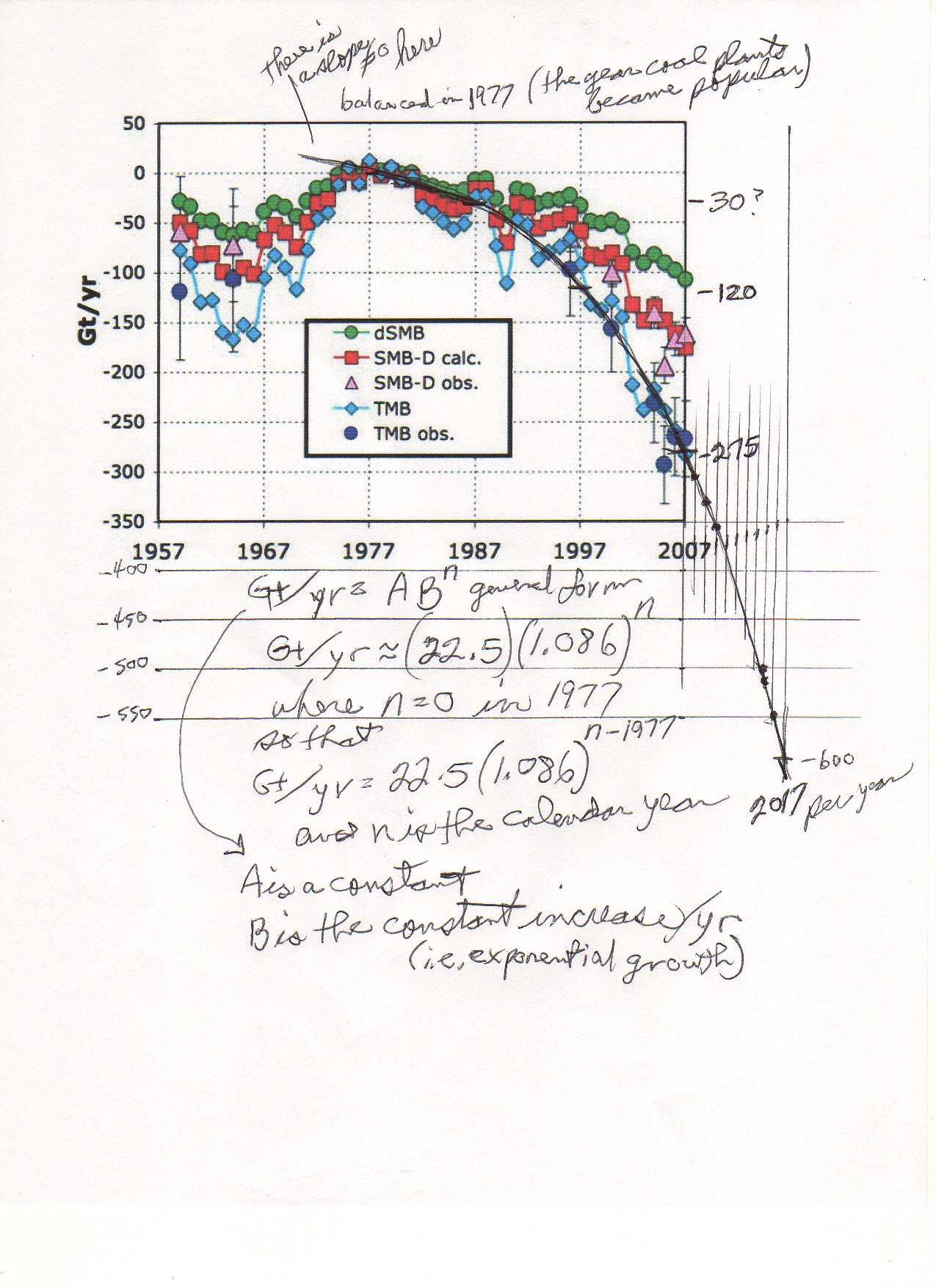
Record High Temperatures Far Outpace Record Lows Across US (November 13, 2009) -- Spurred by a warming climate, daily record high temperatures occurred twice as often as record lows over the last decade across the continental United States, new research shows. The ratio of record highs to lows is likely to increase dramatically if emissions of greenhouse gases continue to climb. ... > full story
Antarctica Glacier Retreat Creates New Carbon Dioxide Store; Has Beneficial Impact On Climate Change (November 10, 2009) -- Large blooms of tiny marine plants called phytoplankton are flourishing in areas of open water left exposed by the recent and rapid melting of ice shelves and glaciers around the Antarctic Peninsula. This remarkable colonization is having a beneficial impact on climate change. As the blooms die back phytoplankton sinks to the sea-bed where it can store carbon for thousands or millions of years. ... > full story
Reducing Greenhouse Gases May Not Be Enough To Slow Climate Change (November 11, 2009) -- Because land use changes are responsible for 50 percent of warming in the US, policymakers need to address the influence of global deforestation and urbanization on climate change, in addition to greenhouse gas emissions, experts urge. ... > full story
Changing Arctic Affecting Air, Ocean, And Everything In Between (November 9, 2009) -- Despite the fact that summer 2009 had more sea ice than in 2007 or 2008, scientists are seeing drastic changes in the region from just five years ago and at rates faster than anticipated. ... > full story
North Carolina Sea Levels Rising Three Times Faster Than In Previous 500 Years, Study Finds (October 29, 2009) -- An international team of environmental scientists has shown that sea-level rise in North Carolina is accelerating, a jump that appears to have occurred during a time of industrial change. ... > full story
Arctic Lake Sediments Show Warming, Unique Ecological Changes In Recent Decades (October 27, 2009) -- An analysis of sediment cores indicates that biological and chemical changes occurring at a remote Arctic lake are unprecedented over the past 200,000 years and likely are the result of human-caused climate change, according to a new study. ... > full story
Arctic Sediments Show That 20th Century Warming Is Unlike Natural Variation (October 25, 2009) -- The possibility that climate change might simply be a natural variation like others that have occurred throughout geologic time is dimming, according to new evidence. The research reveals that sediments retrieved by geologists from a remote Arctic lake are unlike those seen during previous warming episodes. ... > full story
West Antarctic Ice Sheet May Not Be Losing Ice As Fast As Once Thought (October 20, 2009) -- New ground measurements suggest the rate of ice loss of the West Antarctic ice sheet has been slightly overestimated. For the first time, researchers have directly measured the vertical motion of the bedrock at sites across West Antarctica using GPS. The results will lead to more accurate estimates of ice mass loss. ... > full story
Global Surface Temperature Was Second Warmest For September (October 18, 2009) -- The combined global land and ocean surface temperature was the second warmest September on record, according to NOAA. Scientists also reported that the average land surface temperature for September was the second warmest on record, behind 2005. Additionally, the global ocean surface temperature was tied for the fifth warmest on record for September. ... > full story
Survey Data Supports Rapid Ice Loss: Largely Open Arctic Seas In Summer Within 10 Years (October 15, 2009) -- The Arctic Ocean sea ice is thinning, new data show, supporting the emerging thinking that the Ocean will be largely ice-free during summer within a decade. ... > full story
Arctic Has Potential To Alter Earth's Climate: Arctic Land And Seas Account For Up To 25 Percent Of World's Carbon Sink (October 15, 2009) -- In a new study, ecologists estimate that Arctic lands and oceans are responsible for up to 25 percent of the global net sink of atmospheric carbon dioxide. Under current predictions of global warming, this Arctic sink could be diminished or reversed, potentially accelerating predicted rates of climate change. ... > full story
Rising Sea Levels Are Increasing Risk Of Flooding Along South Coast Of England (October 10, 2009) -- A new study has found that sea levels have been rising across the south coast of England over the past century, substantially increasing the risk of flooding during storms. ... > full story
Arctic warming overtakes 2,000 years of natural cooling
http://www.gizmag.com/arctic-warming-overtakes-2000-years-of-natural-cooling/12744/
Peering Under The Ice Of Collapsing Polar Coast (October 8, 2009) -- Starting this month, a giant NASA DC-8 aircraft loaded with geophysical instruments and scientists will buzz at low level over the coasts of West Antarctica, where ice sheets are collapsing at a pace far beyond what scientists expected a few years ago. The flights, dubbed Operation Ice Bridge, are an effort to image what is happening on, and under, the ice, in order to estimate future sea-level rises that might result. ... > full story
Arctic Sea Ice Recovers Slightly In 2009, Remains On Downward Trend (October 6, 2009) -- Despite a slight recovery in summer Arctic sea ice in 2009 from record-setting low years in 2007 and 2008, the sea ice extent remains significantly below previous years and remains on a trend leading toward ice-free Arctic summers, according to the University of Colorado at Boulder's National Snow and Ice Data Center. ... > full story
How Will Future Sea-level Rise Linked To Climate Change Affect Coastal Areas? (October 6, 2009) -- The anticipated sea-level rise associated with climate change, including increased storminess, over the next 100 years and the impact on the nation's low-lying coastal infrastructure is the focus of a new, interdisciplinary study led by geologists. ... > full story
Global Increase In Atmospheric Methane Likely Caused By Unusual Arctic Warmth, Tropical Wetness (September 28, 2009) -- Unusually high temperatures in the Arctic and heavy rains in the tropics likely drove a global increase in atmospheric methane in 2007 and 2008 after a decade of near-zero growth, according to a new study. Methane is the second most abundant greenhouse gas after carbon dioxide, albeit a distant second. ... > full story
Cassandras of Climate By PAUL KRUGMAN
As climate scientists have begun reaching consensus that Earth's outlook is getting worse at greater speed, the need for government action is thrown into sharper relief.
http://www.nytimes.com/2009/09/28/opinion/28krugman.html?th&emc=th
China is beginning to rethink climate change because of their own rapidly melting glacier, which is a popular tourist attraction, but is rapidly melting away.
http://www.nytimes.com/2009/09/26/opinion/26Schell.html?_r=1&th&emc=th
Lasers From Space Show Thinning Of Greenland And Antarctic Ice Sheets (September 24, 2009) -- The most comprehensive picture of the rapidly thinning glaciers along the coastline of both the Antarctic and Greenland ice sheets has been created using satellite lasers. The findings are an important step forward in the quest to make more accurate predictions for future sea level rise. ... > full story
Arctic Sea Ice Reaches Minimum Extent For 2009, Third Lowest Ever Recorded (September 18, 2009) -- The Arctic sea ice cover appears to have reached its minimum extent for the year, the third-lowest recorded since satellites began measuring sea ice extent in 1979. ... > full story
Ocean Acidification: Impact On Key Organisms Of Oceanic Fauna May Be Worse Than Predicted (September 17, 2009) -- In addition to global warming, carbon dioxide emissions cause another, less well-known but equally serious and worrying phenomenon: ocean acidification. Researchers have just demonstrated that key marine organisms, such as deep-water corals and pteropods (shelled pelagic mollusks) will be profoundly affected by this phenomenon during the years to come. ... > full story
Melting Of The Greenland Ice Sheet Mapped (September 17, 2009) -- Will all of the ice on Greenland melt and flow out into the sea, bringing about a colossal rise in ocean levels on Earth, as the global temperature rises? ... > full story
The new results show the ice sheet is very sensitive to the temperature.
New Carbon Dioxide Data Helps Unlock The Secrets Of Antarctic Formation (September 14, 2009) -- The link between declining carbon dioxide levels in the earth's atmosphere and the formation of the Antarctic ice caps some 34 million years ago has been confirmed for the first time in a major research study. ... > full story
Early Warning Signals Of Change: 'Tipping Points' Identified Where Sudden Shifts To New Conditions Occur (September 5, 2009) -- What do abrupt changes in ocean circulation and Earth's climate, shifts in wildlife populations and ecosystems, the global finance market and its system-wide crashes, and asthma attacks and epileptic seizures have in common? According to new research, all share generic early-warning signals that indicate a critical threshold of change dead ahead. ... > full story
Long-term Cooling Trend In Arctic Abruptly Reverses, Signaling Potential For Sea Rise (September 4, 2009) -- Warming from greenhouse gases has trumped the Arctic's millennia-long natural cooling cycle, suggests new research. Although the Arctic has been receiving less energy from the summer sun for the past 8,000 years, summer temperatures began climbing in 1900. The decade from 1999 to 2008 was the warmest in the Arctic in two millennia, report scientists who tracked Arctic temperatures 2,000 years into the past using natural archives including lake sediments, tree rings and ice cores. ... > full story
Methane Gas Likely Spewing Into The Oceans Through Vents In Sea Floor (September 3, 2009) -- Scientists worry that rising global temperatures accompanied by melting permafrost in arctic regions will initiate the release of underground methane into the atmosphere. A new paper elucidates how this underground methane in frozen regions would escape and concludes that methane trapped under the ocean may already be escaping through vents in the sea floor a million times faster than previously believed. ... > full story
Time To Lift The Geoengineering Taboo, Experts Urge (September 2, 2009) -- Hot on the heels of the Royal Society's Geoengineering the Climate report, September's Physics World contains feature comment from UK experts stressing the need to start taking geoengineering -- deliberate interventions in the climate system to counteract man-made global warming -- more seriously. ... > full story
Stop Emitting Carbon Dioxide, Or Geoengineering Could Be Only Hope For Earth's Climate, Experts Warn (September 1, 2009) -- The future of the Earth could rest on potentially dangerous and unproven geoengineering technologies unless emissions of carbon dioxide can be greatly reduced, the latest Royal Society report has found. ... > full story
International Greenland Ice Coring Effort Sets New Drilling Record In 2009 (August 31, 2009) -- A new international research effort on the Greenland ice sheet has set a record for single-season deep ice-core drilling this summer, recovering more than a mile of ice core that is expected to help scientists better assess the risks of abrupt climate change in the future. ... > full story “saying good by to coastal cities”
Ocean Warming, Ocean Warning: Global ocean surface temperature in July warmest on record Posted on Friday, August 21, 2009
http://www.climatesciencewatch.org/index.php/csw/details/ocean-warming-ocean-warning/
Warming Of Arctic Current Over 30 Years Triggers Release Of Methane Gas (August 16, 2009) -- The warming of an Arctic current over the last 30 years has triggered the release of methane, a potent greenhouse gas, from methane hydrate stored in the sediment beneath the seabed. Scientists have found that more than 250 plumes of bubbles of methane gas are rising from the seabed of the West Spitsbergen continental margin in the Arctic. ... > full story
Antarctic Glacier Thinning At Alarming Rate (August 15, 2009) -- The thinning of a gigantic glacier in Antarctica is accelerating, scientists report. The Pine Island Glacier in West Antarctica, which is around twice the size of Scotland, is losing ice four times as fast as it was a decade years ago. The research also reveals that ice thinning is now occurring much further inland. ... > full story
Connect the dots … climate change is a threat to the US security.
http://www.nytimes.com/2009/08/09/science/earth/09climate.html?_r=1&th&emc=th
Long Debate Ended Over Cause, Demise Of Ice Ages? Research Into Earth's Wobble (August 7, 2009) -- Researchers have largely put to rest a long debate on the underlying mechanism that has caused periodic ice ages on Earth for the past 2.5 million years -- they are ultimately linked to slight shifts in solar radiation caused by predictable changes in Earth's rotation and axis. ... > full story
Researchers Reveal Ocean Acidification At Station ALOHA In Hawaii (August 7, 2009) -- Despite the global environmental importance of ocean acidification, there are few studies of sufficient duration, accuracy and sampling intensity to document the rate of change of ocean pH and shed light on the factors controlling its variability. Researchers in Hawaii have recently addressed this issue. ... > full story
http://www.nytimes.com/2009/08/04/science/earth/04clima.html?_r=1&th=&emc=th&pagewanted=all
Arctic Climate Under Greenhouse Conditions In The Late Cretaceous (July 17, 2009) -- New evidence for ice-free summers with intermittent winter sea ice in the Arctic Ocean during the Late Cretaceous -- a period of greenhouse conditions -- gives a glimpse of how the Arctic is likely to respond to future global warming. Ice free summers and only small amounts of thin ice in the winters... > full story
Climate models predict only half the temperature change that actually occurred.
http://www.sciencedaily.com/releases/2009/07/090714124956.htm
Arctic glacier to lose Manhattan-sized 'tongue'
Trapping Carbon Dioxide Or Switching To Nuclear Power Not Enough To Solve Global Warming Problem, Experts Say (July 13, 2009) -- Attempting to tackle climate change by trapping carbon dioxide or switching to nuclear power will not solve the problem of global warming, according to new energy calculations. Scientists have calculated the total energy emissions from the start of the industrial revolution in the 1880s to the modern day. They have worked out that using the increase in average global air temperature as a measure of global warming is an inadequate measure of climate change. They suggest that scientists must also take into account the total energy of the ground, ice masses and the seas if they are to model climate change accurately. ... > full story
New NASA Satellite Survey Reveals Dramatic Arctic Sea Ice Thinning (July 8, 2009) -- Arctic sea ice thinned dramatically between the winters of 2004 and 2008, with thin seasonal ice replacing thick older ice as the dominant type for the first time on record. The new results, based on data from a NASA Earth-orbiting spacecraft, provide further evidence for the rapid, ongoing transformation of the Arctic's ice cover. ... > full story
Ancient Supervolcano's Eruption Caused Decade Of Severe Winters (July 6, 2009) -- Previous studies have suggested that Indonesia's Toba supervolcano, when it erupted about 74,000 years ago, triggered a 1,000-year episode of ice sheet advance, and also may have produced a short-lived "volcanic winter," which drastically reduced the human population at the time. Researchers have now found that none of the models to simulate the supervolcanic eruption initiate glaciation. ... > full story
Super-size Deposits Of Frozen Carbon In Arctic Could Worsen Climate Change (July 6, 2009) -- The vast amount of carbon stored in the Arctic and boreal regions of the world is more than double that previously estimated, according to a new study. The new estimate is over 1.5 trillion tons of frozen carbon, about twice as much carbon as contained in the atmosphere. ... > full story
The Arctic Thaw Could Make Global Warming Worse
Sea Ice At Lowest Level In 800 Years Near Greenland (July 2, 2009) -- New research, which reconstructs the extent of ice in the sea between Greenland and Svalbard from the 13th century to the present indicates that there has never been so little sea ice as there is now. ... > full story
Plants Save The Earth From An Icy Doom (July 2, 2009) -- When glaciers advanced over much of the Earth's surface during the last ice age, what kept the planet from freezing over entirely? This has been a puzzle to climate scientists because leading models have indicated that over the past 24 million years geological conditions should have caused carbon dioxide levels in the atmosphere to plummet, possibly leading to runaway "icehouse" conditions. Now researchers report on the missing piece of the puzzle -- plants. ... > full story
Sea Level Rise: It’s Worse Than We Thought
Global Sunscreen Won't Save Corals (June 26, 2009) -- Emergency plans to counteract global warming by artificially shading the Earth from incoming sunlight might lower the planet's temperature a few degrees, but such "geoengineering" solutions would do little to stop the acidification of the world oceans that threatens coral reefs and other marine life, report the authors of a new study. The culprit is atmospheric carbon dioxide, which even in a cooler globe will continue to be absorbed by seawater, creating acidic conditions. ... > full story
Ice Sheets Can Retreat 'In A Geologic Instant,' Study Of Prehistoric Glacier Shows (June 22, 2009) -- Modern glaciers, such as those making up the Greenland and Antarctic ice sheets, are capable of undergoing periods of rapid shrinkage or retreat, according to new findings by paleoclimatologists, resulting in sharply rising global sea levels, which would threaten coastal populations. Briner said the findings are especially relevant to the Jakobshavn Isbrae, Greenland's largest and fastest moving tidewater glacier, which is retreating under conditions similar to those he studied in the Canadian Arctic.... > full story
2 Degree C rise forecasted to occur somewhere between 20 to 40 years from now
http://www.wired.com/wiredscience/2009/04/humans-halfway-to-causing-dangerous-climate-change/ and
http://www.realclimate.org/index.php/archives/2009/06/a-warning-from-copenhagen/
see how these points appear on my 2006 forecast report posted here:
http://egpreston.com/oceanriseprediction.pdf
Carbon Dioxide Higher Today Than Last 2.1 Million Years (June 21, 2009) -- Researchers have reconstructed atmospheric carbon dioxide levels over the past 2.1 million years in the sharpest detail yet, shedding new light on its role in the Earth's cycles of cooling and warming. ... > full story
Greenland Ice Sheet Melting Faster Than Expected; Larger Contributor To Sea-level Rise Than Thought (June 13, 2009) -- The Greenland ice sheet is melting faster than expected, according to a new study. Study results indicate that the ice sheet may be responsible for nearly 25 percent of global sea rise in the past 13 years. ... > full story
Carbon Emissions Linked To Global Warming In Simple Linear Relationship (June 11, 2009) -- Scientists have found a direct relationship between carbon dioxide emissions and global warming. Researchers used a combination of global climate models and historical climate data to show that there is a simple linear relationship between total cumulative emissions and global temperature change. ... > full story
As Alaska Glaciers Melt, It's Land That's Rising. Relieved of billions of tons of glacial weight, the land in Juneau is rising much as a cushion regains its shape after someone gets up from a couch.
http://www.nytimes.com/2009/05/18/science/earth/18juneau.html?th&emc=th
Warming Climate Is Affecting Cascades Snowpack In Pacific Northwest (May 15, 2009) -- There has been recent disagreement about the snowpack decline in the Cascade Mountains of the Pacific Northwest, but new research leaves little doubt that a warmer climate has a significant effect on the snowpack, even if other factors keep year-to-year measurements close to normal for a period of years. ... > full story
Melting Threat From West Antarctic Ice Sheet May Be Less Than Expected; But U.S. Coastal Cities At Risk (May 15, 2009) -- While a total or partial collapse of the West Antarctic Ice Sheet as a result of warming would not raise global sea levels as high as some predict, levels on the US seaboards would rise 25 percent more than the global average and threaten cities like New York, Washington, D.C., and San Francisco, according to a new study. ... > full story
Cold Water Ocean Circulation Doesn't Work As Expected (May 14, 2009) -- The familiar model of Atlantic ocean currents that shows a discrete "conveyor belt" of deep, cold water flowing southward from the Labrador Sea is probably all wet. ... > full story
Climate Change Could Displace Millions In Asia's Coral Triangle (May 14, 2009) -- Coral reefs could disappear entirely from the Coral Triangle region of the Pacific Ocean by the end of the century, threatening the food supply and livelihoods for about 100 million people, according to a new study. Averting catastrophe will depend on quick and effective global action on climate change coupled with the implementation of regional solutions to problems of over-fishing and pollution. ... > full story Comment from Gene Preston. As an energy system expert I can tell you that there will not be any quick global actions on climate change. I would recommend you plan for the less optimistic scenario.
Global Warming Inadvertently Curbed In Past By Lead Pollution, Scientists Find (May 13, 2009) -- Lead pollution in the air may have considerably curbed the greenhouse effect in the past. Lead pollution in the air stimulates the formation of ice particles in clouds. Scientist have found that particles containing lead are excellent seeds for the formation of ice crystals in clouds. This not only has a bearing on the formation of rain and other forms of precipitation but may also have an influence on the global climate. ... > full story
Changes In The Sun Are Not Causing Global Warming, New Study Shows (May 12, 2009) -- With the US Congress beginning to consider regulations on greenhouse gases, a troubling hypothesis about how the sun may impact global warming is finally laid to rest. ... > full story
Climate Experts Warn That Short-Term Snapshots Of Temperature Data Can Be Misleading: Focus Instead On The Bigger Picture (May 5, 2009) -- In the hotly debated arena of global climate change, using short-term trends that show little temperature change or even slight cooling to refute global warming is misleading, write two climate experts in a paper recently published by the American Geophysical Union -- especially as the long-term pattern clearly shows human activities are causing the earth's climate to heat up. ... > full story
Climate Change: Halving Carbon Dioxide Emissions By 2050 Could Stabilize Global Warming (May 4, 2009) -- If carbon dioxide emissions are halved by 2050 compared to 1990, global warming can be stabilized below two degrees, according to a new study by German, Swiss and British researchers. ... > full story
Arctic Trek To 'Break The Ice' On New NASA Airborne Radars (May 4, 2009) -- NASA will 'break the ice' on a pair of new airborne radars that can help monitor climate change as a team of scientists embarks on a two-month expedition to the vast, frigid terrain of Greenland and Iceland. ... > full story
Satellite Imagery Shows Fragile Wilkins Ice Shelf Destabilized (April 29, 2009) -- Satellite images show that icebergs have begun to calve from the northern front of the Wilkins Ice Shelf – indicating that the huge shelf has become unstable. This follows the collapse three weeks ago of the ice bridge that had previously linked the Antarctic mainland to Charcot Island. ... > full story
Industry Ignored Its Scientists on Climate
By ANDREW C. REVKIN
A fossil fuels industry group campaigned against an idea
its own scientists called irrefutable: a link between
heat-trapping gases and climate change.
http://www.nytimes.com/2009/04/24/science/earth/24deny.html?th&emc=th
Increasing Antarctic Sea Ice Extent Linked To Ozone Hole (April 22, 2009) -- Increased growth in Antarctic sea ice during the past 30 years is a result of changing weather patterns caused by the ozone hole, according to new research. ... > full story
Antarctica Ice is growing and shrinking at the same time – an update.
Cuts In Greenhouse Gas Emissions Would Save Arctic Ice, Reduce Sea Level Rise (April 15, 2009) -- The impact of global warming can be greatly diminished if nations cut emissions of heat-trapping greenhouse gases by 70 percent this century, according to a new study. The most dangerous potential aspects of climate change, including massive losses of Arctic ice and significant sea-level rise, could be partially avoided. ... > full story
When Oceans Get Warmer, Carbon Dioxide Uptake By Marine Plankton May Be Reduced (April 14, 2009) -- Melting ice at the poles, rising sea-level, extreme weather conditions: the signs of climate change are ubiquitous. Biologists have now shown that the uptake of carbon dioxide by marine plankton organisms will be reduced in response to ocean warming, thereby potentially feeding back to climate change. ... > full story
When Oceans Get Warmer, Carbon Dioxide Uptake By Marine Plankton May Be Reduced (April 14, 2009) -- Melting ice at the poles, rising sea-level, extreme weather conditions: the signs of climate change are ubiquitous. Biologists have now shown that the uptake of carbon dioxide by marine plankton organisms will be reduced in response to ocean warming, thereby potentially feeding back to climate change. ... > full story
Climate Change Leads To Major Decrease In Carbon Dioxide Storage (April 10, 2009) -- The North Atlantic Ocean is one of the Earth's tools to offset natural carbon dioxide emissions. In fact, the 'carbon sink' in the North Atlantic is the primary gate for carbon dioxide entering the global ocean and stores it for about 1500 years. The oceans have removed nearly 30 per cent of anthropogenic (man-made) emissions over the last 250 years. However, several recent studies show a dramatic decline in the North Atlantic Ocean's carbon sink. ... > full story
Giant mass of Antarctic ice 'set for collapse'
Arctic Literally On Thin Ice, According To New Satellite Data (April 6, 2009) -- The latest data from NASA and the University of Colorado at Boulder's National Snow and Ice Data Center show the continuation of a decade-long trend of shrinking sea ice extent in the Arctic, including new evidence for thinning ice as well. ... > full story
Collapse Of The Ice Bridge Supporting Wilkins Ice Shelf Appears Imminent (April 4, 2009) -- The Wilkins Ice Shelf is at risk of partly breaking away from the Antarctic Peninsula as the ice bridge that connects it to Charcot and Latady Islands looks set to collapse. The beginning of what appears to be the demise of the ice bridge began this week when new rifts forming along its center axis resulted in a large block of ice breaking away. ... > full story
Rising Sea Levels Will Lead To 'Relocation, Relocation, Relocation': Math Could Address Climate Change Population Concerns (April 3, 2009) -- As sea levels rise in the wake of climate change and semi-arid regions turn to desert, people living in those parts of the world are likely to be displaced. Mathematicians have worked out a new approach to planned relocation. ... > full story
Carbonated Oceans (March 27, 2009) -- The loading of carbon dioxide into oceans is a consequence of fossil fuel use that has only begun to be widely recognized as problematic in the past decade. Its subsequent effects on seawater chemistry have the potential to spread ecological disaster to a variety of industries dependent on the seas. ... > full story
EPA: Carbon Dioxide A Danger To Public Health.
The Wall Street Journal (3/24, Talley) reports the Environmental Protection Agency has submitted a proposed finding to the White House indicating that "carbon dioxide is a danger to public health, a step that could trigger a clampdown on emissions of greenhouse gases across a wide swath of the economy." Were the White House to approve the finding, the EPA could "use the Clean Air Act to control emissions of carbon dioxide and other greenhouse gases believed to contribute to climate change," and "raise pressure on Congress to enact a system that caps greenhouse gases."
The AP (3/24, Hebert) reports the White House has indicated it will "move cautiously when it comes to actually regulating greenhouse gases, preferring to have Congress act on the matter." White House Press Secretary Robert Gibbs said, "I think this is just the step in [the] process" of determining whether emissions should be regulated under the Clean Air Act. Another White House official suggested it would be "'a long process' before any rules would be expected to be issued on heat-trapping emissions."
The Washington Post (3/24, A1, Eilperin) reports on the front page that White House spokesman Ben LaBolt stressed, "The president has made clear that to combat climate change, his strong preference is for Congress to pass energy security legislation that includes a cap on greenhouse gas emissions. The Supreme Court ruled that the EPA must review whether greenhouse gas emissions pose a threat to public health or welfare, and this is simply the next step in what will be a long process that engages stakeholders and the public." The Detroit News (3/23, Shepardson), the Los Angeles Times (3/24, Eilperin), Bloomberg News (3/23, Dodge), Time (3/24, Walsh), and the New York Times (3/24, A16, Galbraith, Barringer) also report the story.
Climate Warming Affects Antarctic Ice Sheet Stability (March 22, 2009) -- A five-nation scientific team has published new evidence that even a slight rise in atmospheric concentrations of carbon dioxide, one of the gases that drives global warming, affects the stability of the West Antarctic Ice Sheet. The massive WAIS covers the continent on the Pacific side of the Transantarctic Mountains. Any substantial melting of the ice sheet would cause a rise in global sea levels. ... > full story
Carbon Sinks Losing The Battle With Rising Emissions (March 21, 2009) -- The stabilizing influence that land and ocean carbon sinks have on rising carbon emissions is gradually weakening, scientists who attended the international Copenhagen Climate Change Conference. ... > full story
Climate-related Changes Affect Life On The Antarctic Peninsula (March 17, 2009) -- Scientists have long established that the Antarctic Peninsula is one of the most rapidly warming spots on Earth. Now, new research using detailed satellite data indicates that the changing climate is affecting not just the penguins at the apex of the food chain, but simultaneously the microscopic life that is the base of the ecosystem. ... > full story
Sea Level Rise Due To Global Warming Poses Threat To New York City (March 16, 2009) -- Global warming is expected to cause the sea level along the northeastern US coast to rise almost twice as fast as global sea levels during this century, putting New York City at greater risk for damage from hurricanes and winter storm surge, according to a new study. ... > full story
Ninth Warmest February For Globe, NOAA (March 16, 2009) -- The combined global land and ocean surface average temperature for February 2009 was the ninth warmest since records began in 1880, according to an analysis by NOAA. ... > full story
Environmental Researchers Drill Arctic Lake For Climate Change Clues.
The Boston Globe (3/16, Venkataraman) reports, "A hardy band of scientists led by a UMass professor - undeterred by white-out blizzards or 40-below-zero cold - today sent a drill through the floor of a Siberian crater lake and deep into the earth. From there, they hope to extract an unparalleled record of climate change." The article describes how the researchers prepared the drill site and equipment, as well as the conditions they endure working in the Arctic. The Globe notes that, "unlike many other lakes in northern latitudes," Lake El'gygytgyn "was never plowed by glaciers, which scrape away layers of soil. As a result, scientists believe, it could hold the only detailed record of sediment deposits on a polar land mass that dates back millions of years." Analyzing the samples "could tell researchers how the Arctic landscape has changed over time," among other things. (article from ASEE Mar 16, 2009)
Wind Shifts May Stir Carbon Dioxide From Antarctic Depths, Amplifying Global Warming (March 13, 2009) -- Natural releases of carbon dioxide from the Southern Ocean due to shifting wind patterns could have amplified global warming at the end of the last ice age -- and could be repeated as man-made warming proceeds, a new article in the journal Science suggests. ... > full story
Rising Sea Levels Set To Have Major Impacts Around The World (March 11, 2009) -- New research shows that the upper range of sea level rise by 2100 could be in the range of about one meter, or possibly more. This means that if emissions of greenhouse gases is not reduced quickly and substantially, even the best case scenario will hit low lying coastal areas housing one in ten humans on the planet hard. ... > full story
Sea level rise could bust IPCC estimate
- 14:38 10 March 2009 by Catherine Brahic, Copenhagen
- For similar stories, visit the Climate Change Topic Guide
- Sea level rise could bust IPCC estimate
Rising Sea Levels Set To Have Major Impacts Around The World (March 11, 2009) -- New research shows that the upper range of sea level rise by 2100 could be in the range of about one meter, or possibly more. This means that if emissions of greenhouse gases is not reduced quickly and substantially, even the best case scenario will hit low lying coastal areas housing one in ten humans on the planet hard. ... > full story
Coral Reefs May Start Dissolving When Atmospheric Carbon Dioxide Doubles (March 10, 2009) -- Rising carbon dioxide in the atmosphere and the resulting effects on ocean water are making it increasingly difficult for coral reefs to grow, say scientists. A new study warns that if carbon dioxide reaches double pre-industrial levels, coral reefs can be expected to not just stop growing, but also to begin dissolving all over the world. ... > full story
Sea Level Rises Offer New Explanation For Puzzling Biological Divide Along Malay Peninsula (March 9, 2009) -- More than 58 rapid sea level rises in the last five million years could account for an apparently abrupt switch in the kinds in of mammals found along the Malay Peninsula in southeast Asia -- from mainland species to island species -- in the absence of any geographical barrier, ecologists say. ... > full story
Birds Move North With Climate Change (March 5, 2009) -- For the first time, researchers have documented a shift in breeding ranges for northerly species in North America. The study parallels findings in Europe. ... > full story
Mediterranean Sea Level Could Rise By Over Two Feet, Global Models Predict (March 4, 2009) -- A Spanish-British research project has come up with three future scenarios for the effects of climate change on the Mediterranean over the next 90 years, using global models from the Intergovernmental Panel on Climate Change. The conclusions show that ocean temperatures in this area will increase, along with sea levels. ... > full story
Oceanic Seesaw Links Northern And Southern Hemisphere During Abrupt Climate Change During Last Ice Age (March 3, 2009) -- Very large and abrupt changes in temperature recorded over Greenland and across the North Atlantic during the last Ice Age were actually global in extent, according to new research. The research supports the idea that changes in ocean circulation within the Atlantic played a central role in abrupt climate change on a global scale. ... > full story
Erosion Rates Double Along Portion Of Alaska's Coast (March 1, 2009) -- Skyrocketing coastal erosion occurred in Alaska between 2002 and 2007 along a 40-mile stretch of the Beaufort Sea, a new study finds. The surge of erosion in recent years, averaging more than double historical rates, is threatening coastal towns and destroying Alaskan cultural relics. ... > full story
Lower Increases In Global Temperatures Could Lead To Greater Impacts Than Previously Thought, Study Finds (March 1, 2009) -- A new study by scientists updating the findings of the Intergovernmental Panel on Climate Change 2001 Third Assessment Report finds that even a lower level of increase in average global temperatures due to greenhouse gas emissions could cause significant problems in five key areas of global concern. ... > full story
Carbon Dioxide Drop And Global Cooling Caused Antarctic Glacier To Form (February 27, 2009) -- Global climate rapidly shifted from a relatively ice-free world to one with massive ice sheets on Antarctica about 34 million years ago. What happened? What changed? Scientists offer a new perspective on the nature of changing climatic conditions across this greenhouse-to-icehouse transition -- one that refutes earlier theories and has important implications for predicting future climate changes. ... > full story
Study: Antarctic glaciers slipping swiftly seaward
UT geophysicist's related work shows that in the "worst case," sea levels could rise 20 feet because of changes in west Antarctic Ice Sheet.
Arctic's methane bubbles seen as climate threat
http://www.statesman.com/news/content/news/stories/world/02/26/0226methane.html
Carbon Dioxide Drop And Global Cooling Caused Antarctic Glacier To Form (February 27, 2009) -- Global climate rapidly shifted from a relatively ice-free world to one with massive ice sheets on Antarctica about 34 million years ago. What happened? What changed? Scientists offer a new perspective on the nature of changing climatic conditions across this greenhouse-to-icehouse transition -- one that refutes earlier theories and has important implications for predicting future climate changes. ... > full story
Ice Declining Faster Than Expected In Both Arctic And Antarctic Glaciers (February 26, 2009) -- New evidence of the widespread effects of global warming in the polar regions is emerging. Snow and ice are declining in both polar regions, affecting human livelihoods as well as local plant and animal life in the Arctic, as well as global ocean and atmospheric circulation and sea level. The Greenland and Antarctic ice sheets are losing mass contributing to sea level rise. Warming in the Antarctic is much more widespread than previously thought, and it now appears that the rate of ice loss from Greenland is increasing. ... > full story
Greenland And Antarctic Ice Sheet Melting, Rate Unknown (February 25, 2009) -- The Greenland and Antarctica ice sheets are melting, but the amounts that will melt and the time it will take are still unknown, according to researchers. ... > full story
Melting on the Greenland Ice Cap, 2008
http://earthobservatory.nasa.gov/IOTD/view.php?id=37215
Vital Climate Change Warnings Are Being Ignored, Says Expert (February 23, 2009) -- Canada's inland waters, the countless lakes and reservoirs across the country, are important "sentinels" for climate change and yet the warnings are being ignored. ... > full story
Ocean Less Effective At Absorbing Carbon Dioxide Emitted By Human Activity (February 23, 2009) -- In the Southern Indian Ocean, climate change is leading to stronger winds, which mix waters, bringing carbon dioxide up from the ocean depths to the surface. As a result, the Southern Ocean can no longer absorb as much atmospheric CO2 as before. Its role as a 'carbon sink' has been weakened, and it may now be ten times less efficient than previously estimated. The same trend can be observed at high latitudes in the North Atlantic. ... > full story
NASA-Funded Carbon Dioxide Map Of U.S. Released On Google Earth (February 23, 2009) -- Interactive maps that detail carbon dioxide emissions from fossil fuel combustion are now available on the popular Google Earth platform. The maps, funded by NASA and the U.S. Department of Energy through the joint North American Carbon Program, can display fossil fuel emissions by the hour, geographic region, and fuel type. ... > full story
Tracking Warming Trend In Northwestern North America (February 22, 2009) -- A new study says that weather, especially in late winter and early spring, is getting warmer in northwestern North America. ... > full story
Glaciers In China And Tibet Fading Fast (February 22, 2009) -- Glaciers that serve as water sources to one of the most ecologically diverse alpine communities on earth are melting at an alarming rate, according to a recent report. ... > full story
Planet Earth: Avoiding The Hothouse And The Icehouse Of The Future (February 19, 2009) -- By controlling emissions of fossil fuels we may be able to greatly delay the start of the next ice age, new research concludes. From an Earth history perspective, we are living in cold times. The greatest climate challenge mankind has faced has been surviving ice ages that have dominated climate during the past million years. ... > full story
Permafrost Is Thawing In Northern Sweden (February 19, 2009) -- Areas with lowland permafrost are likely to shrink in northern Sweden. Warmer summers and more winter precipitation are two of the reasons. ... > full story
Climate 'Flickering' Ended Last Ice Age In North Atlantic Region (February 17, 2009) -- The period towards the end of the ice age was engraved by extreme and short-lived variations, which finally terminated the ice age. ... > full story
Climate Change Likely To Be More Devastating Than Experts Predicted, Warns Top IPCC Scientist (February 15, 2009) -- Without decisive action, global warming is likely to accelerate at a much faster pace and cause more environmental damage than predicted, says Stanford scientist Chris Field, a leading member of the Nobel Prize-winning Intergovernmental Panel on Climate Change. Field warns that higher temperatures could ignite tropical forests and melt the Arctic tundra, releasing billions of tons of greenhouse gas that could raise temperatures even more -- a vicious cycle that could spiral out of control. ... > full story!
Related to climate change:
Climate Change Increasingly Impacting Investment Decisions (February 16, 2009) -- Three-quarters of 80 global institutional investors factor climate change information into investment decisions and asset allocations. Some investor institutions are now willing to ask companies to reduce their greenhouse gas emissions. ... > full story
Dramatic Rise In Sea Level And Its Broad Ramifications Uncovered (February 10, 2009) -- Scientists have found proof in Bermuda that the planet's sea level was once more than 70 feet higher about 400,000 years ago than it is now. This had grave ramifications for the biodiversity on the planets coastlines and small islands. ... > full story
Global Warming Threatens Antarctic Sea Life (February 9, 2009) -- Climate change is about to cause a major upheaval in the shallow marine waters of Antarctica. Predatory crabs are poised to return to warming Antarctic waters and disrupt the primeval marine communities. ... > full story
Collapse Of Antarctic Ice Sheet Would Likely Put Washington, D.C. Largely Underwater (February 6, 2009) -- Geophysicists have shown that should the West Antarctic Ice Sheet collapse and melt in a warming world -- as many scientists are concerned it will -- it is the coastlines of North America and of nations in the southern Indian Ocean that will face the greatest threats from rising sea levels. ... > full story
Sea-level Rise Around North America Upon Collapse Of Antarctic Ice Sheet To Be Higher Than Expected (February 6, 2009) -- Geophysicists have shown that should the West Antarctic Ice Sheet collapse and melt in a warming world -- as many scientists are concerned it will -- it is the coastlines of North America and of nations in the southern Indian Ocean that will face the greatest threats from rising sea levels. ... > full story
More Extreme Weather In The Arctic Regions (February 5, 2009) -- A study suggests that extreme weather events in the Arctic will become more common as the winter ice cover retreats, with potentially severe consequences for human activity. ... > full story
EnergyWise: PNAS Paper Details Irreversible Climate
Change
A paper in the Proceedings of the National Academy of Sciences spells out
human-induced climate changes that will be irreversible for as much as 1000
years after greenhouse gas emissions stop. The findings carry extra weight
because of the scientific prestige of the lead author, the atmospheric chemist
Susan Solomon.
Read more and comment.
Global Scientists Draw Attention To Threat Of Ocean Acidification (February 5, 2009) -- More than 150 leading marine scientists from 26 countries are calling for immediate action by policy-makers to sharply reduce carbon dioxide emissions so as to avoid widespread and severe damage to marine ecosystems from ocean acidification. ... > full story
Glaciers Around The Globe Continue To Melt At High Rates (February 4, 2009) -- Glaciers around the globe continue to melt at high rates. Tentative figures for the year 2007, of the World Glacier Monitoring Service indicate a further loss of average ice thickness of roughly 0.67 meter water equivalent (m w.e.). Some glaciers in the European Alps lost up to 2.5 m w.e. ... > full story
Climate Change Largely Irreversible For Next 1,000 Years, NOAA Reports (January 28, 2009) -- A new scientific study led by the National Oceanic and Atmospheric Administration reaches a powerful conclusion about the climate change caused by future increases of carbon dioxide: to a large extent, there's no going back. ... > full story
Global Warming From Carbon Dioxide Will Increase Five-fold Over The Next Millennium, Scientists Predict (January 29, 2009) -- Scientists have found that heating from carbon dioxide will increase five-fold over the next millennium. ... > full story
Orbiting Carbon Observatory Investigates Mystery Of The Missing Sinks (January 27, 2009) -- Trees "inhale" carbon dioxide from the atmosphere, transforming that greenhouse gas into the building materials and energy it needs to grow its branches and leaves. Though scientists agree the remaining carbon dioxide is also "inhaled" by Earth, they have been unable to precisely determine where it is going, what processes are involved, and whether Earth will continue to absorb it in the future. A new NASA satellite scheduled to launch in February 2009 is poised to shed a very bright light on these "missing" sinks: the Orbiting Carbon Observatory. ... > full story
Much Of Antarctica Is Warming More Than Previously Thought (January 22, 2009) -- Scientists have long believed that while the world was getting warmer, most of Antarctica was getting colder. New research shows that for the last 50 years much of Antarctica has actually been warming at a rate comparable to the rest of the world. ... > full story
Also see http://earthobservatory.nasa.gov/IOTD/view.php?id=36736
Scientists Agree Human-induced Global Warming Is Real, Survey Says (January 21, 2009) -- A broad poll of experts taken by earth scientists finds that the vast majority of climatologists and other earth scientists believe in global warming and think human activity is a factor for the temperature rise. This survey dispels lingering doubts by some of a consensus among the scientists. ... > full story
Global Impact Of Climate Change On Biodiversity (January 22, 2009) -- When three undergraduates set off on an expedition in 1965 to trap moths on Mount Kinabalu in Borneo, little did they realize that they were establishing the groundwork for a study of the impacts of climate change. ... > full story
Japan To Launch Satellite To Measure Greenhouse Gases. (ASEE report)
Bloomberg News (1/20, Sato, White) reported, "The Japan Aerospace Exploration Agency plans to launch a satellite in two days to measure greenhouse gases in the earth's atmosphere as nations seek better data on the evolution of global warming." According to an agency spokesperson, the "project will measure the density of carbon dioxide and other greenhouse gases emitted into the atmosphere at 56,000 points around the globe." The spokesperson added that "development costs for the satellite, dubbed 'Ibuki,' the Japanese word for 'breath,' totaled 18.3 billion yen ($202 million)." Mitsubishi Heavy Industries Ltd., Japan's largest heavy-machinery maker, stated "that it will help the agency launch Ibuki." Bloomberg notes, "Scientists are increasingly called upon by governments to predict the effects of global warming."
New Tool Improves Reliability Of Climate Models (January 21, 2009) -- Scientists have created a new quantitative tool which reconstructs the sea surface temperature during the Last Glacial Maximum. Project MARGO offers more exhaustive data than that available at present and will serve to represent more exact models of the past and predict the climate's evolution in the future. ... > full story
2008 Global Temperature Ties As Eighth Warmest On Record (January 19, 2009) -- The year 2008 tied with 2001 as the eighth warmest year on record for the Earth, based on the combined average of worldwide land and ocean surface temperatures through December, according to a preliminary analysis by NOAA's National Climatic Data Center. For December alone, the month also ranked as the eighth warmest globally, for the combined land and ocean surface temperature. The assessment is based on records dating back to 1880. ... > full story
Arctic Heats Up More Than Other Places: High Sea Level Rise Predicted (January 16, 2009) -- Temperature change in the Arctic is happening at a greater rate than other places in the Northern Hemisphere, and this is expected to continue. As a result, glacier and ice-sheet melting, sea-ice retreat, coastal erosion and sea level rise can be expected. A new comprehensive scientific synthesis of past Arctic climates demonstrates for the first time the pervasive nature of Arctic climate amplification. ... > full story
Could Ice-like Cages Be Used To Trap Carbon Dioxide Underground? (January 15, 2009) -- Ice-like "cages" of gas trapped underground may offer a safe and efficient way to reduce global warming. Researchers are investigating the potential for permanently storing carbon dioxide in geological reservoirs, by locking the global-warming gas within solid, cage-like structures called hydrates. ... > full story note by Gene Preston. This project will fail because the triple point for CO2 requires that the CO2 ice be kept at about –60 C to remain a solid – see http://en.wikipedia.org/wiki/Carbon_dioxide_(data_page)#Phase_diagram
There is no location on Earth that can maintain the 10 atms pressure at this low temperature. Therefore the project is not feasible. This R&D is a waste of money.
Orbiting Carbon Observatory Will Help Track Sources Of Rising Carbon Dioxide (January 15, 2009) -- Scientists still do not know precisely where all the carbon dioxide in our atmosphere comes from and where it goes. Now, they soon expect to get some answers to these and other compelling carbon questions, thanks to the Orbiting Carbon Observatory, a new Earth-orbiting NASA satellite set to launch in early 2009. ... > full story
a Level Rise Of One Meter Within 100 Years (January 11, 2009) -- New research indicates that the ocean could rise in the next 100 years to a meter higher than the current sea level -- which is three times higher than predictions from the UN's Intergovernmental Panel on Climate Change, IPCC. ... > full story
Scientists Refute Argument Of Climate Skeptics (January 10, 2009) -- Scientists have investigated the frequency of warmer than average years between 1880 and 2006 for the first time. The result: the observed increase of warm years after 1990 is not a statistical accident. ... > full story
Cause Of Glacial Earthquakes In Greenland Clarified (January 8, 2009) -- Satellite observations during the past decade have shown dramatic changes in flow speed on year-to-year timescales at Greenland's outlet glaciers. Seismic events traced back to glaciers during the same time period have been interpreted to have resulted from calving events at the glacier terminus or surging events lubricated by subglacial meltwater. ... > full story
USGS Report on climate change December 2008
http://www.usgs.gov/newsroom/article.asp?ID=2091&from=rss_home
http://www.climatescience.gov/default.php
http://www.statesman.com/opinion/content/editorial/stories/01/01/05/0105climate_edit.html
Solar Activity Between 1250-1850 Linked To Temperature Changes In Siberia (December 22, 2008) -- Scientists have discovered a strong link between regional temperatures and the solar activity in the period 1250-1850, concluding that the sun was an important driver of preindustrial temperature changes in the Siberian Altai. Interestingly, the regional temperatures followed the solar forcing with a time lag of 10 to 30 years. ... > full story
Arctic Greening Linked To Retreating Sea Ice (December 22, 2008) -- An interdisciplinary group of scientists has strongly linked sea ice changes to changes in Arctic land-surface temperatures and increased tundra greenness. ... > full story
NASA Study Links Severe Storm Increases, Global Warming
http://www.jpl.nasa.gov/news/news.cfm?release=2008-242
Did Early Global Warming Divert A New Glacial Age? (December 18, 2008) -- The common wisdom is that the invention of the steam engine and the advent of the coal-fueled industrial age marked the beginning of human influence on global climate. Humans may have influenced the climate for thousands of years and prevented an ice age... > full story
Global Warming Impacts On U.S. Coming Sooner Than Expected, Report Predicts (December 18, 2008) -- A new report provides insights on the potential for abrupt climate change and the effects it could have on the United States, identifying key concerns that include faster-than-expected loss of sea ice, rising sea levels and a possibly permanent state of drought in the American West. ... > full story
Scientists Find Increased Methane Levels In Arctic Ocean (December 18, 2008) -- Researchers have found new data to suggest that the carbon pool beneath the Arctic Ocean is leaking. ... > full story
Cosmic Rays Do Not Explain Global Warming, Study Finds (December 17, 2008) -- A new study supports earlier findings by stating that changes in cosmic rays most likely do not contribute to climate change. ... > full story
Greenland's Glaciers Losing Ice Faster This Year Than Last Year, Which Was Record-setting Itself (December 16, 2008) -- Researchers watching the loss of ice flowing out from the giant island of Greenland say that the amount of ice lost this summer is nearly three times what was lost one year ago. The loss of floating ice in 2008 pouring from Greenland's glaciers would cover an area twice the size of Manhattan Island in the US, they said. ... > full story
As Ice Melts, Antarctic Bedrock Is On The Move (December 15, 2008) -- As ice melts away from Antarctica, parts of the continental bedrock are rising in response -- and other parts are sinking, scientists have discovered. The finding will give much needed perspective to satellite instruments that measure ice loss on the continent, and help improve estimates of future sea level rise. ... > full story
Methane, Potent Greenhouse Gas, Flowing Into The Atmosphere From Tundra Much Faster Than Expected (December 11, 2008) -- Much more methane gas is being emitted into the atmosphere from the tundra in northeast Greenland than previous studies have shown. New figures reveal that large amounts of greenhouse gases are being emitted into the atmosphere, not just during the warm summer months, but also during the colder autumn months. ... > full story
Carbon Dioxide Helped Ancient Earth Escape Deathly Deep Freeze (December 8, 2008) -- The planet's present day greenhouse scourge, carbon dioxide, may have played a vital role in helping ancient Earth to escape from complete glaciation, say scientists. ... > full story
Shrinking Glaciers Reveal Hidden Forests And A Warmer Climate (December 5, 2008) -- Uniquely old tree remains have recently been uncovered by the thawing of the rapidly shrinking Kårsa Glacier west of Abisko in Lapland, in northernmost Sweden. The finds show that in the last 7,000 years it has probably never been so warm as during the last century. ... > full story
U.S. Greenhouse Gas Emissions Still Increasing (December 5, 2008) -- Total U.S. greenhouse gas emissions were 7,282 million metric tons carbon dioxide equivalent (MMTCO 2e) in 2007, an increase of 1.4 percent from the 2006 level according to Emissions of Greenhouse Gases in the United States 2007. Since 1990, U.S. GHG emissions have grown at an average annual rate of 0.9 percent. ... > full story
Young People Choose Cars Above Greener Transport Options (December 5, 2008) -- Young people find the prospect of driving cars more attractive than other modes of travel that are kinder to the environment, according to new research. ... > full story
Climate Clues In Southern Ocean: Ocean Currents Surprisingly Resistant To Intensifying Winds (December 2, 2008) -- The Antarctic Circumpolar Current is the current system with the largest volume transport in the world ocean. Between 40° and 60°S strong westerlies move about 140 million cubic meters of water per second around the Antarctic continent (this is about five times the transport of the Gulf Stream). Vertical motions associated with this current have been responsible for transporting a substantial fraction of the anthropogenic carbon dioxide emissions from the atmosphere to the deep ocean, thereby effectively damping the rate of global warming. ... > full story
Antarctica: Wilkins Ice Shelf Under Threat (December 1, 2008) -- New rifts have developed on the Wilkins Ice Shelf that could lead to the opening of the ice bridge that has been preventing the ice shelf from disintegrating and breaking away from the Antarctic Peninsula. ... > full story
UT scientist drops research that he says pollutes
Robot Gliders Take The Oceans’s Pulse
Sea Level Rise Alters Chesapeake Bay's Salinity (November 25, 2008) -- While global-warming-induced coastal flooding moves populations inland, the changes in sea level will affect the salinity of estuaries, which influences aquatic life, fishing and recreation. ... > full story
Ocean Growing More Acidic Faster Than Once Thought; Increasing Acidity Threatens Sea Life (November 26, 2008) -- Scientists have documented that the ocean is growing more acidic faster than previously thought. In addition, they have found that the increasing acidity correlates with increasing levels of atmospheric carbon dioxide. The increasingly acidic water harms certain sea animals and could reduce the ocean's ability to absorb carbon dioxide. ... > full story
Arctic Sea Ice Decline Shakes Up Ecosystems
http://earthobservatory.nasa.gov/Newsroom/view.php?id=35950
Second Warmest October For Global Temperatures, NOAA Says (November 24, 2008) -- The combined global land and ocean surface average temperature for October 2008 was the second warmest since records began in 1880, according to a preliminary analysis by NOAA. ... > full story
One Democrat takes chance in ousting another fellow Democrat:
Doggett helped dethrone energy panel chief
http://www.statesman.com/news/content/news/stories/nation/11/22/1122texasenergy.html
How Global Warming May Affect U.S. Beaches, Coastline (November 24, 2008) -- Scientists are finding that sea level rise will have different consequences in different places but that they will be profound on virtually all coastlines. Land in some areas of the Atlantic and Gulf coasts of the United States will simply be underwater. On the West Coast, with its different topography and different climate regimes, problems will likely play out differently. The scientists' most recent conclusions, even when conservative scenarios are involved, suggest that coastal development, popular beaches, vital estuaries, and even California's supply of fresh water could be severely impacted by a combination of natural and human-made forces.
Snow In The Arctic: An Ingredient In A Surprising Chemical Cocktail (November 22, 2008) -- In the Arctic in spring, the snow cover gives off nitrogen oxides. This phenomenon, the extent of which had not been previously realized, is the source of one third of the nitrates present in the Arctic atmosphere, according to researchers. Scientists made a quantitative study of the origin and evolution of nitrogen compounds in the Arctic atmosphere, in order to understand their environmental impact on this region. ... > full story
Quicker, Easier Way To Make Coal Cleaner (November 19, 2008) -- Construction of new coal-fired power plants in the United States is in danger of coming to a standstill, partly due to the high cost of the requirement -- whether existing or anticipated -- to capture all emissions of carbon dioxide, an important greenhouse gas. But an MIT analysis suggests an intermediate step that could get construction moving again, allowing the nation to fend off growing electricity shortages using our most-abundant, least-expensive fuel while reducing emissions. ... > full story
Speeding Antarctic Glacier: Scientists Discover Another Reason For Glacial Acceleration (November 19, 2008) -- New satellite data have helped scientists crack the case of a speeding Antarctic glacier -- a finding that promises to help improve sea level forecasts. ... > full story
Water Vapor Confirmed As Major Player In Climate Change (November 18, 2008) -- Water vapor is known to be Earth's most abundant greenhouse gas, but the extent of its contribution to global warming has been debated. Using recent NASA satellite data, researchers have estimated more precisely than ever the heat-trapping effect of water in the air, validating the role of the gas as a critical component of climate change. ... > full story
* Correcting Ocean Cooling
http://earthobservatory.nasa.gov/Features/OceanCooling/
Scientists revise their conclusion that the ocean has cooled since 2003.
A second opinion http://earthobservatory.nasa.gov/Features/OceanCooling/page2.php
Two kinds of bad data http://earthobservatory.nasa.gov/Features/OceanCooling/page3.php
Smoothing the bumps http://earthobservatory.nasa.gov/Features/OceanCooling/page4.php
Balancing the sea level budget http://earthobservatory.nasa.gov/Features/OceanCooling/page3.php
The entire article: http://earthobservatory.nasa.gov/Features/OceanCooling/printall.php
Carbon Dioxide Levels Already In Danger Zone, Revised Theory Shows (November 9, 2008) -- If climate disasters are to be averted, atmospheric carbon dioxide must be reduced below the levels that already exist today, according to a new study in Open Atmospheric Science Journal. ... > full story
World Needs Climate Emergency Backup Plan, Says Expert (November 10, 2008) -- In submitted testimony to the British Parliament, climate scientist said that while steep cuts in carbon emissions are essential to stabilizing global climate, there also needs to be a backup plan. Geoengineering solutions such as injecting dust into the atmosphere are risky, but may become necessary if emissions cuts are insufficient to stave off catastrophic warming. He urged that research into the pros and cons of geoengineering be made a high priority. ... > full story
Global Warming Predicted To Hasten Carbon Release From Peat Bogs (November 10, 2008) -- Billions of tons of carbon sequestered in the world's peat bogs could be released into the atmosphere in the coming decades as a result of global warming, according to a new analysis of the interplay between peat bogs, water tables, and climate change. ... > full story
When It Comes To Sea Level Changing Glaciers, New NASA Technique Measures Up (November 10, 2008) -- Scientists have used satellite data to make the most precise measurements to date of changes in the mass of mountain glaciers in the Gulf of Alaska, a region expected to be a significant contributor to global sea level rise over the next 50-100 years. ... > full story
Emerging Carbon Finance Market Will Play Critical Role In Addressing Climate Change, Experts Say (November 10, 2008) -- Climate change is an unprecedented global problem and an emerging carbon finance market will play a critical role in addressing it, asserts a newly published Yale report. ... > full story
Sunlight Has More Powerful Influence On Ocean Circulation And Climate Than North American Ice Sheets (November 7, 2008) -- A study reported in Nature disputes a longstanding picture of how ice sheets influence ocean circulation during glacial periods. ... > full story
'Unprecedented' Warming Drives Dramatic Ecosystem Shifts In North Atlantic, Study Finds (November 7, 2008) -- While Earth has experienced numerous changes in climate over the past 65 million years, recent decades have experienced the most significant climate change since the beginning of human civilized societies about 5,000 years ago, says a new Cornell University study. ... > full story
Maldives Considers Buying Dry Land if Seas Rise
The nation of 1,200 low islands in the Indian Ocean is planning to establish a fund so that it can buy a haven for its citizens should global warming raise sea levels at a dangerous pace.
SCIENTISTS PROBE ANTARCTIC GLACIERS
Scientists from the Jackson School of Geosciences, the University of Edinburgh
and the Australian Antarctic Division have teamed up to explore two of the last
uncharted regions of Earth, the Aurora and Wilkes Subglacial Basins, immense
ice-buried lowlands in Antarctica with a combined area the size of Mexico. The
research could show how Earth’s climate changed in the past and how future
climate change will affect global sea level. more
about Antarctic glacier research...
NASA - Melt Ponds, Northeastern Greenland
http://earthobservatory.nasa.gov/Newsroom/NewImages/images.php3?img_id=18196
NASA – News, http://earthobservatory.nasa.gov/Newsroom/NasaNews/2008/200810.html
- 2008 Ozone Hole Maximum Announced
- NASA Measurements Show Greenhouse Gas Methane on the Rise Again
- Potent Greenhouse Gas More Common in Atmosphere Than Estimated
- Climate Change Seeps Into the Sea
NASA – Headlines,
http://earthobservatory.nasa.gov/Newsroom/Headlines/2008/200810.html
Long-term Stabilization Of Carbon Dioxide In Atmosphere Will Require Major Cuts In Emissions (November 3, 2008) -- Carbon dioxide, the greenhouse gas that has had the largest impact on our climate, will continue to rise even if current national and international targets for reducing emissions are met, scientists warn. But, they say, strong action taken now – such as the 80% target recently announced by the UK government – will continue to have benefits a long time into the future. ... > full story
Arctic Sea Ice Is Suddenly Getting Thinner As Well As Receding (November 3, 2008) -- Last winter, the thickness of sea ice in large parts of the Arctic fell by nearly half a meter (19 per cent) compared with the average thickness of the previous five winters. This followed the dramatic 2007 summer low when Arctic ice extent dropped to its lowest level since records began. ... > full story
New Model Predicts A Glacier's Life (October 31, 2008) -- Researchers have developed a numerical model that can re-create the state of Switzerland's Rhône Glacier as it was in 1874 and predict its evolution until the year 2100. This is the longest period of time ever modeled in the life of a glacier, involving complex data analysis and mathematical techniques. The work will serve as a benchmark study for those interested in the state of glaciers and their relation to climate change. ... > full story
Methane Gas Levels Begin To Increase Again (October 30, 2008) -- The amount of methane in Earth's atmosphere shot up in 2007, bringing to an end a period of about a decade in which atmospheric levels of the potent greenhouse gas were essentially stable, according new research. ... > full story
Climate Change Seeps Into The Sea (October 30, 2008) -- Good news has turned out to be bad. The ocean has helped slow global warming by absorbing much of the excess heat and heat-trapping carbon dioxide that has been going into the atmosphere since the start of the Industrial Revolution. All that extra carbon dioxide, however, has been a bitter pill for the ocean to swallow. It's changing the chemistry of seawater, making it more acidic and otherwise inhospitable, threatening many important marine organisms. ... > full story
Global Warming Is Killing Frogs And Salamanders In Yellowstone Park, Researchers Say (October 29, 2008) -- Frogs and salamanders, those amphibious bellwethers of environmental danger, are being killed in Yellowstone National Park. The predator, Stanford researchers say, is global warming. One biology graduate student spent three summers in a remote area of the park searching for frogs and salamanders in ponds that had been surveyed 15 years ago. Almost everywhere she looked, she found a catastrophic decrease in the population. ... > full story
Austin American Statesman Commentary
Burnett: Is Palin using Cheney's climate change playbook?
Jason Burnett, Former EPA Administrator
http://www.statesman.com/opinion/content/editorial/stories/10/28/1028burnett
North Pole Exploration: Large Sliding Masses Close Beneath The Seafloor Of East-Siberian Continental Shelf Discovered (October 28, 2008) -- RV Polarstern has returned to Bremerhaven from the Arctic Sea. It has cruised both the Northeast and the Northwest Passages and thereby circled the North Pole. The third part of the research vessel's 23rd Arctic expedition started its journey on Aug. 12 in Reykjavik and ended it on Oct. 17 in Bremerhaven. The ship traveled a distance of 20,000 km. ... > full story
Earth In Midst Of Sixth Mass Extinction: 50% Of All Species Disappearing (October 21, 2008) -- The Earth is in the midst of the sixth mass extinction of both plants and animals, with nearly 50 percent of all species disappearing, scientists say. Which plants should be a top priority to conserve? Researchers say the most genetically unique species are the ones that have the greatest importance in an ecosystem. ... > full story
Less Ice In Arctic Ocean 6000-7000 Years Ago (October 20, 2008) -- Recent mapping of a number of raised beach ridges on the north coast of Greenland suggests that the ice cover in the Arctic Ocean was greatly reduced some 6000-7000 years ago. The Arctic Ocean may have been periodically ice free. ... > full story
Rising Arctic Storm Activity Sways Sea Ice, Climate (October 14, 2008) -- A new NASA study shows that the rising frequency and intensity of arctic storms over the last half century, attributed to progressively warmer waters, directly provoked acceleration of the rate of arctic sea ice drift, long considered by scientists as a bellwether of climate change. ... > full story
Challenge To Discover Antarctica’s Hidden World (October 15, 2008) -- Later this month teams of scientists, engineers, pilots and support staff from British Antarctic Survey (BAS), USA, Germany, Australia, China and Japan will join forces for one of the most scientifically, technically ambitious and physically demanding Antarctic projects yet to be undertaken. ... > full story
Claim That Simulated Temperature Trends For Tropics Inconsistent With Observations Is Flawed, Experts Argue (October 13, 2008) -- Scientists have helped reconcile the differences between simulated and observed temperature trends in the tropics. They have refuted a recent claim that simulated temperature trends in the tropics are fundamentally inconsistent with observations. This claim was based on the application of a flawed statistical test and the use of older observational datasets. ... > full story
Species Extinction By Asteroid A Rarity (October 10, 2008) -- New research argues in favor of a "sick earth" mechanism for most extinctions, rather than external event like an asteroid strike. ... > full story
Satellite Data Reveals Extreme Summer Snowmelt In Northern Greenland (October 10, 2008) -- The northern part of the Greenland ice sheet experienced extreme snowmelt during the summer of 2008, with large portions of the area subject to record melting days. This conclusion is based on an analysis of microwave brightness temperature recorded by the Special Sensor Microwave Imager onboard the F13 satellite. ... > full story
Thinning Of Greenland Glacier Attributed To Ocean Warming Preceded By Atmospheric Changes (October 10, 2008) -- The sudden thinning in 1997 of Jakobshavn Isbræ, one of Greenland's largest glaciers, was caused by subsurface ocean warming, according to research in the journal Nature Geoscience. The research team traces these oceanic shifts back to changes in the atmospheric circulation in the North Atlantic region. ... > full story
Arctic Soil May Contain Nearly Twice Greenhouse-Gas Producing Material Than Previously Estimated (October 8, 2008) -- Frozen arctic soil contains nearly twice the greenhouse-gas-producing organic material as was previously estimated, according to new research. The research team discovered a previously undocumented layer of organic matter on top of and in the upper part of permafrost, ranging from 60 to 120 centimeters deep. ... > full story
Most Alaskan Glaciers Retreating, Thinning, Or Stagnating (October 6, 2008) -- Most glaciers in every mountain range and island group in Alaska are experiencing significant retreat, thinning or stagnation, especially glaciers at lower elevations, according to U.S. Geological Survey research. ... > full story
Arctic Sea Ice Hits Second-lowest Recorded Extent, Likely Lowest Volume (October 3, 2008) -- Arctic sea ice extent during the 2008 melt season dropped to the second-lowest level Sept. 14 since satellite measurements began in 1979 and may represent the lowest volume of sea ice on record, according to researchers. ... > full story
Global Warming Will Have Significant Economic Impacts On Florida Coasts, Reports State (October 1, 2008) -- Scientists have released two new studies, including a report finding that climate change will cause significant impacts on Florida's coastlines and economy due to increased sea level rise and hurricane storm surge. Property damage is expected to increase. A second study recommends that the state of Florida adopt a series of policy programs aimed at adapting to these large coastal and other impacts as a result of climate change. ... > full story
Canada's Shores Saved Animals From Devastating Climate Change 252 Million Years Ago (October 2, 2008) -- Scientists have solved part of the mystery of where marine organisms that recovered from the biggest extinction on earth were housed. The researchers discovered that the shorelines of ancient Canada provided a refuge for marine organisms that escaped annihilation during the Permian-Triassic extinction event. ... > full story
Mass Extinctions And The Evolution Of Dinosaurs (September 30, 2008) -- Dinosaurs did not proliferate immediately after they originated, but that their rise was a slow and complicated event, and driven by two mass extinctions, according to new research. ... > full story
Sounds Travel Farther Underwater As World's Oceans Become More Acidic (September 30, 2008) -- It is common knowledge that the world's oceans and atmosphere are warming as humans release more and more carbon dioxide into the Earth's atmosphere. However, fewer people realize that the chemistry of the oceans is also changing -- seawater is becoming more acidic as carbon dioxide from the atmosphere dissolves in the oceans. These changes in ocean temperature and chemistry will have an unexpected side effect -- sounds will travel farther underwater. ... > full story
Ancient Arctic Ice Could Tell Us About Future Of Permafrost (September 29, 2008) -- Researchers have discovered the oldest known ice in North America, and that permafrost may be a significant touchstone when looking at global warming. ... > full story
Carbon Dioxide Emissions Booming, Shifting East, Researchers Report (September 29, 2008) -- Despite widespread concern about climate change, annual carbon dioxide emissions from burning fossil fuels and manufacturing cement have grown 38 percent since 1992, from 6.1 billion tons of carbon to 8.5 billion tons in 2007. ... > full story
Global Carbon Emissions Speed Up, Beyond IPCC Projections (September 28, 2008) -- The Global Carbon Project posted the most recent figures for the worlds' carbon budget, a key to understanding the balance of carbon added to the atmosphere, the underpinning of human induced climate change. Despite the increasing international sense of urgency, the growth rate of emissions continued to speed up, bringing the atmospheric carbon dioxide concentration to 383 parts per million in 2007. Emissions growth for 2000-2007 was above even the most fossil fuel intensive scenario of the Intergovernmental Panel on Climate Change. ... > full story
Arctic Saw Fastest August Sea Ice Retreat On Record, NASA Data Show (September 28, 2008) -- Following a record-breaking season of arctic sea ice decline in 2007, NASA scientists have kept a close watch on the 2008 melt season. Although the melt season did not break the record for ice loss, NASA data are showing that for a four-week period in August 2008, sea ice melted faster during that period than ever before. ... > full story
Study Merges Decade Of Arctic Data As Ice Collapses Into The Sea (September 25, 2008) -- The Markham Ice Shelf, a massive 19-square-mile platform of ice, broke away from Ellesmere Island in early August and is adrift in the Arctic Ocean. More than half of the nearby Serson Ice Shelf -- about 47 square miles -- also recently broke away into the sea. ... > full story
Abrupt Climate Change Focus Of U.S. National Laboratories (September 23, 2008) -- Abrupt climate change is the focus of IMPACTS, a major new program bringing together six US Department of Energy national laboratories to investigate the instability of marine ice sheets, warming of the boreal forests and Arctic, megadroughts in the Southwestern United States, and methane release from frozen hydrates. ... > full story
10 Eastern US states enact CO2 reduction programs.
http://www.nytimes.com/2008/09/25/opinion/25thu2.html?_r=1&th&emc=th&oref=slogin
Arctic Sea Ice At Lowest Recorded Level Ever (September 16, 2008) -- Arctic sea ice may well have reached its lowest volumes ever, as summer ice coverage of the Arctic Sea looks set to be close to last year's record lows, with thinner ice overall. Final figures on minimum ice coverage for 2008 are expected in a matter of days, but they are already flirting with last year's record low of 1.59 million square miles, or 4.13 million square kilometers. ... > full story
Ice Core Studies Confirm Accuracy Of Climate Models (September 15, 2008) -- An analysis has been completed of the global carbon cycle and climate for a 70,000 year period in the most recent Ice Age, showing a remarkable correlation between carbon dioxide levels and surprisingly abrupt changes in climate. ... > full story
Curbing Coal Emissions Alone Might Avert Climate Danger, Say Researchers (September 13, 2008) -- An ongoing rise in atmospheric carbon dioxide from burning of fossil fuels might be kept below harmful levels if emissions from coal are phased out within the next few decades, say researchers. They say that less plentiful oil and gas should be used sparingly as well, but that far greater supplies of coal mean that it must be the main target of reductions. ... > full story
Rapid Retreat: Ice Shelf Loss along Canada's Ellesmere Coast
http://earthobservatory.nasa.gov/Study/Ellesmere/
Beginning in late July 2008, the remaining ice shelves along the northern coast of Canada's Ellesmere Island underwent rapid retreat, losing a total of 214 square kilometers (83 square miles).
Climate: New Spin On Ocean's Role (September 10, 2008) -- New studies of the Southern Ocean are revealing previously unknown features of giant spinning eddies that are profoundly influencing marine life and the world's climate. These massive swirling structures -- the largest are known as gyres -- can be thousands of kilometers across and can extend down as deep as 500 meters or more, new research shows. ... > full story
Bad Sign For Global Warming: Thawing Permafrost Holds Vast Carbon Pool (September 7, 2008) -- Permafrost blanketing the northern hemisphere contains more than twice the amount of carbon in the atmosphere, making it a potentially mammoth contributor to global climate change depending on how quickly it thaws ... > full story
"Climate Change and the Greenland Ice Sheet"
The UT ESI presents "Giant Ice Sheets Threaten Globe !?: Climate Change and the Greenland Ice Sheet" with Ginny Catania, a research associate at the Institute for Geophysics. http://www.esi.utexas.edu/outreach/ols/lectures/Catania/
Global Sea-rise Levels By 2100 May Be Lower Than Some Predict, Says New Study (September 5, 2008) -- Despite projections by some scientists of global seas rising by 20 feet or more by the end of this century as a result of warming, a new study concludes that global sea rise of much more than 6 feet is a near physical impossibility. ... > full story
Global Warming Greatest In Past Decade (September 2, 2008) -- Researchers confirm that surface temperatures in the Northern Hemisphere were warmer over the last 10 years than any time during the last 1300 years, and, if the climate scientists include the somewhat controversial data derived from tree-ring records, the warming is anomalous for at least 1700 years. ... > full story
Earth Has Had Sharp Climatic Shifts In Past: Is Earth Nearing Another Tipping Point? (September 2, 2008) -- In the Earth’s history, periods of relatively stable climate have often been interrupted by sharp transitions to a contrasting state. For instance, glaciation periods typically ended suddenly. About 34 million years ago the Earth’s long lasting tropical state in which most recent life forms evolved, shifted abruptly and irreversibly to a cooler state with ice caps. This shift is known as the "Greenhouse-Icehouse-Transition". ... > full story
Faster Rise In Sea Level Predicted From Melting Greenland Ice Sheet, Based On Lessons From Ice Age (September 1, 2008) -- If the lessons being learned by scientists about the demise of the last great North American ice sheet are correct, estimates of global sea level rise from a melting Greenland ice sheet may be seriously underestimated. Scientists report that sea level rise from greenhouse-induced warming of the Greenland ice sheet could be double or triple current estimates over the next century. ... > full story
Arctic Ice On Verge Of Another All-time Low (August 28, 2008) -- Following last summer's record minimum ice cover in the Arctic, current observations from ESA's Envisat satellite suggest that the extent of polar sea-ice may again shrink to a level very close to that of last year. ... > full story
Arctic sea ice drops to 2nd lowest level http://www.statesman.com/news/content/news/stories/nation/08/28/0828nation.html
Thursday, August 28, 2008
SCIENCE
Report: Arctic sea ice at second-lowest level
More ominous signs have some scientists saying that a global warming "tipping point" in the Arctic could be happening before their eyes: Sea ice in the Arctic Ocean is at its second-lowest level in about 30 years. The National Snow and Ice Data Center reported that sea ice in the Arctic now covers about 2.03 million square miles. The lowest point since satellite measurements began in 1979 was 1.65 million square miles set last September. With about three weeks left in the Arctic summer, this year could wind up breaking that previous record, scientists said.
Why Is Greenland Covered In Ice? Changes In Carbon Dioxide Levels Explain Transition (August 28, 2008) -- A fall in levels of atmospheric carbon dioxide, close to that of pre-industrial times, explains the transition from a mostly ice-free Greenland of three million years ago to the ice-covered region we see today. ... > full story
Ice Cracks at Greenland's Tip Worry Scientists
http://dsc.discovery.com/news/2008/08/22/greenland-ice-crack.html
Continued Breakup Of Two Of Greenland's Largest Glaciers Shown In Satellite Images (August 22, 2008) -- Researchers monitoring daily satellite images of Greenland's glaciers have discovered break-ups at two of the largest glaciers in the last month. They expect that part of the Northern hemisphere's longest floating glacier will continue to disintegrate within the next year. ... > full story
Melting Arctic Ocean opens new shipping frontier
Greenland Ice Core Reveals History Of Pollution In The Arctic (August 20, 2008) -- New research, reported in the Proceedings of the National Academy of Sciences, finds that coal burning, primarily in North America and Europe, contaminated the Arctic and potentially affected human health and ecosystems in and around Earth's polar regions. ... > full story
Antarctic Climate: Short-term Spikes, Long-term Warming Linked To Tropical Pacific (August 15, 2008) -- Dramatic year-to-year temperature swings and a century-long warming trend across West Antarctica are linked to conditions in the tropical Pacific, according to an analysis of ice cores. The findings show the connection of the world's coldest continent to global warming, as well as to events such as El Niño. ... > full story
Ocean Surface Topography Mission/Jason 2 Begins Mapping Oceans
http://www.sciencedaily.com/releases/2008/08/080807074916.htm
The Iceman Cometh
http://www.nytimes.com/2008/08/03/opinion/03Friedman.html?_r=1&th&emc=th&oref=slogin
http://www.nytimes.com/2008/08/06/opinion/06friedman.html?_r=1&th&emc=th&oref=slogin
Cold And Ice, Not Heat, Episodically Gripped Tropical Regions 300 Million Years Ago (August 1, 2008) -- Geoscientists have long presumed that, like today, the tropics remained warm throughout Earth's last major glaciation 300 million years ago. New evidence, however, indicates that cold temperatures in fact episodically gripped these equatorial latitudes at that time. ... > full story
NOAA: Eighth Warmest June On Record For Globe (July 21, 2008) -- The combined average global land and ocean surface temperatures for June 2008 ranked eighth warmest for June since worldwide records began in 1880, according to an analysis by NOAA. Also, globally it was the ninth warmest January to June period on record. ... > full story
http://www.noaanews.noaa.gov/stories2008/20080716_globe.html
Sun Could Cause 15% To 20% Of Effects Of Climate Change, Researcher Says (July 18, 2008) -- Global warming is mainly caused by greenhouse gas emissions resulting from human activities; however, current climatic variations may be affected "around 15% or 20%" by solar activity," according to one researcher. In the past, the sun was the main external agent affecting climate change on Earth, together with the effects of volcanic explosions and internal factors such as ocean currents. The role of the sun in the Earth's climatic variations "is not inconsiderable," but the researcher pointed out that over the last 40 years solar activity has not increased, and has in fact remained constant or even diminished, which is why it is diff! icult to attribute a significant global warming effect to it. ... > full story
Future Snowmelt In West Twice As Early As Expected; Threatens Ecosystems And Water Reserves (July 16, 2008) -- Global warming could lead to larger changes in snowmelt in the western United States than was previously thought, possibly increasing wildfire risk and creating new water management challenges for agriculture, ecosystems and urban populations. Researchers discovered that a critical surface temperature feedback is twice as strong as what had been projected by earlier studies. ... > full story
Wilkins Ice Shelf, Near Antarctica, Hanging By Its Last Thread (July 10, 2008) -- The Wilkins Ice Shelf is experiencing further disintegration that is threatening the collapse of the ice bridge connecting the shelf to Charcot Island. Since the connection to the island in the image center helps to stabilize the ice shelf, it is likely the break-up of the bridge will put the remainder of the ice shelf at risk. ... > full story
Senate Minority reports discount global warming as being man made:
http://epw.senate.gov/public/index.cfm?FuseAction=Minority.SenateReport
and http://epw.senate.gov/public/index.cfm?FuseAction=Minority.Blogs&ContentRecord_id=175B568A-802A-23AD-4C69-9BDD978FB3CD
and
http://epw.senate.gov/public/index.cfm?FuseAction=Minority.Blogs&ContentRecord_id=f1f2f75f-802a-23ad-4701-a92b4ebbccbf
or http://tinyurl.com/2hftxf and http://tinyurl.com/55ooz4 and
http://www.worldnetdaily.com/news/article.asp?ARTICLE_ID=59329
http://www.humanevents.com/article.php?id=26771
Summer Arctic Sea Ice Expected To Be Among Lowest On Record (July 9, 2008) -- The ice cover in the Arctic Ocean at the end of summer 2008 will lie, with almost 100 per cent probability, below that of the year 2005 -- the year with the second lowest sea ice extent ever measured. Chances of an equally low value as in 2007 lie around eight per cent. Climate scientists come to this conclusion in a recent model calculation. ... > full story
Acidifying Oceans Add Urgency To Carbon Dioxide Cuts (July 6, 2008) -- It's not just about climate change anymore. Besides loading the atmosphere with heat-trapping greenhouse gases, human emissions of carbon dioxide have also begun to alter the chemistry of the ocean. The ecological and economic consequences are difficult to predict but possibly calamitous, warn a team of chemical oceanographers, and halting the changes already underway will likely require even steeper cuts in carbon emissions than those currently proposed to curb climate change. ... > full story
Cleaned up skies explains surprise rate of warming
Unravelling The 'Inconvenient Truth' Of Glacier Movement (June 30, 2008) -- Predicting climate change depends on many factors not properly included in current forecasting models, such as how the major polar ice caps will move in the event of melting around their edges. This in turn requires greater understanding of the processes at work when ice is under stress, influencing how it flows and moves. ... > full story
Exclusive: No ice at the North Pole
Polar scientists reveal dramatic new evidence of climate change
Climate Change May Challenge National Security, Classified Report Warns (June 26, 2008) -- The National Intelligence Council has completed a new classified assessment that explores how climate change could threaten US security in the next 20 years by causing political instability, mass movements of refugees, terrorism, or conflicts over water and other resources in specific countries. ... > full story
Ocean Temperatures And Sea Level Increases 50 Percent Higher Than Previously Estimated (June 19, 2008) -- New research suggests that ocean temperature and associated sea level increases between 1961 and 2003 were 50 percent larger than estimated in the 2007 Intergovernmental Panel on Climate Change report. ... > full story
Greenland Ice Core Analysis Shows Drastic Climate Change Near End Of Last Ice Age (June 19, 2008) -- Information gleaned from a Greenland ice core by an international science team shows that two huge Northern Hemisphere temperature spikes prior to the close of the last ice age some 11,500 years ago were tied to fundamental shifts in atmospheric circulation. ... > full story
NASA Mission Poised to Help Us Gauge Our Rising Seas
http://www.nasa.gov/mission_pages/ostm/main/index.html
http://www.nasa.gov/mission_pages/ostm/news/ostm-20080520.html
Even The Antarctic Winter Cannot Protect Wilkins Ice Shelf (June 14, 2008) -- Wilkins Ice Shelf has experienced further break-up with an area of about 160 square kilometers breaking off from May 30-31, 2008. ESA's Envisat satellite captured the event -- the first ever-documented episode to occur in winter. ... > full story
Freshwater Runoff From Greenland Ice Sheet Will More Than Double By End Of Century (June 12, 2008) -- The Greenland Ice Sheet is melting faster than previously calculated according to a recently released scientific paper. The study is based on the results of state-of-the-art modeling using data from the Intergovernmental Panel on Climate Change as well as satellite images and observations from on the ground in Greenland. ... > full story
Global Warming Could Release Trillions Of Pounds Of Carbon Annually From East Siberia's Vast Frozen Soils (June 12, 2008) -- East Siberia's permafrost contains about 500 Gigatons (1100 trillion pounds) of frozen carbon deposits that are highly susceptible to disturbances as the climate warms. Once started, irreversible thawing could release 4.4-6.2 trillion pounds of carbon per year into the atmosphere between the years 2300 and 2400, transforming 74 percent of the initial carbon stock into carbon dioxide and methane. ... > full story
NASA Office Is Criticized on Climate Reports
http://www.nytimes.com/2008/06/03/science/earth/03nasa.html?th&emc=th
Apparent Problem With Global Warming Climate Models Resolved
http://www.sciencedaily.com/releases/2008/05/080530144943.htm
Large Methane Release Could Cause Abrupt Climate Change As Happened 635 Million Years Ago (May 29, 2008) -- An abrupt release of methane about 635 million years ago from ice sheets caused a dramatic shift in climate, triggering a series of events that effectively ended the last "snowball" ice age. Methane clathrate destabilization acted as a runaway feedback to increased warming, and was the tipping point that ended the last snowball Earth. ... > full story
Study says inaction on climate change could cost trillions
http://www.statesman.com/news/content/news/stories/nation/05/23/0523warming.html
Ice Cores Reveal Fluctuations In Earth's Greenhouse Gases (May 17, 2008) -- The newest analysis of trace gases trapped in Antarctic ice cores now provide a reasonable view of greenhouse gas concentrations as much as 800,000 years into the past, and are further confirming the link between greenhouse gas levels and global warming, scientists have reported in Nature. ... > full story
Put The Trees In The Ground: A Fix For The Global Carbon Dioxide Problem? (May 15, 2008) -- One possible approach to carbon dioxide reduction would be to deliberately plant forests, bind the carbon dioxide through photosynthesis and then removed the trees from the global cycle by burial. ... > full story
Warming Climate Is Changing Life On Global Scale, Says New Study (May 15, 2008) -- A vast array of physical and biological systems across the earth are being affected by warming temperatures caused by humans, says a new analysis of information not previously assembled all in one spot. The effects on living things include earlier leafing of trees and plants over many regions; movements of species to higher latitudes and altitudes in the northern hemisphere; changes in bird migrations in Europe, North America and Australia; and shifting of the oceans' plankton and fish from cold- to warm-adapted communities. ... > full story
McCain Differs With Bush on Climate Change
By ELISABETH BUMILLER and JOHN M. BRODER
Senator John McCain called for a limit on greenhouse gas
emissions in the U.S.
http://www.nytimes.com/2008/05/13/us/politics/13mccain.html?th&emc=th
Carbon Dioxide Capture And Storage: Grasping At Straws In The Climate Debate?
ScienceDaily (May 9, 2008) — Great hopes are being placed on undeveloped technology. Capturing and storing carbon dioxide is predicted to be one of the most important measures to counter the threats to our climate. But the technology still hasn’t been tested in full scale, and the complications and risks it entails may have been grossly underestimated.
http://www.sciencedaily.com/releases/2008/05/080508142552.htm
Ocean Carbon Cycle Research Gets Boost From Satellite Data
http://www.sciencedaily.com/releases/2008/05/080505094125.htm
Global Warming Affects World's Largest Freshwater Lake
http://www.sciencedaily.com/releases/2008/05/080501091349.htm
Greenland’s Ice is melting faster and faster
http://physicsworld.com/cws/article/print/33967
Greenhouse Gases, Carbon Dioxide And Methane, Rise Sharply In 2007 (April 24, 2008) -- Last year alone global levels of atmospheric carbon dioxide, the primary driver of global climate change, increased by 0.6 percent, or 19 billion tons. Additionally methane rose by 27 million tons after nearly a decade with little or no increase. NOAA scientists released these and other preliminary findings April 23 as part of an annual update to the agency's greenhouse gas index, which tracks data from 60 sites around the world. ... > full story - Gene’s comment – it appears we are close to a thermal runway condition in which the release of tundra methane causes a rapid rise in greenhouse gases well beyond the effects of CO2.
Europe Turns to Coal Again, Raising Alarms on Climate
By ELISABETH ROSENTHAL
European countries plan to use coal, generally the dirtiest
fuel on earth, in new power plants.
http://www.nytimes.com/2008/04/23/world/europe/23coal.html?th&emc=th
Europe Turns to Coal Again, Raising Alarms on Climate
http://www.nytimes.com/2008/04/23/world/europe/23coal.html?_r=1&th=&oref=slogin&emc=th&pagewanted=all
European power companies building more coal plants.
In a front-page story, the New York Times (4/23, A1, Rosenthal) reports that "European countries are expected to put into operation about 50 coal-fired plants over the next five years," despite the fact that "the world's top climate experts agree that carbon emissions must be rapidly reduced to hold down global warming." Europe has revisited coal powered plants because of "rising demand, record high oil and natural gas prices, concerns over energy security, and an aversion to nuclear energy." But while the move alarms environmentalists, "electric companies say they have little choice but to build coal plants to replace aging infrastructure, particularly in countries like Italy and Germany that have banned the building of nuclear power plants." They also tout coal's advantages, such as large reserves and low prices. While many European power companies "emphasize that they are making the new coal plants as clean as possible," environmentalists are skeptical, and call clean coal "a pipe dream" and "building spurt shortsighted."
Arctic Ice More Vulnerable To Sunny Weather, New Study Shows
http://www.sciencedaily.com/releases/2008/04/080421124230.htm
Greenland Ice May Not Be Headed Down Too Slippery A Slope, But Stability Still Far From Assured (April 20, 2008) -- Lubricating meltwater that makes its way from the surface down to where a glacier meets bedrock turns out to be only a minor reason why Greenland's outlet glaciers accelerated their race to the sea 50 to 100 percent in the 1990s and early 2000s, scientists say. Their work also shows that surface meltwater is reaching bedrock farther inland under the Greenland Ice Sheet, something scientists had speculated was happening but had little evidence. ... > full story
ASEE - U.S. must conserve gasoline, support ethanol R and D.
Wisconsin's Sheboygan Press (4/22) editorialized that the U.S. must "commit to doing two things: immediately begin to conserve gasoline by driving less and continue the research and development of alternative fuels, including ethanol." The Press pointed out that ethanol does not solely come from corn. "We're keenly aware of the rise in the price of food, blamed in part on the rush by farmers to plant corn that goes into gas and not to market or into feed." Cellulosic ethanol, "which can be produced from agricultural wastes," as well as "wood chips, sawdust,...paper pulp" and switch grass, also has potential. "The good thing about this method of producing ethanol is that none of the sources are food products," explained the Press. However, "turn[ing] cellulose into ethanol" and "doing it in a cost-efficient way is another matter." The Press concluded that the "government must do its part in providing research dollars," and should "also encourage private investment through tax breaks from capital invested in renewable energy."
Climate Change Likely To Intensify Storms, New Study Confirms
http://www.sciencedaily.com/releases/2008/04/080417170213.htm
Global Land Temperature Warmest On Record In March 2008
http://www.sciencedaily.com/releases/2008/04/080418112341.htm
Ted Turner’s Predictions:
http://newsbusters.org/people/television/ted-turner
Scientists Debate The Accuracy Of Al Gore's Documentary 'An Inconvenient Truth' (April 15, 2008) -- There is no question that Al Gore's 2006 documentary An Inconvenient Truth is a powerful example of how scientific knowledge can be communicated to a lay audience. What is up for debate is whether it accurately presents the scientific argument that global warming is caused by human activities. Climate change experts express their opinions on the scientific validity of the film's claims in several recent articles. ... > full story
Absence Of Clouds (may have) Caused Pre-human Supergreenhouse Periods (April 11, 2008) -- In a world without human-produced pollution, biological productivity controls cloud formation and may be the lever that caused supergreenhouse episodes during the Cetaceous and Eocene, according to paleoclimatologists. ... > full story
Why Is Arctic Sea Ice Melting Faster Than Predicted? NOAA Probing Arctic Pollution (April 9, 2008) -- Scientists are now flying through springtime Arctic pollution to find out why the region is warming -- and summertime sea ice is melting -- faster than predicted. Some 35 NOAA researchers are gathering with government and university colleagues in Fairbanks, Alaska, to conduct the study. ... > full story
Climate Models Look Good When Predicting Climate Change (April 6, 2008) -- The accuracy of computer models that predict climate change over the coming decades has been the subject of debate. A new study by meteorologists shows that current climate models are quite accurate and can be valuable tools for those seeking solutions on reversing global warming trends. Most of these models project a global warming trend that amounts to about 7 degrees Fahrenheit over the next 100 years. ... > full story
Carbon Dioxide Emission Reduction Assumptions Overly Optimistic, Study Says (April 4, 2008) -- Reducing global emissions of carbon dioxide over the coming century will be more challenging than society has been led to believe, according recent research. ... > full story
Climate Change Is Not Caused By Cosmic Rays, According To New Research (April 4, 2008) -- New research has dealt a blow to the skeptics who argue that climate change is all due to cosmic rays rather than to man-made greenhouse gases. The new evidence shows no reliable connection between the cosmic ray intensity and cloud cover. ... > full story
Earth could have thermal runaway condition if methane release increases sharply. http://www.sciencedaily.com/releases/2008/04/080423181652.htm
Antarctic warming claims another ice shelf
http://earthobservatory.nasa.gov/Study/WilkinsIceSheet/
Virginia Tech research team to head carbon sequestration project.
Virginia Business (4/1, Foster) reports that Dr. Michael Karmis of Virginia Tech "says that while it's an admirable goal to reduce the carbon dioxide emissions that contribute to global warming, the problem won't be fixed until those emissions are prevented from entering the atmosphere." Karmis, director of Virginia Tech's Virginia Center for Coal and Energy Research, is "heading up an $11 million-plus research project to develop technologies for carbon sequestration -- the storing of captured carbon dioxide emissions." According to Virginia Business, Karmis' "team is studying methods of injecting captured pressurized carbon dioxide gases into 'unmineable' coal seams that are too deep or thin to be commercially viable." Tests will be performed "this summer in Russell County," Va. However, "Opponents, such as the Southern Environmental Law Center, have questioned whether such technologies will ever be practical." Virginia Business notes, "Both the capture and storage technologies will likely not be available for another 10 years."
Increased
Knowledge About Global Warming Leads To Apathy, Study Shows
I think this is because no valid solutions have been presented and the
public knows this and gets turned off. The best solution to global warming is
to get the fusion power process to work so we can tap into the 50 trillion year
supply. Gene Preston
Huge Iceberg Breaks Away, Antarctic Ice Shelf 'Hangs By A Thread' (March 25, 2008) -- British Antarctic Survey has captured dramatic images of an Antarctic ice shelf that looks set to be the latest to break out from the Antarctic Peninsula. A large part of the Wilkins Ice Shelf on the Antarctic Peninsula is now supported only by a thin strip of ice hanging between two islands. Scientists monitoring satellite images of the Wilkins Ice Shelf spotted that a huge iceberg appears to have broken away in recent days -- it is still on the move. ... > full story
Arctic Sea Ice Still At Risk Despite Cold Winter, NASA Says
http://www.sciencedaily.com/releases/2008/03/080318151743.htm
Glaciers Are Melting Faster Than Expected, UN Reports
http://www.sciencedaily.com/releases/2008/03/080317154235.htm
From the ASEE – American Society for Engineering Education
Government reports warn infrastructure planners of global warming dangers.
The New York Times http://www.nytimes.com/2008/03/12/science/12coast.html?em&ex=1205467200&en=f4fd1d869d29e1ee&ei=5087%0A (3/12, A21, Dean) reports, "A rise in sea levels and other changes fueled by global warming threaten roads, rail lines, ports, airports and other important infrastructure," according to a report by the National Research Council (NRC), "the research arm of the National Academy of Sciences." As a result, NRC researchers say "policy makers and planners should be acting now to avoid or mitigate their effects." The report found that "increased heat and 'intense precipitation events' threaten these structures," but that the greatest "potential impact is coastal flooding." Another study, this one a "multiagency effort led by the Environmental Protection Agency," added that "natural features like beaches, wetlands and fresh-water supplies are also threatened by encroaching saltwater." Henry G. Schwartz Jr., the chairman of the NRC panel and "a member of the National Academy of Engineering," said, "We need to think about it now."
The AP (3/12, Schmid) adds that the NRC report "cites five major areas of growing threat." The first area cited in the report is "[m]ore heat waves, requiring load limits at hot-weather or high-altitude airports and causing thermal expansion of bridge joints and rail track deformities." Next, "[r]ising sea levels and storm surges flood coastal roadways," while the third area, "[m]ore rainstorms, delay[s] air and ground traffic, flooding tunnels and railways, and eroding road, bridge and pipeline supports." The fourth area of concern, "[m]ore frequent strong hurricanes," would disrupt "air and shipping service" and blow "debris onto roads [while] damaging buildings." Last, rising temperatures in the arctic would thaw "permafrost, resulting in road, railway and airport runway subsidence and potential pipeline failures." The committee noted that "proper preparation will be expensive," and it "called on federal, state and local governments to increase consideration of climate change in transportation planning and construction."
The Carnegie Institute says CO2 must end to stabilizing the climate.
http://www.sciencedaily.com/releases/2008/02/080215103252.htm
West Antarctic Glaciers Melting At 20 Times Former Rate, Rock Analysis Shows (March 2, 2008)
http://www.sciencedaily.com/releases/2008/02/080229075228.htm
Skeptics on Human Climate Impact Seize on Cold Spell
http://www.nytimes.com/2008/03/02/science/02cold.html?_r=1&th&emc=th&oref=slogin
“Climate skeptics typically take a few small pieces of the puzzle to debunk global warming, and ignore the whole picture that the larger science community sees by looking at all the pieces,” said Ignatius G. Rigor, a climate scientist at the Polar Science Center of the University of Washington in Seattle.
Greenland's Rising Air Temperatures Drive Ice Loss At Surface And Beyond
http://www.sciencedaily.com/releases/2008/02/080220175223.htm
Stabilizing Climate Requires Near-zero Carbon Emissions
http://www.sciencedaily.com/releases/2008/02/080215103252.htm
Studies Deem Biofuels a Greenhouse Threat
http://www.nytimes.com/2008/02/08/science/earth/08wbiofuels.html?th&emc=th
Record Warm Summers Cause Extreme Ice Melt In Greenland (January 16, 2008) -- Recent warm summers have caused the most extreme Greenland ice melting in 50 years. New research provides further evidence of a key impact of global warming and helps scientists place recent satellite observations of Greenland's shrinking ice mass in a longer-term climatic context. ... > full story
Warming Climate Can Support Glacial Ice: It Did In Much Warmer Times
http://www.sciencedaily.com/releases/2008/01/080110144824.htm
A scientific scramble is under way to clarify whether the erosion of the world's most vulnerable ice sheets can continue to accelerate.
http://www.nytimes.com/2008/01/08/science/earth/08gree.html?th&emc=th
New Ship Breaks New Grounds, And Old Ice (December 31, 2007) -- It can crush ice sideways and stay precisely on station to an accuracy of a meter. It can drill a hole 1,000 meters deep into the seabed while floating above 5,000 meters of ocean and it can generate 55 megawatts of power. So far, Aurora Borealis is the most unusual ship that has never been built, and it represents a floating laboratory for European science, a breakthrough for polar research.
Americans are not serious about reducing greenhouse gas emissions.
http://www.nytimes.com/2008/01/01/opinion/01tue1.html?th&emc=th
Climatic Chain Reaction Caused Runaway Greenhouse Effect 55 Million Years Ago (December 27, 2007) -- Analogous to the Earth's current situation, greenhouse warming 55 million years ago was caused by a relatively rapid increase of carbon dioxide concentrations in the atmosphere. The study shows that a large proportion of the greenhouse gases was released as a result of a chain-reaction of events. ... > full story
Heat From Earth's Magma Contributing To Melting Of Greenland Ice (December 18, 2007) -- Scientists have discovered what they think may be another reason why Greenland's ice is melting: a thin spot in Earth's crust is enabling underground magma to heat the ice. They have found at least one "hotspot" in the northeast corner of Greenland -- just below a site where an ice stream was recently discovered. ... > full story
Without Its Insulating Ice Cap, Arctic Surface Waters Warm To As Much As 5 C Above Average (December 17, 2007) -- Record-breaking amounts of ice-free water have deprived the Arctic of more of its natural "sunscreen" than ever in recent summers. The effect is so pronounced that sea surface temperatures rose to 5 C above average in one place this year, a high never before observed, say oceanographers who have compiled the first-ever look at average sea surface temperatures for the region. ... > full story
UN Climate Change Convention In Bali: Forum Approves Climate Roadmap (December 17, 2007) -- The outcome of the United Nations Climate Change Convention in Bali, Indonesia was that 187 countries agreed to launch a two-year process of formal negotiations on strengthening international efforts to fight, mitigate and adapt to the problem of global warming. After almost two weeks of marathon discussions, delegates have agreed on both the agenda for the negotiations and a 2009 deadline for completing them so that a successor pact to the Kyoto Protocol on greenhouse gas emissions can enter into effect in 2013. ... > full story
Climate change deal is reached U.S. is booed, told to 'get out of the way' before finally agreeing to compromise at climate conference.
http://www.statesman.com/news/content/news/stories/world/12/16/1216climate.html
Ancient Flood Disrupted Ocean Circulation And Triggered Climate Cooling (December 17, 2007) -- As the giant North American ice sheets melted an enormous pool of freshwater, many times larger than all of the Great Lakes, formed behind them. About 8400 years ago this pool of freshwater burst free and flooded the North Atlantic. About the same time, a sharp century long cold spell is observed around the North Atlantic and other areas. Researchers have often speculated that the cooling was the result of changes in ocean circulation triggered by this freshwater flood. The sudden addition of so much freshwater would have curtailed (suppressed) the sinking of deep water in the North Atlantic and as a consequence less warm water would be pulled north in the Gulf stream. ... > full story
Bitter truth: The Arctic is melting
Death of Biofuels? http://environment.newscientist.com/channel/earth/mg19626343.800?DCMP=NLC-nletterbanner&nsref=mg19626343.800
Rising Carbon Dioxide Signals Wetter Storms For Northern Hemisphere, Study Says (December 13, 2007) -- While two new studies by researchers at the University of Colorado at Boulder's Cooperative Institute for Research in Environmental Sciences predict wetter storms for the Arctic and for the Northern Hemisphere because of global warming, whether or not this means more net precipitation depends on the latitude. ... > full story
Current Melting Of Greenland's Ice Mimicks 1920s-1940s Event (December 13, 2007) -- Two researchers here spent months scouring through old expedition logs and reports, and reviewing 70-year-old maps and photos before making a surprising discovery: They found that the effects of the current warming and melting of Greenland 's glaciers that has alarmed the world's climate scientists occurred in the decades following an abrupt warming in the 1920s. ... > full story
Changing View Of Earth's Gravitational Forces Recognized With Award (December 12, 2007) -- A mission that has changed the way we study Earth's gravitational forces has been recognized with a prestigious award for helping scientists better understand our home planet. NASA and the U.S. Department of the Interior presented the coveted William T. Pecora Award to the Gravity Recovery and Climate Experiment (Grace) mission team. ... > full story
NASA Satellites Help Lift Cloud of Uncertainty on Climate Change
http://www.nasa.gov/mission_pages/cloudsat/news/secret_clouds.html
Scientists Issue Bali Climate Change Warning (December 7, 2007) -- More than 200 leading climate scientists have warned the United Nations Climate Conference of the need to act immediately to cut greenhouse gas emissions, with a window of only 10-15 years for global emissions to peak and decline, and a goal of at least a 50 percent reduction by 2050. ... > full story
Toll Of Climate Change On World Food Supply Could Be Worse Than Thought (December 4, 2007) -- Global agriculture, already predicted to be stressed by climate change in coming decades, could go into steep, unanticipated declines in some regions due to complications that scientists have so far inadequately considered, say three new scientific reports. The authors say that progressive changes predicted to stem from 1- to 5-degree C temperature rises in coming decades fail to account for seasonal extremes of heat, drought or rain, multiplier effects of spreading diseases or weeds, and other ecological upsets. ... > full story
IPCC on "Synthesis Report" of "Climate Change 2007"
http://www.ipcc.ch/pdf/assessment-report/ar4/syr/ar4_syr_spm.pdf
Power Plant CO2 Emissions Data Base - http://carma.org/
Climate Change Triggers Wars And Population Decline, Study Shows
http://www.sciencedaily.com/releases/2007/11/071121112917.htm
Kyoto Not Enough To Curb Climate Change
ScienceDaily (Nov. 24, 2007) — Kyoto was a valiant first attempt to tackle global carbon emissions, and support for the Kyoto Protocol is still needed in the international community, but it will not be enough to make a breakthrough with climate change.
http://www.sciencedaily.com/releases/2007/11/071123211035.htm
Dire IPCC Report Released http://www.sciencedaily.com/releases/2007/11/071118081601.htm
IPCC Synthesis Report: Risks And Rewards Of Combating Climate Change (November 20, 2007) -- The fourth IPCC report raises serious concerns of species extinction as well as arguing strongly in favor of stepping up support and action on adaptation to the effects of global warming. The report says that around 20 per cent to 30 per cent of the plant and animal species assessed are likely to be at increased risk of extinction if global average temperatures exceed 1.5 degree C to 2.5 degree C over late 20th century levels. The report also points to the likelihood of "irreversible" impacts. For example if temperature increases exceed about 3.5 degrees C, between 40 per cent and 70 per cent of the species assessed might be at increas! ed risk of extinction. ... > full story
Delay In Autumn Color Caused By Increased Carbon Dioxide Not Global Warming http://www.sciencedaily.com/releases/2007/11/071117104404.htm
Climate Change Risk Assessment – Action Vs No Action
http://www.youtube.com/watch?v=bDsIFspVzfI
and an article on the same topic
U.N. Report Describes Risks of Inaction on Climate Change
http://www.nytimes.com/2007/11/17/science/earth/17climate.html?_r=1&th&emc=th&oref=slogin
Growth In US Greenhouse Gas Emissions Predicted To Accelerate
http://www.sciencedaily.com/releases/2007/11/071114200148.htm
Carbon Dioxide Emissions From Power Plants Rated Worldwide
http://www.sciencedaily.com/releases/2007/11/071114163448.htm
Scientists Enhance Mother Nature's Carbon Handling Mechanism
http://www.sciencedaily.com/releases/2007/11/071107074316.htm
October 28 2007 - These reports show coal may not be
viable for powering new US plants:
Fight
Against Coal Plants Draws Diverse Partners - unlikely groups join together
Plans
for Coal Power Plants Scrapped - coal plant cancellations over the past
year
Teco
Cancels Advanced IGCC Coal Plant - ads on TV are still touting this
project
Coal-Friendly
Climate Changes in Kansas - this sent a shock wave through the industry
Here are some of the reports posted this week giving some of the scientific
evidence:
Greenland
Ice Study: Could Higher Sea Level Come Sooner Than Expected?
Could
Warmer Oceans Make Atmospheric Carbon Dioxide Rise Faster Than Expected?
Unexpected
Growth In Atmospheric Carbon Dioxide
Fossil
Record Supports Evidence Of Impending Mass Extinction
Volcanic
Eruptions And Global Warming Likely Cause Of Great Dying 250 Million Years Ago
Unprecedented Global Measurement Network Achieves Full Coverage Of Oceans http://www.sciencedaily.com/releases/2007/10/071029172833.htm
Methane Bubbling From Arctic Lakes, Now And At End Of Last Ice Age
Climate Change and Trace Gases by James Hansen and others http://sallan.org/pdf-docs/2007_Hansen.pdf and summary by EV World http://egpreston.com/ClimateCatastropheConcern.htm
2007 Record Sea Ice Minimum http://earthobservatory.nasa.gov/Newsroom/NewImages/images.php3?img_id=17800
Arctic Melt Unnerves the Experts http://www.nytimes.com/2007/10/02/science/earth/02arct.html?_r=1&th&emc=th&oref=slogin
National Snow and Ice Data Center: http://nsidc.org/research/
James Hansen predicts 5 meters ocean rise per century http://climatechangecdn.blogspot.com/
Greenland's Ice Island Alarm http://earthobservatory.nasa.gov/Study/Greenland/
and http://earthobservatory.nasa.gov/Newsroom/NewImages/images.php3?img_id=17758 is melting at a faster rate.
New York Times Science Articles on Climate Change
http://topics.nytimes.com/top/news/science/topics/globalwarming/index.html?inline=nyt-classifier#
The 11th Hour Film http://11thhouraction.com/seethefilm
NASA Predicts Global Warming Will Bring Violent Storms And Tornadoes
Glacial Meltdown http://channel.nationalgeographic.com/channel/ET/popup/200709062200.html
Greenland Snow Melting Hit Record High In High Places, NASA Finds
Melting Ice in Antarctica http://earthobservatory.nasa.gov/Newsroom/NewImages/images.php3?img_id=17780
* NASA News http://earthobservatory.nasa.gov/Newsroom/NasaNews/
* Media Alerts http://earthobservatory.nasa.gov/Newsroom/MediaAlerts/
* Headlines from the press, radio, and television: http://earthobservatory.nasa.gov/Newsroom/Headlines/
Greenland Ice Study: Could Higher Sea Level Come Sooner Than Expected?
http://www.sciencedaily.com/releases/2007/10/071020101205.htm
Fossil Record Supports Evidence Of Impending Mass Extinction (October 24, 2007) -- Global temperatures predicted for the coming centuries may trigger a new 'mass extinction event' where over 50 percent of animal and plant species would be wiped out, warn scientists. Scientists have discovered a close association between Earth climate and extinctions in a study that has examined the relationship over the past 520 million years -- almost the entire fossil record available. http://www.sciencedaily.com/releases/2007/10/071024083644.htm and newer paper
http://www.sciencedaily.com/releases/2007/10/071025091047.htm
Feedback Mechanisms Could Magnify Temperature Rise
http://www.sciencedaily.com/releases/2007/10/071025143339.htm
Methane Bubbling From Arctic Lakes, Now And At End Of Last Ice Age
http://www.sciencedaily.com/releases/2007/10/071025174618.htm
Warmer
Oceans Could Make Atmospheric Carbon Dioxide Rise Faster
Than Expected http://www.sciencedaily.com/releases/2007/10/071023163953.htm
Carbon dioxide in atmosphere increasing faster than expected
Researchers say emissions were 35 percent higher in 2006 than in 1990.
http://www.statesman.com/news/content/news/stories/nation/10/23/1023carbon.html
http://www.sciencedaily.com/releases/2007/10/071022171932.htm
Energy Consumption Fueling Catastrophic Climate Change, Report Warns
http://www.sciencedaily.com/releases/2007/10/071021114258.htm
Fight Against Coal Plants Is Creating Diverse Partnerships
An increasingly vocal, potent and widespread anti-coal movement, including environmentalists, ranchers, farmers and others, is developing in the West.
http://www.nytimes.com/2007/10/20/business/20coal.html?th&emc=th
Ancient Fossil Evidence Supports Carbon Dioxide As Driver Of Global Warming (October 17, 2007) -- A new way to study Earth's past climate by analyzing the chemical composition of ancient marine fossils has been devised. The first published tests with the method further support the view that atmospheric carbon dioxide has contributed to dramatic climate variations in the past, and strengthen projections that human carbon dioxide emissions could cause global warming. ... > full story
Global Warming Starts to Divide G.O.P. Contenders
http://www.nytimes.com/2007/10/17/us/politics/17climate.html?th&emc=th
Scientific consensus on global warming solidifies
Most of the remaining doubts that some scientists harbored about the impact of human activity on global temperatures have disappeared in the last decade.
http://www.statesman.com/news/content/news/stories/nation/10/13/1013nobelsider.html
Arctic Sea Ice Extent May Have Fallen By 50 Percent Since 1950s
http://www.sciencedaily.com/releases/2007/10/071001160655.htm
Snowmelt In Antarctica Creeping Inland, Based On 20 Year Of NASA Data (Sep. 24, 2007) — In a new NASA study, researchers using 20 years of data from space-based sensors have confirmed that Antarctic snow is melting farther inland from the coast over time, melting at higher altitudes ... > read more
Carbon Dioxide Did Not End The Last Ice Age, Study Says
http://www.sciencedaily.com/releases/2007/09/070927154905.htm
'Remarkable' Drop In Arctic Sea Ice Raises Questions
http://www.sciencedaily.com/releases/2007/09/070927090341.htm
Fossil-fuel hangover may block ice ages
Quarter-Degree Fix Fuels Climate Fight
http://www.nytimes.com/2007/08/26/us/26climate.html?_r=1&ref=science&oref=slogin
Scientists Call For 80 Percent Drop In U.S. Emissions By 2050 To Avoid Dangerous Warming
http://www.sciencedaily.com/releases/2007/09/070928220337.htm
Bush climate talks face skepticism
China, developing nations dubious on U.S. climate talks, say poverty needs come first.
http://www.statesman.com/news/content/news/stories/world/09/27/0927warming.html
U.N. leaders say climate change efforts must begin now
http://www.statesman.com/news/content/news/stories/world/09/25/0925climate.html
Global Corporate Climate Change Report Released
http://www.sciencedaily.com/releases/2007/09/070924072431.htm
Snowmelt In Antarctica Creeping Inland, Based On 20 Year Of NASA Data
http://www.sciencedaily.com/releases/2007/09/070920122154.htm
Arctic Sea Ice Minimum Shatters All-time Record Low, Report Scientists
http://www.sciencedaily.com/releases/2007/09/070920160226.htm
http://www.colorado.edu/
http://www.colorado.edu/news/releases/2007/362.html
http://nsidc.org/news/press/2007_seaiceminimum/20070810_index.html
Carbon Dioxide Emissions Could Violate EPA Ocean-quality Standards Within Decades
http://www.sciencedaily.com/releases/2007/09/070919175542.htm
US Climate Change Science Program Making Good Progress, National Academies Report
http://www.sciencedaily.com/releases/2007/09/070913153045.htm
Northwest Passage Opens: Arctic Sea Ice Reaches New Low
http://www.sciencedaily.com/releases/2007/09/070914095358.htm
Sea Ice Is Getting Thinner
http://www.sciencedaily.com/releases/2007/09/070913133001.htm
Studying Evidence From Ice Age Lakes
http://www.sciencedaily.com/releases/2007/09/070909222111.htm
Mathematics Of Ice To Aid Global Warming Forecasts
http://www.sciencedaily.com/releases/2007/09/070910140549.htm
Religious Leaders Join Scientists in Environmental Concerns on Greenland's Melting Glaciers
http://abcnews.go.com/WN/GlobalWarming/story?id=3572327&page=1
Polar Bear Population Predicted To Dwindle WIth Retreating Ice
http://www.sciencedaily.com/releases/2007/09/070907224237.htm
Faster Climate Change Means Bigger Problems
http://www.sciencedaily.com/releases/2007/08/070831211647.htm
Scientists, Evangelicals Team Up For Alaska Expedition
http://www.sciencedaily.com/releases/2007/08/070829120500.htm
Greenhouse Gases Likely Drove Near-record U.S. Warmth In 2006
http://www.sciencedaily.com/releases/2007/08/070828132449.htm
As China Roars, Pollution Reaches Deadly Extremes
Expansion of irrigation has masked greenhouse warming in California’s Central Valley
http://www.sciencedaily.com/releases/2007/08/070814093826.htm
Arctic Sea Ice News Fall 2007
http://nsidc.org/news/press/2007_seaiceminimum/20070810_index.html
http://www.sciencedaily.com/releases/2007/08/070816133926.htm - related articles -
http://www.statesman.com/news/content/news/stories/world/08/18/0818ice.html
Incredible Shrinking of Floating Ice in the Arctic This Summer (2007)
http://www.nytimes.com/2007/08/10/science/earth/10arctic.html?th&emc=th
http://arctic.atmos.uiuc.edu/cryosphere/
Locked In Glaciers, Ancient Ice May Return To Life As Glaciers Melt
http://www.sciencedaily.com/releases/2007/08/070807084214.htm
This paper presents evidence that DNA damage due to radiation makes it unlikely that DNA came from space. http://www.sciencedaily.com/releases/2007/08/070814093819.htm presents the opposite argument, that Earth’s early DNA is likely to have come from comets and this paper http://www.sciencedaily.com/releases/2007/08/070814150630.htm also suggests that DNA like strands might form in space.
Climate Change And Permafrost Thaw Alter Greenhouse Gas Emissions In Northern Wetlands
http://www.sciencedaily.com/releases/2007/08/070808213844.htm
Polluters finance research to cast doubt on global warming theories
http://www.statesman.com/business/content/business/stories/other/08/08/0808climatechange.html
Global Warming: Carbon Dioxide 'Tree Banking' May Help, Provided Trees Have Optimal Water And Nutrient Levels
http://www.sciencedaily.com/releases/2007/08/070807084202.htm
European Heat Waves Double In Length Since 1880
http://www.sciencedaily.com/releases/2007/08/070803110815.htm
Climate Change Threatens Siberian Forests
http://www.sciencedaily.com/releases/2007/07/070731191203.htm
Stronger Evidence For Human Origin Of Global Warming
http://www.sciencedaily.com/releases/2007/07/070730141145.htm
Global Warming Threatens Pacific Northwest Coast
http://www.sciencedaily.com/releases/2007/07/070727211602.htm
Rising Surface Ozone Reduces Plant Growth And Adds To Global Warming
http://www.sciencedaily.com/releases/2007/07/070725143612.htm and related article
http://www.sciencedaily.com/releases/2007/07/070726104756.htm
Melting Glaciers On The Tibetan Plateau
http://www.sciencedaily.com/releases/2007/07/070720163907.htm
Glaciers And Ice Caps To Dominate Sea Level Rise This Century
http://www.sciencedaily.com/releases/2007/07/070719143502.htm
 Shrinking
Ice - Himalayan Glaciers in Retreat
Shrinking
Ice - Himalayan Glaciers in Retreat
http://video.on.nytimes.com/index.jsp?fr_story=ed0790a933ae17ba3d2cfb0818ececd251bf08a6
Mount Everest is Being Ravaged by Warming
http://dsc.discovery.com/news/2007/07/06/everest_pla.html
Invisible Gases Form Most Organic Haze In Urban, Rural Areas
(this is related to global cooling, an effect that has masked the global warming mechanism)
http://www.sciencedaily.com/releases/2007/07/070709131259.htm
Fossilized Midges Provide Clues To Future Climate Change
Fossilized midges have helped scientists at the University of Liverpool identify two episodes of abrupt climate change that suggest the UK climate is not as stable as previously thought.
http://www.sciencedaily.com/releases/2007/07/070709111430.htm
World's First Carbon Management MBA Launched
http://www.sciencedaily.com/releases/2007/07/070709100803.htm
Counting on Failure, Energy Chairman Floats Carbon Tax - A tax bill is introduced to show that we’re not ready to deal with global warming. As expected, the bill fails.
http://www.nytimes.com/2007/07/07/washington/07carbon.html?_r=1&oref=slogin
Global Warming Is Evaporating Arctic Ponds, New Study Shows
http://www.sciencedaily.com/releases/2007/07/070703173140.htm
NASA hosts Q&A on Global Warming
http://earthobservatory.nasa.gov/Study/GlobalWarmingQandA/
NASA Satellite Captures First View Of 'Night-shining' Clouds
http://www.sciencedaily.com/releases/2007/06/070629100914.htm
Moving Beyond Kyoto by Al Gore
http://www.nytimes.com/2007/07/01/opinion/01gore.html?_r=1&th&emc=th&oref=slogin
Study Sees Climate Change Impact on Alaska
http://www.nytimes.com/2007/06/28/us/28climate.html?_r=1&th&emc=th&oref=slogin
Rising sea level forecasts understated, say scientists
http://www.abc.net.au/news/stories/2007/06/20/1957115.htm
Freak winter is Europe's warmest for 700 years
Exclusive global warming poll: The buck stops here
http://environment.newscientist.com/article/mg19426091.500?DCMP=NLC-nletter&nsref=mg19426091.500
Climate Models Consistent With Ocean Warming Observations
http://www.skype.com/download/skype/windows/downloading.html
Exxon Now Says It Never Doubted Global Warming Threat
http://www.evworld.com/news.cfm?newsid=15443
http://www.reuters.com/article/environmentNews/idUSL1441452220070614
Global Warming Threatens Antarctic Base - The WMF identified climate change as the biggest threat to the hut, built in 1911 at Cape Evans by Captain Scott's British Antarctic expedition. The hut is wooden but for decades was permanently frozen. With the ice melting, the timbers have become waterlogged and are rotting.
http://sfgate.com/cgi-bin/article.cgi?f=/n/a/2007/06/08/international/i062450D79.DTL
Arctic Spring Comes Weeks Earlier Than A Decade Ago
http://www.sciencedaily.com/releases/2007/06/070618110013.htm
Latest predictions for life in North America's changing climate
http://www.sciencenews.org/articles/20070616/bob9.asp
Human Activities Increasing Carbon Sequestration In Forests
http://www.sciencedaily.com/releases/2007/06/070613131909.htm
North American Birds Moving North As A Result Of Climate Change
http://www.sciencedaily.com/releases/2007/06/070611112536.htm
Who Needs Environmental Monitoring?
http://www.sciencedaily.com/releases/2007/06/070607171025.htm
Study Of Underground Lakes In Antarctica Could Be Critical
http://www.sciencedaily.com/releases/2007/06/070605185640.htm
Dirty Snow May Warm Arctic As Much As Greenhouse Gases
http://www.sciencedaily.com/releases/2007/06/070606113327.htm
Geoengineering: A Quick Fix With Big Risks
http://www.sciencedaily.com/releases/2007/06/070604170712.htm
Hundreds Of Antarctic Peninsula Glaciers Accelerating As Climate Warms
http://www.sciencedaily.com/releases/2007/06/070605121037.htm
Everybody Talks About the Weather; All of a Sudden, It’s Controversial
http://www.nytimes.com/2007/06/04/business/media/04weather.html?_r=1&th&emc=th&oref=slogin
Greenland Has Experienced A Significant Loss Of Ice, NASA Research Shows
http://www.sciencedaily.com/releases/2007/05/070530132357.htm
Climate change debate shares stage at Exxon meeting
http://www.statesman.com/business/content/business/stories/other/05/31/31exxon.html
The Coal Trap - The many "energy independence" bills circulating in Congress will likely be disastrous from a global warming perspective.
http://www.nytimes.com/2007/05/30/opinion/30wed1.html?th&emc=th
Will Warming Lead to a Rise in Hurricanes?
http://www.nytimes.com/2007/05/29/science/earth/29hurr.html?_r=1&th&emc=th&oref=slogin
WARMING TRENDS - Engulfed by Climate Change, Town Seeks Lifeline
The permanently frozen subsoil, known as permafrost, upon which many Native Alaskan villages rest is melting.
http://www.nytimes.com/2007/05/27/us/27newtok.html?th&emc=th
Study: Worldwide Carbon Dioxide Emissions Soar
May 23 — Warnings about global warming may not be dire enough, according
to a climate study that describes a runaway-train acceleration of industrial
carbon dioxide emissions. (USA Today)
Warming Blamed for Costa Rica Frog Die-Offs
May 22 — Global warming is the top suspect for the disappearance of 17
amphibian species from Costa Rican jungles, scientists said, warning monkey and
reptile populations were also plummeting. (Reuters)
World Carbon Dioxide Output to Increase 59 Percent by 2030: U.S.
May 21 — Global emissions of the main gas scientists link to global
warming will rise 59 percent from 2004 to 2030, with much of the growth coming
from coal burning in developing countries like China, the U.S. government
forecast. (Reuters)
Report: Warming Imperils State Flowers
May 19 — Global warming threatens the state flowers and trees in at
least 18 states, scientists with the National Wildlife Federation report.
(Associated Press)
Study: Southern Ocean Saturated with Carbon Dioxide
May 17 — The Southern Ocean around Antarctica is so loaded with carbon
dioxide that it can barely absorb any more, so more of the gas will stay in the
atmosphere to warm up the planet, scientists report. (Reuters)
Big Areas of Antarctica Melted in 2005
May 16 — Vast areas of snow in Antarctica melted in 2005 when
temperatures warmed up for a week in the summer in a process that may
accelerate invisible melting deep beneath the surface, NASA said. (Reuters)
Ocean Around Japan Warming Up Fast: Report
May 15 — The ocean around Japan has warmed up faster than elsewhere in
the world over the last hundred years partly because of global warming, the
Japan Meteorological Agency said. (Reuters)
Scientists Urge Half of Canada Forest Be Protected
May 14 — Canada's vast forests should be protected much more than they
are now to preserve wildlife and water and to fight global warming, a group of
1,500 scientists from around the world said. (Reuters)
China Warns Over Climate Change
May 10 — The Chinese authorities have announced that the country is
likely to be hit by more adverse weather this year than at any time in the past
decade. (BBC)
Study Ties Coral Disease to Warmer Oceans
May 8 — Warmer sea temperatures are linked to the severity of a coral
disease, according to a study on Australia's Great Barrier Reef that offers a
dire warning about global warming's potential impact on the world's troubled
reefs. (Reuters)
Plants Don't Produce Greenhouse Gas, New Study Finds
May 8 — Plants are not a significant source of methane, a potent
greenhouse gas, according to new research that casts doubt on the results of an
earlier study. (LiveScience.com)
Famous Caymans Coral Reefs Dying, Scientists Say
May 6 — The reef system of the western Caribbean territory has lost 50
percent of its hard corals in the last 10 years and climate change may to be
blame, scientists say. (Reuters)
Snowball Fight Erupts Over Frozen Earth Theory
May 6 — The theory that the Earth long ago froze completely over is
challenged by new data from desert outcroppings in Oman that indicate even as
glaciers spread across all the continents 700 million years ago, warm spells
with liquid water were still common. (LiveScience.com)
Creating More Accurate Climate Models Based On New Ice Cores (May 7, 2007) — Frequent climate fluctuations on the world's southernmost continent have been so extreme over the past 5 million years that Antarctica's Ross Ice Shelf, a floating slab of ice the size of France.
Alarming Acceleration In Carbon Dioxide Emissions Worldwide
The research shows that the actual global emissions since 2000 grew faster than in the highest of the scenarios developed by the Intergovernmental Panel on Climate Change (IPCC).
http://www.sciencedaily.com/releases/2007/05/070516152106.htm
http://www.statesman.com/news/content/news/stories/world/05/22/22co2.html
Investigating Coral Reefs To Help Understand Past And Future Climate Change
http://www.sciencedaily.com/releases/2007/05/070516095219.htm
Southern Ocean Carbon Sink Weakened
http://www.sciencedaily.com/releases/2007/05/070517142558.htm
Can Cities Save the Earth?
http://www.nytimes.com/2007/05/19/opinion/19sat4.html?_r=1&th&emc=th&oref=slogin
The small ice caps of Mont Blanc and the Dôme du Goûter are not melting, or at least, not yet.
http://www.sciencedaily.com/releases/2007/05/070516101548.htm
Papers Describe How Global Warming Could Affect The World's Fisheries
http://www.sciencedaily.com/releases/2007/05/070516132955.htm
Antarctic surface thaw 'most significant' in 30 years
http://environment.newscientist.com/article/dn11865?DCMP=NLC-nletter&nsref=dn11865
Glacial Retreats are Accelerating
http://earthobservatory.nasa.gov/Newsroom/NewImages/images.php3?img_id=17644
NASA Finds Vast Regions of West Antarctica Melted in Recent Past
http://www.jpl.nasa.gov/news/news.cfm?release=2007-058
http://www.sciencedaily.com/releases/2007/05/070515152520.htm
NASA Finds Arctic Replenished Very Little Thick Sea Ice in 2005
http://www.jpl.nasa.gov/news/news.cfm?release=2007-037
Scientists Back Off Theory of a Colder Europe in a Warming World
http://www.nytimes.com/2007/05/15/science/earth/15cold.html?_r=1&th&emc=th&oref=slogin
Global warming bill gets unexpected support
http://www.statesman.com/news/content/region/legislature/stories/05/12/12warming.html
Water project to take climate change into account
http://www.statesman.com/news/content/news/stories/local/05/14/14climate.html
Confirmed: Deforestation Plays Critical Climate Change Role
http://www.sciencedaily.com/releases/2007/05/070511100918.htm
Forested Developing Nations Seek To Combat Climate Change By Reducing Deforestation
http://www.sciencedaily.com/releases/2007/05/070510160906.htm
Massive Carbon Dioxide Burps Came From Ocean At End Of Last Ice Age
http://www.sciencedaily.com/releases/2007/05/070510164044.htm
'Short-circuit' Found In Ocean Circulation A 'short-circuit' in the circulation of the world's oceans allows cold waters that sink to the abyss to return to the surface more rapidly than previously thought.
http://www.sciencedaily.com/releases/2007/05/070510123724.htm
Summers Will Become Extremely Hot In The Future, NASA Prediction (May 10, 2007) -- A new study by NASA scientists suggests that greenhouse-gas warming may raise average summer temperatures in the eastern United States nearly 10 degrees Fahrenheit by the 2080s.
http://www.sciencedaily.com/releases/2007/05/070509210100.htm
Understanding The Global Carbon Budget
Science Daily — As climate change becomes more and more a central issue in local, national, and international discussions, understanding the global carbon budget, and how it influences trends in global warming, will become increasingly crucial.
http://www.sciencedaily.com/releases/2007/05/070509161113.htm
Healthy Coral Reefs Hit Hardest By Warmer Temperatures
http://www.sciencedaily.com/releases/2007/05/070508100559.htm
Melting Of The Greenland Ice Cap May Have Consequences For Climatic Change
http://www.sciencedaily.com/releases/2007/05/070507113401.htm
Creating More Accurate Climate Models Based On New Ice Cores
http://www.sciencedaily.com/releases/2007/05/070506095410.htm
Stopping Climate Change Is Possible, According To WWF Report
http://www.sciencedaily.com/releases/2007/05/070504151424.htm
The Cost Of Coal On The Environment
http://www.sciencedaily.com/releases/2007/05/070504151722.htm
Climate Change Impacts Stream Life
http://www.sciencedaily.com/releases/2007/05/070504101355.htm
Amphibians In Losing Race With Environmental Change
http://www.sciencedaily.com/releases/2007/05/070501075044.htm
Widespread 'Twilight Zone' Detected Around Clouds, Not Included In Most Climate Change Models
http://www.sciencedaily.com/releases/2007/05/070504114317.htm
What Can We Do With All The Carbon Dioxide?
http://www.sciencedaily.com/releases/2007/04/070430214619.htm
Feeling Warmth, Subtropical Plants Move North
http://www.nytimes.com/2007/05/03/science/03flowers.html?_r=1&th&emc=th&oref=slogin
Subglacial Lakes, Antarctica
http://earthobservatory.nasa.gov/Newsroom/NewImages/images.php3?img_id=17626
Recovery Ice Stream, Antarctica
http://earthobservatory.nasa.gov/Newsroom/NewImages/images.php3?img_id=17625
A Handful Of Countries Can Solve The Climate Problem
http://www.sciencedaily.com/releases/2007/04/070427094458.htm
Ocean's 'Twilight Zone' Plays Important Role In Climate Change
http://www.sciencedaily.com/releases/2007/04/070426145055.htm
Earth's Climate Is Seesawing, According To Climate Researchers
http://www.sciencedaily.com/releases/2007/04/070428170229.htm
Satellites Shed Light On Global Warming
http://www.sciencedaily.com/releases/2007/04/070427120347.htm
Don't Blame Climate Change On Plants, Methane Emission Study Says
http://www.sciencedaily.com/releases/2007/04/070427095127.htm
Ancient Global Warming Linked To Volcanic Eruptions That Formed North Atlantic Ocean
http://www.sciencedaily.com/releases/2007/04/070426145029.htm
Extraordinary Antarctic Ice Core Will Help Scientists Study Global Warming
http://john1701a.com/prius/documents/Prius_Info-Sheet.pdf
Understanding Polar Climate, With Help Of Cloudy Skies
http://www.sciencedaily.com/releases/2007/04/070424162558.htm
Lakes Drain under Antarctic Ice Sheet
http://earthobservatory.nasa.gov/Newsroom/NewImages/images.php3?img_id=17623
Study Finds That Biodiesel Won't Drive Down Global Warming
http://www.sciencedaily.com/releases/2007/04/070423080511.htm
UN Debates Climate Change Effects - Worse Than Terrorism?
http://www.nytimes.com/2007/04/24/opinion/24homer-dixon.html?_r=1&th&emc=th&oref=slogin
Astronomer Backs Link Between Greenhouse Gases And Climate Change
http://www.sciencedaily.com/releases/2007/04/070419114538.htm
Climate Change Poses Serious Threat To U.S. National Security
http://www.sciencedaily.com/releases/2007/04/070417092232.htm
http://www.nytimes.com/2007/04/20/opinion/20fri2.html?_r=1&th&emc=th&oref=slogin
Global Warming Increases Wind Shear, Reduces Hurricanes, Climate Model Shows
http://www.sciencedaily.com/releases/2007/04/070417182843.htm
California Temperatures on the Rise
http://earthobservatory.nasa.gov/Newsroom/NewImages/images.php3?img_id=17616
China's Signals on Warming
China may be beginning to grasp that climate change poses a danger to itself as well as everyone else.
http://www.nytimes.com/2007/04/16/opinion/16mon2.html?_r=1&th&emc=th&oref=slogin
Helping India Prepare For Impact Of Global Warming
http://www.sciencedaily.com/releases/2007/04/070413111521.htm
Carbon Dioxide Capture And Storage Could Help Offset Global Warming
http://www.sciencedaily.com/releases/2007/04/070413100826.htm
Carbon Dioxide Storage: Coal Suitable For Filtering Carbon Dioxide
http://www.sciencedaily.com/releases/2007/04/070413111643.htm
The Arctic Atmosphere Is Very Clean This Year
http://www.sciencedaily.com/releases/2007/04/070412100253.htm
Sea’s Rise in India Buries Islands and a Way of Life
http://www.nytimes.com/2007/04/11/world/asia/11india.html?_r=1&th&emc=th&oref=slogin
Spectacular 'Night-shining' Clouds Could Be A Harbinger Of Climate Change
http://www.sciencedaily.com/releases/2007/04/070410131926.htm
http://www.sciencedaily.com/releases/2007/08/070820145343.htm related article
More cyclones, rising sea levels and increased flooding will be the pattern for Australia's coastal communities by 2050
http://www.sciencedaily.com/releases/2007/04/070409223406.htm
IPCC Report: Millions At Risk Of Hunger And Water Stress In Asia Unless Global Greenhouse Emissions Cut
http://www.sciencedaily.com/releases/2007/04/070410134724.htm
IPCC Report - The Arctic: Thawing Permafrost, Melting Sea Ice And More Significant Changes
http://www.sciencedaily.com/releases/2007/04/070410140922.htm
IPCC Report Underlines Risks To Africa's Agriculture, Infrastructure, Wildlife And Coastal Zones From Rising Greenhouse Gases
http://www.sciencedaily.com/releases/2007/04/070410141336.htm
IPCC Report: Climate Change Hits Hard On Latin America And The Caribbean
http://www.sciencedaily.com/releases/2007/04/070410135944.htm
IPCC Report: Climate Proofing North American Cities
http://www.sciencedaily.com/releases/2007/04/070410140451.htm
IPCC Report: Responding To The Impacts Of Human-caused Climate Change
http://www.sciencedaily.com/releases/2007/04/070410133936.htm
Abrupt Climate Change Far More Common Than Previously Thought
http://www.sciencedaily.com/releases/2007/04/070407152436.htm
PSEG Calls on Congress to Enact National CO2 Cap and Trade Program
http://www.rjrudden.net/newsletter.pdf Also: Entergy Nuclear Receives Early Site Permit
UT member of climate change panel warns against business as usual
http://www.statesman.com/news/content/news/stories/local/04/07/7parmesan.html
Report details grim consequences of global warming
http://www.statesman.com/news/content/news/stories/world/04/07/7climatereport.html
Hot and Cold The world's scientists are telling us with increasing confidence that the costs of doing nothing to regulate greenhouse gas emissions will be far greater than the costs of acting now.
http://www.nytimes.com/2007/04/08/opinion/08sun1.html?th&emc=th
Scientists Detail Climate Changes, Poles to Tropics http://www.ipcc.ch/SPM6avr07.pdf
Arctic Sea Ice Narrowly Missed Record Low In Winter 2007
http://www.sciencedaily.com/releases/2007/04/070404162259.htm
U.N. Draft Cites Humans in Recent Climate Shifts
http://www.uae-digital.com/uae/200704/
http://topics.nytimes.com/top/news/science/topics/globalwarming/index.html?inline=nyt-classifier
http://www.ipcc.ch/SPM2feb07.pdf
Global Warming: Research Shows Need For Protected Areas
http://www.sciencedaily.com/releases/2007/04/070402153321.htm
NASA Finds Arctic Replenished Very Little Thick Sea Ice In 2005
http://www.sciencedaily.com/releases/2007/04/070403142727.htm
Will Climate Change Kill The Amazon?
http://www.sciencedaily.com/releases/2007/04/070403143622.htm
Antarctic Ice Yields Student Research Discovery
http://www.sciencedaily.com/releases/2007/04/070403085901.htm
Justices Say E.P.A. Has Power to Act on Harmful Gases
http://www.nytimes.com/2007/04/03/washington/03scotus.html?_r=1&th&emc=th&oref=slogin
Supreme Court Ruling Opens Door For Global Warming Solutions, Duke Experts Say
http://www.sciencedaily.com/releases/2007/04/070402145759.htm
Electric Light and Power magazine on climate change, see pages 24, 26, 30, 46, and 58
http://www.elp-digital.com/elp/20070304/
Climate Data Shows California Has Been Heating Up
http://www.sciencedaily.com/releases/2007/03/070330221144.htm
Climate Change: Scientists Work To Refine Global Climate Models
http://www.sciencedaily.com/releases/2007/03/070330185053.htm
Thinning Antarctic Ice Needs Improved Monitoring To Reduce Uncertainty Over Sea-level Rise
http://www.sciencedaily.com/releases/2007/03/070328170704.htm
Climate Change: Study Maps Those At Greatest Risk From Cyclones And Rising Seas
http://www.sciencedaily.com/releases/2007/03/070328093605.htm
Greenhouse Gas Effect Consistent Over 420 Million Years
http://www.sciencedaily.com/releases/2007/03/070328155540.htm
Whatever The Warming, Ocean Acidifies From Carbon-dioxide Buildup
http://www.sciencedaily.com/releases/2007/03/070322110240.htm
Himalayan Glacier Melting
Observed From Space
http://www.sciencedaily.com/releases/2007/03/070327113346.htm
Recent measurements show that Greenland's ice cap is melting much faster than expected.
http://www.sciencedaily.com/releases/2007/03/070327122328.htm
Global Warming Forecasts Creation, Loss Of Climate Zones
http://www.sciencedaily.com/releases/2007/03/070326181452.htm
WALSE, the West Antarctic Links to Sea-Level Estimation
Is the West Antarctic ice sheet shrinking?
How likely is a global sea level rise of several meters?
Might flooding be a consequence for millions of people worldwide?
http://www.jsg.utexas.edu/walse/
Lecture explores the effects of global warming
Glaciologist David Vaughan presents "Come Ice or High Water: How Will Global Warming Affect Antarctic Ice Sheets and Sea Levels?" from 7-8 p.m. in Welch Hall. Vaughan's lecture covers many aspects of climate change and its significance to Antarctica and the rest of the planet. Vaughan is the principal investigator at the British Antarctic Survey. http://www.esi.utexas.edu/outreach/ols/lectures/Vaughan/
Heat Invades Cool Heights Over Arizona Desert
http://www.nytimes.com/2007/03/27/us/27warming.html?_r=1&th&emc=th&oref=slogin
http://www.statesman.com/news/content/news/stories/nation/03/27/27climate.html
Appraising Climate And Environmental Risks By Address
http://www.sciencedaily.com/releases/2007/03/070319175827.htm
New Evidence Puts 'Snowball Earth' Theory Out In The Cold
http://www.sciencedaily.com/releases/2007/03/070323104746.htm
Using Microalgae To Try To Eliminate Carbon Dioxide Emissions
http://www.sciencedaily.com/releases/2007/03/070323131609.htm
Gravity Measurements Help Melt Ice Mysteries March 23, 2007
http://earthobservatory.nasa.gov/Newsroom/NasaNews/2007/2007032324604.html
Recent measurements show that Greenland's ice cap is melting much faster than expected.
http://www.jpl.nasa.gov/news/features.cfm?feature=1315
http://www.jpl.nasa.gov/videos/earth/ipy20070320/ is an important video
Gore takes global warming fight to Congress
http://www.statesman.com/news/content/news/stories/nation/03/22/22gore.html
Powerful New Tool To Track Atmospheric Carbon Dioxide By Source
http://www.sciencedaily.com/releases/2007/03/070321153646.htm
Prehistoric Hurricane Activity Uncovered
http://www.sciencedaily.com/releases/2007/03/070320120440.htm
First Greenhouse Gas Animations Produced Using New Envisat Data
http://www.sciencedaily.com/releases/2007/03/070320103826.htm
Statistical Analysis Debunks Climate Change Naysayers (March 19, 2007) -- In a thought-provoking statistical analysis, a Canadian economics professor concludes that whether or not climate change can be wholly attributed to human factors, it makes strong economic and environmental sense to treat it as human-caused and take action now.
http://www.sciencedaily.com/releases/2007/03/070319110332.htm
NASA Studies How Airborne Particles Affect Climate Change
http://www.sciencedaily.com/releases/2007/03/070317131918.htm
Researchers Question Validity Of A 'Global Temperature'
http://www.sciencedaily.com/releases/2007/03/070315101129.htm
Warming Oceans Threaten Antarctic Glaciers
http://www.sciencedaily.com/releases/2007/03/070315161053.htm
Global December-February Temperature Warmest On Record
http://www.sciencedaily.com/releases/2007/03/070316164359.htm
http://www.noaanews.noaa.gov/stories2007/s2819.htm
Antarctic Glaciers' Sloughing Of Ice Has Scientists at a Loss
http://www.washingtonpost.com/wp-dyn/content/article/2007/03/15/AR2007031501063.html
Mars' South Pole Ice Deep and Wide – enough to cover the planet surface in 36 ft of water
http://www.jpl.nasa.gov/news/news.cfm?release=2007-030
Arctic Sea Ice Decline May Trigger Climate Change Cascade
http://www.sciencedaily.com/releases/2007/03/070315161102.htm
Global 'Sunscreen' Has Likely Thinned, Report NASA Scientists
http://www.sciencedaily.com/releases/2007/03/070315161021.htm
A Step Toward Inexpensive Geothermal Energy
http://www.sciencedaily.com/releases/2007/03/070313110634.htm
First Ozone And Nitrogen Dioxide Measurements From The Global Ozone Monitoring Experiment
http://www.sciencedaily.com/releases/2007/03/070314110559.htm
Those West Coast Environmental Trends: Is California Dreaming?
http://www.questline.com/service/document.cfm?id=3294&CFID=515791&CFTOKEN=86149150
TXU picks Mitsubishi for reactor design
New nuclear projects in Texas might take years to be approved.
http://www.statesman.com/business/content/business/stories/other/03/15/15txu.html
Transported Black Carbon A Significant Player In Pacific Ocean Climate
http://www.sciencedaily.com/releases/2007/03/070314134655.htm
Push to Fix Ozone Layer and Slow Global Warming
http://www.nytimes.com/2007/03/15/business/worldbusiness/15warming.html?_r=1&th&emc=th&oref=slogin
Solar Energy Conversion Offers A Solution To Help Mitigate Global Warming
http://www.sciencedaily.com/releases/2007/03/070307075611.htm
Renewing a Call to Act Against Climate Change
http://www.nytimes.com/2007/03/14/science/14mckibben.html?_r=1&th&emc=th&oref=slogin
Analysts say TXU coal plant cancellations are 'tip of the iceberg'
TXU buyout includes global warming, emissions plan
See letter to AAS by Eugene Preston 03/13/2007
http://www.statesman.com/opinion/content/editorial/stories/03/13/13letters_edit.html
TXU answering demands
TXU Corp.'s suspension of plans to build eight of 11 proposed coal-fired power plants and its intention to buy more wind energy and build nuclear power plants is the right move and shows TXU is responding to concerns for the environment.
Wind cannot serve all our power needs because we have no way to store the energy. Wind has its own technical problems and is not entirely benign to the environment. Nuclear energy can have the lowest environmental impact if done safely. Other sources of power are either too expensive or are still in research and development.
If consumers were to cut back on their consumption, TXU would not need so many new plants. TXU is simply responding to customer demands for more and more electric power.
EUGENE PRESTON
Austin
Link Found Between Ocean's Chemical Processes And Microscopic Floating Plants
carbon dioxide-loading of the atmosphere could lead to environmental changes we have not even begun to think about
http://www.sciencedaily.com/releases/2007/03/070307152508.htm
From a Rapt Audience, a Call to Cool the Hype – the problem with denial there is a problem is if we wait longer and there is a real problem, then its too late to correct the problem…Gene Preston
http://www.nytimes.com/2007/03/13/science/13gore.html?pagewanted=2&_r=1&th&emc=th
Draft of climate report to warn of starvation, disease
International document says billions will be threatened by water shortages in decades ahead, while coastal areas will face flooding from rising seas.
http://www.statesman.com/news/content/news/stories/world/03/11/11climate.html
TXU announces plans for gasification plants
http://www.statesman.com/news/content/news/stories/local/03/10/10txu.html
Regardless Of Global Warming, Rising Carbon Dioxide Levels Threaten Marine Life
http://www.sciencedaily.com/releases/2007/03/070308220426.htm
NASA And USGS Produce Most Detailed Satellite Views Of Antarctica
http://www.sciencedaily.com/releases/2007/03/070307152448.htm
Ocean Acidification From Carbon Dioxide
http://www.sciencedaily.com/releases/2007/03/070308084525.htm
Silenced - Protocol Is Cited in Limiting Scientists’ Talks on Climate
http://www.nytimes.com/2007/03/09/us/09polar.html?_r=1&th&emc=th&oref=slogin
Antarctic Ice Sheet's Hidden Lakes Speed Ice Flow Into Ocean, May Disrupt Climate http://www.sciencedaily.com/releases/2007/03/070307075644.htm
and http://earthobservatory.nasa.gov/Newsroom/NasaNews/2007/2007030524470.html
A Climate-change Amplifying Mechanism
http://www.sciencedaily.com/releases/2007/02/070226131713.htm
American Waterworks Association on Ocean Rising
http://www.awwa.org/education/webcasts/index.cfm?event=showWebcast&meeting=W703
Sediment Wedge Key To Glacial Environmental Stability
http://www.sciencedaily.com/releases/2007/03/070302082800.htm
Ocean Upwelling Delay Gives Scientists Sneak Preview Of What Future May Hold http://www.sciencedaily.com/releases/2007/03/070305144628.htm
Pollution From China And India Affecting World's Weather
http://www.sciencedaily.com/releases/2007/03/070306101319.htm
Tundra Disappearing At Rapid Rate
http://www.sciencedaily.com/releases/2007/03/070305140830.htm
Lower carbon dioxide emissions from coal-fueled power plants possible with technology development at University of Texas at Austin (a 90% reduction)
http://www.engr.utexas.edu/news/articles/200702221172/index.cfm
TXU makes commitments to more wind and nuclear
http://www.statesman.com/news/content/news/stories/local/03/05/5txu.html
Largest Study Of Polar Regions To Begin
http://www.sciencedaily.com/releases/2007/02/070226154941.htm
Over 50s have the highest carbon footprint, yet are most concerned over climate change and are calling for stronger leadership from the Government to combat global warming. (UK) http://www.sciencedaily.com/releases/2007/02/070218135655.htm
According to a new report, the Bush administration's climate policy will result in emissions growing 11 percent in 2012 from 2002.
http://www.nytimes.com/2007/03/03/science/03climate.html?_r=1&th&emc=th&oref=slogin
New Evidence That Global Warming Fuels Stronger Atlantic Hurricanes
http://www.sciencedaily.com/releases/2007/02/070228123140.htm
Worldwide Research Network Needed To Really Understand What Is Changing In The Arctic http://www.sciencedaily.com/releases/2007/02/070218132620.htm
From Icehouse To Hothouse: Melting Ice And Rising Carbon Dioxide Caused Climate Shift http://www.sciencedaily.com/releases/2007/02/070220011358.htm
Recent observations of the polar regions in 2006 have prompted alarm from experts that ice melting rates could be exceeding even IPCC projections.
http://www.sciencedaily.com/releases/2007/02/070218135711.htm
Professor demonstrates new hydrogen fuel system - is related to global warming because it might be a solution: http://www.physorg.com/news91436391.html
Lakes Beneath Antarctic Ice Sheets Found To Initiate And Sustain Flow Of Ice To Ocean
http://www.sciencedaily.com/releases/2007/02/070222160443.htm
Scientists from more than 60 countries are preparing to fan out around the North and South Poles in an ambitious two-year effort to understand the vital, shifting dynamics of ice, oceans and life at the ends of the earth.
http://www.statesman.com/news/content/news/stories/world/02/26/26polar.html
TXU agrees to buyout
http://www.statesman.com/news/content/news/stories/nation/02/26/26txu.html
TXU to curb plans for new coal plants - As part of buyout, utility company would abandon plans to build eight of 11 controversial coal plants.
http://www.statesman.com/news/content/news/stories/nation/02/25/25coal.html
The Truth About Coal - Right now, everyone is using the atmosphere like a municipal dump, depositing carbon dioxide free.
http://www.nytimes.com/2007/02/25/opinion/25sun2.html?th&emc=th
In Big Buyout, Utility to Limit New Coal Plants
http://www.nytimes.com/2007/02/25/business/25coal.html?_r=1&th&emc=th&oref=slogin
At $45 Billion, New Contender for Top Buyout
http://www.nytimes.com/2007/02/24/business/24deal.html?_r=1&th&emc=th&oref=slogin
Americans Believe Global Warming Is Real, Want Action, But Not As A Priority
http://www.sciencedaily.com/releases/2007/02/070218140838.htm
Cleaner Coal Is Attracting Some Doubts
Power companies are planning to build about 150 coal plants in the next few years. Almost none of them will be built to capture carbon dioxide.
http://www.nytimes.com/2007/02/21/business/21coal.html?_r=1&th&emc=th&oref=slogin
Judge says governor overstepped bounds - State told it can slow down hearing process on coal plants; ruling may have consequences on other orders.
http://www.statesman.com/news/content/news/stories/local/02/21/21coal.html
Peruvian Glacier May Vanish In 5 Years
http://www.sciencedaily.com/releases/2007/02/070215181454.htm
Antarctic Temperatures Disagree With Climate Model Predictions
We might have competing effects going on in Antarctica where there is low-level CO2 warming but that may be swamped by the effects of ozone depletion. The year 2006 was the all-time maximum for ozone depletion over the Antarctic.
http://www.sciencedaily.com/releases/2007/02/070215144314.htm
NASA Study Reveals Leaks In Antarctic 'Plumbing System'
http://www.sciencedaily.com/releases/2007/02/070215143707.htm
NASA Study Finds Warmer Future Could Bring Droughts
http://www.sciencedaily.com/releases/2007/02/070213142850.htm
2006 Was Earth's Fifth Warmest Year, Say NASA Climatologists
http://earthobservatory.nasa.gov/Newsroom/NewImages/images.php3?img_id=17553
http://www.sciencedaily.com/releases/2007/02/070213142902.htm
A Cool $25 Million for a Climate Backup Plan
http://www.nytimes.com/2007/02/13/science/earth/13tier.html?th&emc=th
Sea Level On The Rise -- In Real And Virtual Worlds
http://www.sciencedaily.com/releases/2007/02/070204111703.htm
and http://www.csiro.au/csiro/content/standard/ps2gt.html
World's Oldest Rocks Show How Earth May Have Dodged Frozen Fate Of Mars
http://www.sciencedaily.com/releases/2007/02/070205130553.htm
Letter to the Austin American Statesman concerning TXU coal (scroll down to the letter)
http://www.statesman.com/opinion/content/editorial/stories/02/4/4letters_edit.html
Coal plants' effects
Even if TXU Corp. does get approval to build the coal plants, the public will soon turn against the company when everyone realizes the impact global warming is going to have on flooding the Texas Coastal Plains areas. I hope it's not already too late to stop the eventual ocean rise. Some scientists think it is already too late.
EUGENE PRESTON
http://egpreston.com
Austin
Strongest Evidence Yet Of Human Link To Global Warming, Expert Says
http://www.sciencedaily.com/releases/2007/02/070204111643.htm
On the Climate Change Beat, Doubt Gives Way to Certainty – an essay
http://www.nytimes.com/2007/02/06/science/earth/06clim.html?_r=1&th&emc=th&oref=slogin
Climate report 'makes nuclear case'
http://www.news.com.au/heraldsun/story/0,21985,21165594-5005961,00.html
World scientists conclude global warming a fact
http://feeds.bignewsnetwork.com/?sid=226795
Bush administration luke warm on UN climate change report
http://feeds.bignewsnetwork.com/?sid=226796
WASHINGTON, Feb 2 (Reuters) - The American Enterprise Institute, which has received $1.6 million from ExxonMobil, offered scientists up to $10,000 for a "policy critique" of the U.N. global warming report released on Friday.
New climate report too rosy, experts say
http://www.kvue.com/news/top/stories/012907kvueclimate-eh.2cad922d.html
Evidence For Human-caused Global Warming Is Now 'Unequivocal' (February 2, 2007) -- The first major global assessment of climate change science in six years has concluded that changes in the atmosphere, the oceans and glaciers and ice caps show unequivocally that the world is warming. The Intergovernmental Panel on Climate Change (IPCC) concludes that major advances in climate modelling and the collection and analysis of data now give scientists "very high confidence" (at least a 9 out of 10 chance of being correct) in their understanding of how human activities are causing the world to warm. This level of confidence is much greater than what could be achieved in 2001 when the IPCC issued its last major report.
http://www.sciencedaily.com/releases/2007/02/070202085036.htm
Science Panel Says Global Warming Is 'Unequivocal' By ELISABETH ROSENTHAL and ANDREW C. REVKIN The report said warming and its harmful consequences could be substantially blunted by prompt action. "Feb. 2 will be remembered as the date when uncertainty was removed as to whether humans had anything to do with climate change on this planet. The evidence is on the table." - ACHIM STEINER, executive director of the United Nations Environment Program.
http://www.nytimes.com/2007/02/03/science/earth/03climate.html?_r=1&th&emc=th&oref=slogin
Mankind to blame for global warming says IPCC
The burning of fossil fuels and other human endeavours are causing global warming, says a major scientific report released today by the Intergovernmental Panel on Climate Change (IPCC). Written by about 600 climate experts, the UN-backed report also concluded that global warming is causing sea levels to rise and will bring drought and other extreme weather to many parts of the globe. The report, which is the IPCC's most forceful statement to date backing the scientific validity of manmade climate change, also warns that it may be too late to stop global warming by stabilizing greenhouse gas emissions.
http://physicsweb.org/articles/news/11/2/3
Bob Parks http://bobpark.physics.umd.edu/bob.html weekly report 02/02/07:
PARIS: THE IPCC REPORT ISSUED TODAY IS ALREADY OUT OF DATE.
Even as 600 climate scientists were meeting this week to update the IPCC report on climate, the Zurich-based World Glacier Monitoring Service reported that the rate of mountain glacier melt is accelerating. The IPCC report, however, does not incorporate data published after 2005. The IPCC report puts the probability at 90% that human activity is responsible for the observed warming, up from 66% in 2001. It's higher. The report refrains from recommending what actions governments should take.
Even Before Its Release, World Climate Report Is Criticized as Too Optimistic
http://www.nytimes.com/2007/02/02/science/02oceans.html?_r=1&th&emc=th&oref=slogin
http://www.ipcc.ch/ is the IPCC home page where you can find the latest report.
New report says that a warming world will be one in which shrinking coastlines are the new normal for centuries to come.
http://www.nytimes.com/2007/01/30/world/30climate.html?_r=1&th&emc=th&oref=slogin
White House refuses to release climate policy documents
http://en.wikinews.org/wiki/White_House_refuses_to_release_climate_policy_documents
Global warming debate heats up among power suppliers - Austin
EPA, TXU disagree on 'IGCC'
TXU executives take their coal-plant case to Congress
http://www.statesman.com/news/content/news/stories/nation/01/26/26txu.html
Can Polyester Save the World?
http://www.nytimes.com/2007/01/25/fashion/25pollute.html?_r=1&th&emc=th&oref=slogin
IPCC report on the capture and storage of CO2
IEA International Energy Agency report on CO2 capture
http://www.iea.org/textbase/papers/2003/gielen.pdf
NET Lab talks about the high cost of sequestration and lower cost of IGCC
http://www.netl.doe.gov/technologies/carbon_seq/core_rd/co2capture.html
British Petroleum info on CO2 capture.
http://www.bp.com/sectiongenericarticle.do?categoryId=9007626&contentId=7014493
A Single IGCC Design for Variable CO2 Capture
http://www.dti.gov.uk/files/file22061.pdf
Scientists Observe Drumlin Beneath Ice Sheet
Drumlins are well known features of landscape scoured by past ice sheets and can be seen in Scotland and Northern England where they were formed during the last ice age. They form underneath the ice as it scrapes up soil and rock, and they slow down the rate at which the ice can flow. Lead author Dr Andy Smith of BAS says, "This is the first time anyone has observed a drumlin actually forming under the ice. These results will help us interpret the way ice sheets behaved in the past, and crucially, will help predict how they might change in the future". To the team's surprise the drumlin grew ten times faster than they had ever expected, giving a new and important insight into the drag on the underside of the ice and hence how fast ice sheets are able to flow. The study took place on the Rutford Ice Stream -- a 2-km thick, fast flowing ice stream draining part of the West Antarctic ice sheet.
http://www.sciencedaily.com/releases/2007/01/070123111035.htm
Global warming is here now, report will say,
First part of climate panel's findings to be released next week.
http://www.statesman.com/news/content/news/stories/nation/01/23/23globalwarming.html
Deep In Arctic Mud, Geologists Find Strong Evidence Of Climate Change
http://www.sciencedaily.com/releases/2007/01/070118181253.htm
The Warming of Greenland
When Being Green Raises the Heat - The notion that we can save the planet just by planting trees is a dangerous illusion.
http://www.nytimes.com/2007/01/16/opinion/16caldeira.html?_r=1&th&emc=th&oref=slogin
UW-Madison-led experiments will be the first continuous computer simulation of the past 21,000 years of global climate change. This period in the earth's history included the last major glacial retreat and a significant increase in atmospheric carbon dioxide (CO2), the "greenhouse gas" most associated with global warming.
http://www.sciencedaily.com/releases/2007/01/070111184302.htm
NOAA Reports 2006 Warmest Year On Record For U.S.
http://www.sciencedaily.com/releases/2007/01/070110124403.htm
The Senate's Task on Warming - It is important that the new Democratic leadership not lose sight of a fundamental reality: Saturating the atmosphere with greenhouse gases is loading the dice in a dangerous game.
http://www.nytimes.com/2007/01/06/opinion/06sat1.html?th&emc=th
The transition from an ice age to an ice-free planet 300 million years ago was highly unstable, marked by dips and rises in carbon dioxide, extreme swings in climate and drastic effects on tropical vegetation.
http://www.sciencedaily.com/releases/2007/01/070104144854.htm
2007 To Be Warmest Year Yet, Say UK Forecasters
http://www.sciencedaily.com/releases/2007/01/070105080024.htm
Climate Experts Search For Answers In The Oceans
http://www.sciencedaily.com/releases/2006/12/061211124014.htm
Radar Reveals View Of Land Beneath Polar Ice (December 28, 2006) -- In the first test of a new radar instrument, scientists have seen through more than a mile of Greenland ice to reveal an image of land that has been hidden for millions of years. Ohio State University scientists and their colleagues will use what they learn from the instrument, dubbed GISMO (for Global Ice Sheet Mapping Orbiter), to determine how global climate change affects ice - http://www.sciencedaily.com/releases/2006/12/061211123943.htm
Projecting Future Sea-Level Rise
Potsdam Institute for Climate Impact Research
http://www.sciencemag.org/cgi/content/abstract/1135456v1?etoc
By 2040 the Artic Ice melts completely in the summer.
http://www.nytimes.com/2006/12/12/science/earth/12arcti.html?_r=1&ref=science&oref=slogin
The Cost of an Overheated Planet By STEVE LOHR
http://www.nytimes.com/2006/12/12/business/worldbusiness/12warm.html?th&emc=th
New Outlook for Climate Change on Capitol Hill
http://www.aip.org/fyi/2006/139.html
Ancient Climate Change May Portend Toasty Future
http://www.sciencedaily.com/releases/2006/12/061207161142.htm
Storing more heat in the ocean will cause sea levels to rise even faster
http://www.sciencedaily.com/releases/2006/12/061205113036.htm
Global Warming Increases Species Extinctions Worldwide
http://www.utexas.edu/opa/news/2006/11/biology14.html
Global warming has some rethinking nukes
http://www.statesman.com/news/content/news/stories/local/11/07/7nukes.html
In Ancient Fossils, Seeds of a New Debate on Warming
Space Sunshade Might Be Feasible In Global Warming Emergency
http://www.sciencedaily.com/releases/2006/11/061104090409.htm
The rail electric gun to launch the satellites needs to be developed and tested.
Antarctic will melt as carbon dioxide levels rise: scientists
http://www.abc.net.au/news/newsitems/200607/s1685513.htm
Atmospheric Carbon Dioxide Levels Highest On Record
http://www.sciencedaily.com/releases/2006/11/061104084951.htm
http://www.hm-treasury.gov.uk/newsroom_and_speeches/press/2006/press_stern_06.cfm
http://www.sciencedaily.com/releases/2006/10/061031191242.htm
http://www.sciencedaily.com/releases/2006/10/061025180408.htm
Other sites of interest:
http://gristmill.grist.org/story/2006/11/11/23656/027 on how to talk to skeptics and links
http://www.foxnews.com/story/0,2933,188940,00.html good overview and its FOX news!
http://www.scienceagogo.com/news/20060223213957data_trunc_sys.shtml shows FL map
http://earthobservatory.nasa.gov/Study/TimeShelf/ photos of white-out and a FL map
http://www.antarctica.ac.uk/BAS_Science/programmes2005-2010/GRADES/index.html
http://en.wikipedia.org/wiki/Global_warming has a good overview
http://uplink.space.com/showflat.php?Cat=&Board=environment&Number=419935&page=7&view=collapsed&sb=5&o=0&fpart= describes what happened 55 million years ago
http://www.ucar.edu/research/climate/past.shtml
http://membrane.com/global_warming/
http://globalchange.gov/archive/2001-12-17.php
http://www.geocraft.com/WVFossils/Carboniferous_climate.html
http://ff.org/centers/csspp/library/co2weekly/2005-08-18/dioxide.htm
http://www.palaeos.com/Mesozoic/Mesozoic.htm
http://homepages.ucalgary.ca/~biol307/
http://www.crystalinks.com/antarctica.html
http://www.ecology.com/earth-at-a-glance/index.html
http://www.earth-policy.org/Updates/Update32.htm talks about increasing ice melting
http://earthobservatory.nasa.gov/Study/vanishing/
http://cires.colorado.edu/science/groups/steffen/
http://amap.no/acia/
and http://www.ipcc.ch/
http://amap.no/workdocs/index.cfm?dirsub=%2FACIA%2Foverview
http://data.giss.nasa.gov/gistemp/2005/ shows extreme polar heating in 2005
http://svs.gsfc.nasa.gov/stories/greenland/ 2006 NASA report – less ice, more ocean
http://www.jpl.nasa.gov/news/news.cfm?release=2006-023 latest reports...
http://www.nasa.gov/centers/goddard/news/topstory/2005/arcticice_decline_prt.htm
http://wps.prenhall.com/esm_bush_ecology_3/0,11852,3116554-,00.html shows graphs
James Hansen’s latest information http://www.giss.nasa.gov/research/news/20060925/ and at http://www.nasa.gov/centers/goddard/news/topstory/2006/world_warmth.html .
Recommendation for avoiding a world wide disaster. This is from a respected scientist who first recognized the CFC problem. Dr James E. Lovelock's book “The Revenge of Gaia: Why the Earth Is Fighting Back and How We Can Still Save Humanity” (Perseus, 2006)
Dr Liang Yang at the University of Texas predicts global warming is certain to melt all the Artic and Antarctic ice within a couple of hundred years - see his site at: http://www.geo.utexas.edu/climate.
Gene Preston’s analysis on Greenland Ice melting
http://egpreston.com/greenlandicemelt.doc
What does Jokulhlaups mean?
http://laps.noaa.gov/albers/bookmarks_wx.html and scroll down to the Greenland Ice info.
Satellite Gravity Measurements Confirm Accelerated Melting of Greenland Ice Sheet
J. L. Chen, C. R. Wilson, and B. D. Tapley
Science published 10 August 2006, 10.1126/science.1129007
http://www.sciencemag.org/cgi/content/abstract/1129007v1
* Warmer Winters Cause Remarkable Loss of Arctic Sea Ice
http://www.livescience.com/environment/060913_arctic_ice.html
Sea ice in the Arctic winter has fallen by 6 percent over each of the last two winters, much more than in previous years. Sept 2006
* Sun's Variations Have Little Effect on Global Warming
http://www.livescience.com/environment/060913_sun_warming.html
Changes in the brightness of the Sun had little affect on Earth's unusual warming since the 17th century. Sept 2006
* 2006 Hotter Than Ever So Far in U.S.
http://www.livescience.com/environment/060914_hot_year.html
The first eight months of 2006 was the warmest in the continental United States since record-keeping began in 1895, NOAA officials said today.
http://www.sciencemag.org/cgi/content/abstract/282/5387/268 reports the Earth's heat flux in Greenland is 51.3 mW/m2. The worldwide average is about 80 mW/m2 which includes hot spots; therefore 50 mW/m2 appears to be a reliable value. This is the continuous heat that comes from within the earth which causes the base of the Greenland ice to be much warmer than the surface. The surface of Greenland’s ice must be extremely cold to remove this heat and keep the ice frozen at the base of the ice.
http://www.ncdc.noaa.gov/paleo/icecore/greenland/summit/document/gispinfo.htm
gives –9 °C at a depth of 3000 meters and –31 °C average at the surface. We would expect the 50 mW/m2 to be consistent with the (31–9) = 22 °C temperature difference, but it isn't. The temperature difference is only 1/3rd of what it should be for this thickness of ice.
http://www.engineeringtoolbox.com/ice-thermal-properties-d_576.html gives the thermal conductivity of ice as ~2.3 W/m°C. If the column of ice is 1 m2 and 3000 meters high with a heat flux of .05 W/m2 flowing up from the Earth, then the steady state temperature difference from bottom to top is (.05)(3000)/2.3 = 65 °C, not 22 °C in ref 2.
http://www.egpreston.com/icetemp.txt is a model of heat flow through 1000 meters of ice. The program shows that only a few hundred years are needed for an average surface temperature change to propagate throughout the thick ice. No more than ~1000 years is needed to reach steady heat flow through 3000 meters of ice.
http://www.secretsoftheice.org/icecore/studies.html and
http://www.ncdc.noaa.gov/paleo/pubs/alley2000/alley2000.html both show that the current Greenland interior surface temperature is an average of –31 °C.
http://www.realclimate.org/index.php?p=267 discusses ice cracks and presents a theory that melt water is running into the cracks. This paper is suggesting that the melt water is coming from below rather than above.
http://news.bbc.co.uk/2/hi/science/nature/4720536.stm indicates that this process may have already begun. Notice that I have not taken into account any global warming effect in this analysis. The –31 °C is the average temperature of the last 10,000 years. A warmer surface temperature will take several hundred years to propagate through the thick ice. More likely a warmer temperature would affect the rate at which glacial ice is removed and thus allow the glaciers to reach the interior of Greenland at a much faster pace. So how likely is the atmosphere to warm up and at what rate?
http://www.greenhouse.crc.org.au/crc/research/c2_bibliog.htm lists papers showing the Earth has been receiving about 10% less sunlight now than 50 years ago due mostly to air pollution and dust particles. The papers project that the greenhouse temperature effect will become apparent when the air pollution in India and China are cleaned up. The Nova program “Dimming of the Sun” had one researcher forecast a 17 degree F rise in global temperature in 100 years. If true, that would certainly cause a much more rapid melting of Greenland’s glaciers. Their research seems to be well supported with field measurements on the subject of the dimming of the sun. It would be foolish to disregard such high quality scientific evidence.
E. G. Preston